Oman has five UNESCO World Heritage Sites, a compact but quietly authoritative list that spans Bronze Age necropolises, a medieval mudbrick fortress, an ancient incense-trade network, living irrigation engineering, and a ruined medieval port city whose harbour once supplied the entire Indian Ocean world. Each inscription tells a different chapter of Arabian history. From Cultural Heritage Online.
Why Oman’s list looks the way it does
Oman ratified the World Heritage Convention in 1981 and received its first inscription just six years later. With five sites, the country’s list is small relative to the breadth of its pre-Islamic, Islamic, and maritime history, but each property reflects a specific and well-documented significance rather than a broad regional claim. All five inscriptions are cultural; Oman has no natural World Heritage Sites on the current list.
That was not always the case. The Arabian Oryx Sanctuary was inscribed in 1994 for its natural significance, but in 2007 it became the first site in history to be formally delisted after Oman reduced its protected area by 90 percent and allowed oil extraction to proceed, causing the oryx population to collapse. The episode remains a benchmark case in conservation policy and a sobering footnote to an otherwise strong record of stewardship.
The first inscriptions
Oman entered the World Heritage list in consecutive years with two very different properties, setting a pattern of thematic range that defines the list to this day:
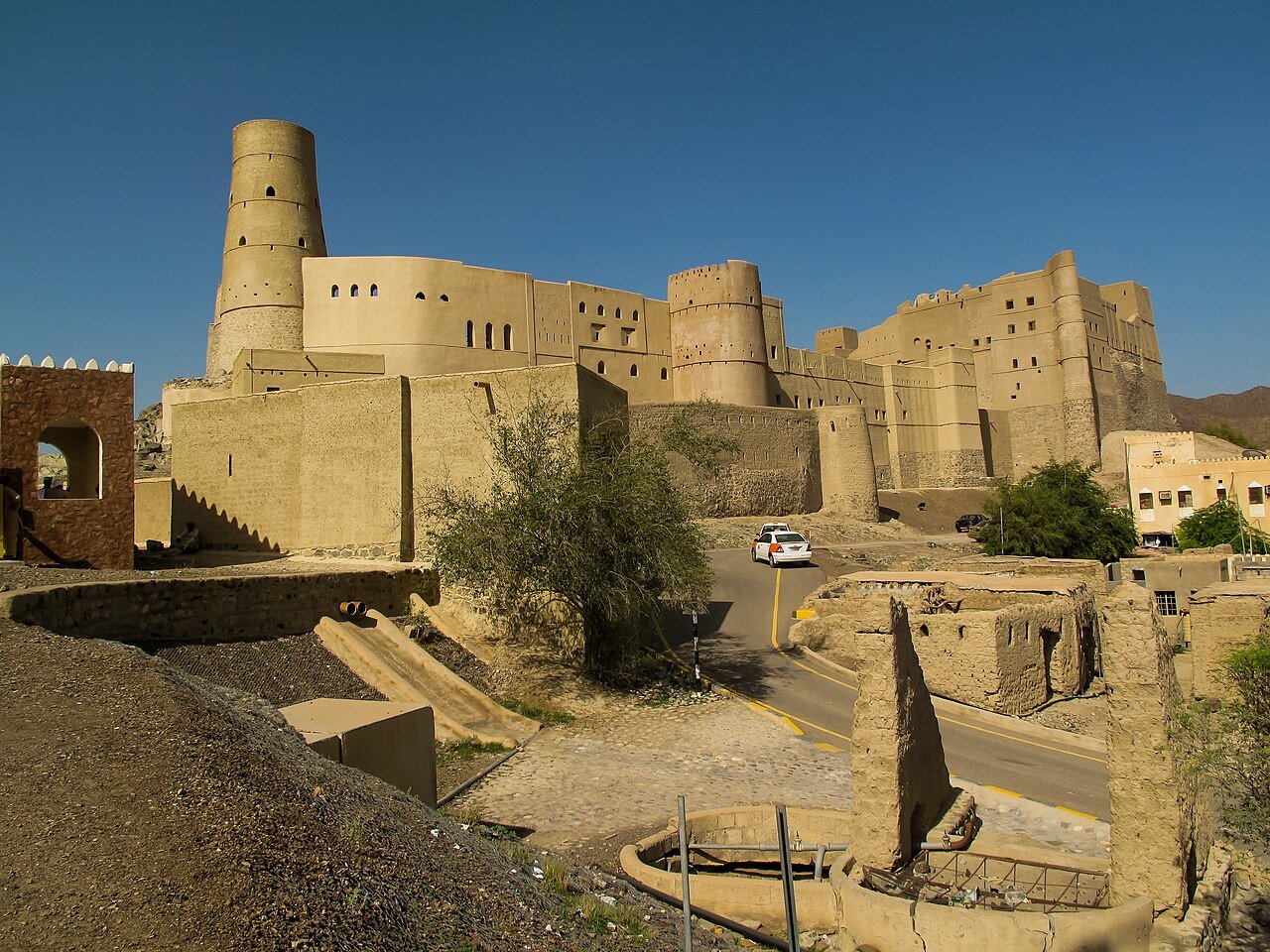
- Bahla Fort (1987) — a vast mudbrick fortification built by the Banu Nebhan tribe in the late Middle Ages, enclosing an entire oasis town with round watchtowers and castellated parapets.
- Archaeological Sites of Bat, Al-Khutm and Al-Ayn (1988) — three Bronze Age sites in the Hajar Mountains containing some of the best-preserved beehive tomb clusters and early settlement remains in the Arabian Peninsula, with evidence of copper extraction and trade reaching as far as Mesopotamia.
Together these two inscriptions announced the depth of Oman’s layered historical record: one medieval and urban, one ancient and funerary, separated by several thousand years but both rooted in the same interior landscape.
The most visited — and the alternatives
Bahla Fort draws the largest share of visitors and is the most photographed of Oman’s five sites, partly because it stands beside a working town and an intact suq. Its scale is genuinely striking: the walls and towers extend for kilometres around the oasis, and the fort itself sits on a rocky spur above the settlement. The Land of Frankincense, inscribed in 2000, is the second most visited cluster, with the ruins at Al-Baleed near Salalah accessible as a day trip and the Wadi Dawkah frankincense grove offering a rare chance to walk among the trees that once drove ancient Mediterranean commerce.
Less visited, and often overlooked by travellers routing through Muscat, are the Bronze Age sites of Bat and Al-Ayn, where beehive tombs dot the foothills in numbers that take time to absorb. The Aflaj Irrigation Systems, inscribed in 2006, present a different kind of challenge: the property is not a single monument but a selection of five representative examples drawn from roughly 3,000 functioning channels across the country, some in continuous use since at least 500 CE. The Ancient City of Qalhat, the most recent inscription (2018), sits on the eastern coast south of Sur and preserves the ruins of a port that served the Kingdom of Hormuz from the eleventh to the sixteenth century before a Portuguese attack left it abandoned.
Natural and shared sites
As of 2026, Oman holds no natural or mixed sites on the active World Heritage list, and none of its five inscriptions are transnational or serial designations shared with other countries. The delisting of the Arabian Oryx Sanctuary in 2007 closed the chapter on natural heritage for now, though Oman’s Empty Quarter desert, its coastal turtle nesting grounds on Masirah Island, and the biodiversity of the Dhofar cloud forest represent a substantial natural inheritance that sits outside the World Heritage framework.
The Land of Frankincense inscription, while cultural rather than natural, does incorporate living landscape elements: the frankincense trees of Wadi Dawkah and the ancient caravan station at Shisr together trace the overland supply route that connected the Dhofar groves to the ports of Khor Rori and Al-Baleed. UNESCO recognised this as a serial cultural landscape rather than a single monument, making it the closest analogue on the Omani list to a mixed designation.
How to find them
Oman’s five World Heritage Sites are spread across the country’s three main geographical zones: the northern interior (Bahla Fort, Bat/Al-Khutm/Al-Ayn, Aflaj sites), the eastern coast (Qalhat), and the southern Dhofar region (Land of Frankincense). No single itinerary captures all five without significant driving, and the Dhofar sites are most comfortably reached during or just after the khareef monsoon season between July and September.
Oman’s World Heritage sites sit alongside thousands of other places on CHO’s interactive map, with GPS and sourced editorial history for each. See also our guides to Italy’s and France’s UNESCO sites, and our piece on cultural travel beyond mass tourism.
Frequently Asked Questions
How many UNESCO World Heritage Sites does Oman have?
Oman has five UNESCO World Heritage Sites as of 2026, all cultural. A sixth property, the Arabian Oryx Sanctuary, was inscribed in 1994 as a natural site but was formally delisted in 2007 — the first site in World Heritage history to lose its designation — after Oman reduced its protected area and oil extraction caused the oryx population to decline sharply.
What was Oman’s first UNESCO World Heritage Site?
Bahla Fort was inscribed in 1987, making it Oman’s first World Heritage Site. The mudbrick fortification in the interior Al Dakhliyah region was built by the Banu Nebhan tribe and encloses an entire oasis settlement, with walls and towers extending for several kilometres. It was followed the very next year by the Bronze Age archaeological sites of Bat, Al-Khutm and Al-Ayn.
What is the most recently inscribed World Heritage Site in Oman?
The Ancient City of Qalhat received its UNESCO inscription in 2018, the most recent addition to Oman’s list. Located on the eastern coast south of Sur, Qalhat was a major port of the Kingdom of Hormuz from the eleventh to the sixteenth century, trading in dates, horses, pearls, and incense, before it was attacked by the Portuguese and subsequently abandoned.
What are the Aflaj Irrigation Systems of Oman?
Inscribed in 2006, the Aflaj Irrigation Systems represent a network of traditional water-management channels — underground and surface — that have been in continuous use across Oman since at least 500 CE. The World Heritage property encompasses five representative examples drawn from approximately 3,000 functioning aflaj still in active use today, distributing water for agriculture and domestic purposes across the country’s arid interior.
Sources used in this article
- UNESCO — State Party Oman — World Heritage list.
- UNESCO — Oman: World Heritage Sites.
- CHO magazine — What is a World Heritage Site?
- CHO — Interactive map of heritage sites.
Sources
- S1 — Potts, Daniel T. The Arabian Gulf in Antiquity. Clarendon Press, 1990. ISBN 978-0-19-814390-1.
- S2 — Costa, P. M. Studies in Arabian Architecture. Routledge, 2001. ISBN 978-0-86078-834-8.
Spotted an error? Write to editorial@culturalheritageonline.com and we correct it the same day.