Afghanistan has 2 UNESCO World Heritage Sites, both inscribed for their cultural significance and both carrying endangered status since the day they were listed — a fact that, more than any other, shapes how the world relates to the country’s built heritage. Millennia of Silk Road commerce, Buddhist monasticism, Ghurid architectural ambition, and the slow passage of dynasties left extraordinary things standing in these valleys and gorges. From Cultural Heritage Online.
Why Afghanistan’s list looks the way it does
With only two inscribed sites, Afghanistan holds one of the shortest UNESCO World Heritage lists of any country with a substantial ancient record. That brevity is not a reflection of what survives — Afghanistan sits at the intersection of Persian, Central Asian, Indian, and Hellenic cultural zones, with archaeological layers going back thousands of years. It reflects instead the practical reality of the inscription process: compiling the documentation, management plans, and state-party coordination that UNESCO requires is difficult under conditions of chronic conflict.
Both inscribed sites were added in rapid succession in 2002 and 2003, and both received “In Danger” designation at the same moment. The UNESCO List of World Heritage in Danger is meant to be temporary, a mechanism for mobilising international support; in Afghanistan’s case it has remained in force without interruption, underscoring the fragility of preservation efforts on the ground.
The first inscriptions
Afghanistan’s World Heritage journey opened with two culturally distinct but equally significant nominations placed on the list within twelve months of each other:
- Minaret and Archaeological Remains of Jam (2002) — a remote Ghurid tower in the Shahrak District of Ghor Province, rising 65 metres above the confluence of the Hari and Jam rivers.
- Cultural Landscape and Archaeological Remains of the Bamiyan Valley (2003) — a high-altitude valley in the Hindu Kush that served as a major Buddhist centre from the 1st through the 13th centuries CE.
Both inscriptions were fast-tracked partly because of urgency: the international community was responding to documented damage and wanted the sites on the UNESCO radar as quickly as possible. The speed of the process was unusual and reflected the political moment of 2001–2003 as much as the sites’ intrinsic qualities — which are, in both cases, considerable.
The most visited — and the alternatives
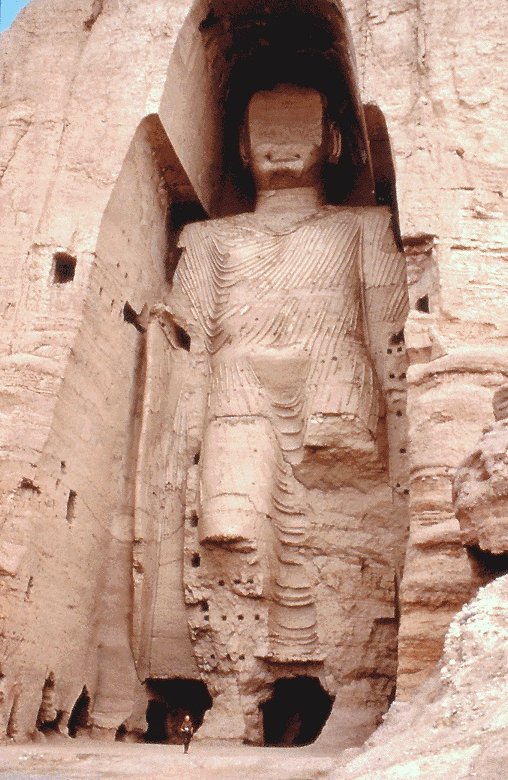
The Bamiyan Valley is by far the better-known of the two sites globally. Before the Taliban destroyed the two colossal Buddha statues carved into the cliff face in March 2001, the valley drew scholars and travellers from across Central Asia. The niches where the statues stood — one 55 metres tall, one 38 metres — remain visible and are themselves part of the inscribed property, alongside cave monasteries, painting fragments, and the fortified city of Shahr-i-Gholghola. The landscape component of the inscription matters: the valley’s relationship between its cliff formations, irrigated fields, and human settlement is treated as an integrated whole.
The Minaret of Jam is less prominent in the international imagination but architecturally remarkable. Completed in 1194 under the Ghurid ruler Ghiyath al-Din Muhammad, it is decorated with geometric brickwork and a Kufic inscription rendered in turquoise tiles — a level of finish unusual for a tower of this period in a location so isolated. Reaching Jam requires travel into Ghor Province along difficult roads, which has kept visitor numbers very low and the site itself relatively undisturbed. Also on Afghanistan’s tentative list and worth noting: the City of Herat, founded around 500 BCE and home to the Gawhar Shad Mausoleum, a landmark of Timurid funerary architecture.
Natural and shared sites
Afghanistan currently has no inscribed natural UNESCO World Heritage Sites. The Band-e-Amir lakes in Bamyan Province — a series of deep-blue travertine lakes held behind natural dams at an altitude above 2,900 metres — appear on Afghanistan’s tentative list and have been discussed for nomination for years. Band-e-Amir became Afghanistan’s first national park in 2009, and the lakes’ striking colour and geological distinctiveness would make a strong case under UNESCO’s natural criteria, but formal nomination has not yet proceeded.
There are no transnational or serial inscriptions in which Afghanistan currently participates, though the country’s position on ancient Silk Road routes has prompted discussion of future shared nominations with neighbouring states. The broader Central Asian Silk Road corridor has been inscribed in segments involving Kyrgyzstan, Kazakhstan, Tajikistan, Uzbekistan, and China; Afghanistan’s section remains outside any formal transnational framework as of 2026.
How to find them
Both inscribed sites are located in inland provinces with limited infrastructure: Jam in Ghor, Bamiyan Valley in Bamyan Province. Neither is accessible via commercial international travel under current conditions, and foreign-ministry travel advisories for Afghanistan remain at their most restrictive level in most countries. Documentation, archival photography, and satellite-derived mapping have become the primary tools for scholarly engagement with these places in the absence of on-the-ground access.
Afghanistan’s World Heritage sites sit alongside thousands of other places on CHO’s interactive map, with GPS and sourced editorial history for each. See also our guides to Italy’s and France’s UNESCO sites, and our piece on cultural travel beyond mass tourism.
Frequently Asked Questions
How many UNESCO World Heritage Sites does Afghanistan have?
Afghanistan has 2 UNESCO World Heritage Sites as of 2022, both classified as cultural sites. Both were inscribed in the early 2000s and both carry concurrent “In Danger” status, placing them on UNESCO’s List of World Heritage in Danger.
What was Afghanistan’s first UNESCO World Heritage Site?
The Minaret and Archaeological Remains of Jam was inscribed in 2002, making it Afghanistan’s first World Heritage Site. The 65-metre Ghurid minaret, built in 1194, stands in a remote river gorge in Ghor Province and is decorated with turquoise-tiled Kufic inscriptions.
Why are Afghanistan’s World Heritage Sites listed as “In Danger”?
Both sites received In Danger status at the time of their inscription, reflecting the threats posed by armed conflict, looting, and limited institutional capacity for conservation. The designation is intended to mobilise international technical and financial support for preservation efforts.
Does Afghanistan have any natural UNESCO World Heritage Sites?
No. As of 2026, all of Afghanistan’s inscribed UNESCO sites are cultural. The Band-e-Amir lakes in Bamyan Province appear on the tentative list as a candidate natural site, but a formal nomination has not yet been submitted to UNESCO.
Sources used in this article
- UNESCO — State Party Afghanistan — World Heritage list.
- UNESCO — Afghanistan: World Heritage Sites.
- CHO magazine — What is a World Heritage Site?
- CHO — Interactive map of heritage sites.