Cambodia has 5 UNESCO World Heritage Sites, a compact but extraordinary collection spanning jungle-ringed temple complexes, a remote Khmer imperial capital, and the sobering memorial landscape of one of history’s darkest episodes — each one a distinct chapter in a civilisation that shaped Southeast Asia for centuries. From Cultural Heritage Online.
Why Cambodia’s list looks the way it does
Cambodia’s UNESCO record reflects both the extraordinary depth of Khmer civilisation and the difficult modern history that shaped how and when international recognition arrived. The country only began inscriptions in 1992, at a moment of fragile transition following decades of conflict — a late start that meant several monuments had already suffered significant damage and looting before formal protection could be consolidated.
All five inscribed sites are cultural; Cambodia has no natural World Heritage Sites to date. That is not a reflection of an impoverished natural landscape — the country holds significant biodiversity — but rather a sequencing of priorities, with temples and memorial places understandably dominating the early waves of nominations.
The first inscriptions
Cambodia’s entry into the World Heritage List came in 1992 with a single, defining nomination:
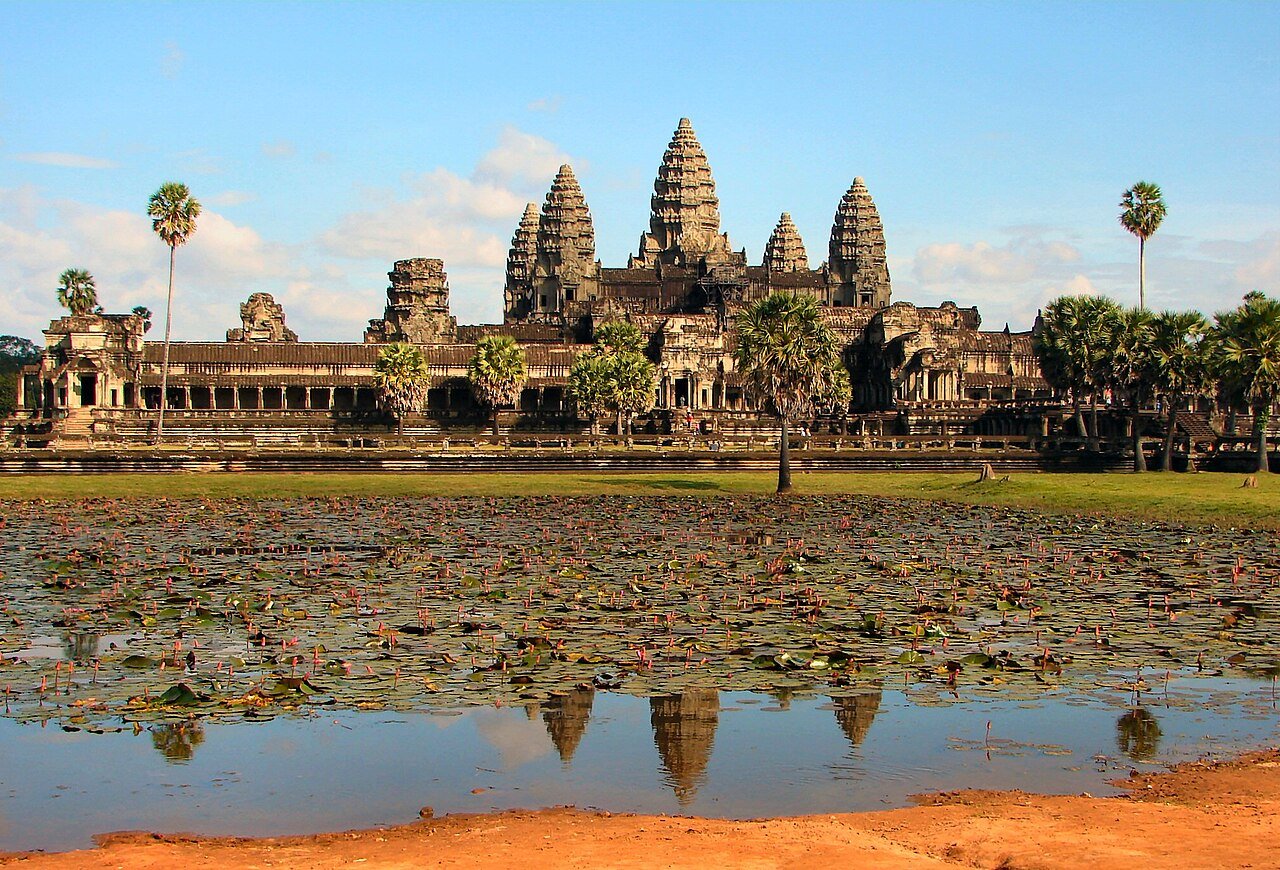
- Angkor (1992) — the vast temple complex centred on Angkor Wat, the largest religious monument in the world, built by the Khmer Empire between the 9th and 15th centuries
The timing was significant. The inscription took place while Cambodia was under temporary United Nations administration, and it helped galvanise international attention and resources for a site that had been largely inaccessible to the outside world for nearly two decades. Angkor remains the country’s most visited site and a touchstone of Khmer cultural identity.
The most visited — and the alternatives
Angkor dominates tourist flows to an extent almost unmatched in Southeast Asia, but Cambodia’s other inscribed sites offer genuinely different experiences. Preah Vihear, inscribed in 2008, is an 11th-century temple complex positioned at the edge of a mountain plateau along the border with Thailand — a location chosen deliberately for its commanding elevation, which gave it both strategic value and a sense of elevation above the everyday world. It remains far less visited than Angkor, in part because of its relative remoteness and a long-running territorial dispute that periodically restricted access.
Sambor Prei Kuk, inscribed in 2017, predates the Angkor period and represents the urban and religious architecture of the Chenla Empire. The site encompasses around 186 sandstone temples set within a forest, developed in a distinctive architectural style that bridges the early Hindu traditions of mainland Southeast Asia with the later Khmer aesthetic. Koh Ker, inscribed in 2023, served briefly as the capital of the Khmer Empire in the 10th century; its pyramid-temple and surrounding complex of Hindu shrines and water-management infrastructure are only beginning to draw the attention they merit.
Natural and shared sites
Cambodia currently holds no natural or mixed World Heritage Sites, and none of its five inscribed properties are shared or serial nominations spanning multiple countries. Each site is located entirely within Cambodian territory. This distinguishes Cambodia from some of its neighbours — Vietnam, Laos, and Thailand all participate in transnational or serial inscriptions — but the country’s cultural sites are substantial enough to stand without that context.
The most recent inscription, added in 2025, is the Cambodian Memorial Sites, a group of three component locations associated with the Khmer Rouge period of the 1970s. This nomination brings a wholly different register to the country’s list: rather than architectural grandeur, it deals with documentation, memory, and accountability, placing Cambodia alongside countries such as Germany and Poland whose World Heritage Sites include sites of atrocity and remembrance.
How to find them
Cambodia’s five sites are spread across the country, from the temples of Angkor near Siem Reap in the northwest to the plateau of Preah Vihear in the north, Sambor Prei Kuk in the centre, Koh Ker northeast of Angkor, and the memorial sites associated with Phnom Penh and the provinces most affected by the Khmer Rouge period. Practical access varies considerably — Angkor is well-served by infrastructure, while Koh Ker has historically been described as difficult to reach.
Cambodia’s World Heritage sites sit alongside thousands of other places on CHO’s interactive map, with GPS and sourced editorial history for each. See also our guides to Italy’s and France’s UNESCO sites, and our piece on cultural travel beyond mass tourism.
Frequently Asked Questions
How many UNESCO World Heritage Sites does Cambodia have?
Cambodia has 5 UNESCO World Heritage Sites as of 2025. All five are classified as cultural properties; the country has no natural or mixed inscriptions on the World Heritage List.
What was Cambodia’s first UNESCO World Heritage Site?
Angkor was Cambodia’s first UNESCO World Heritage Site, inscribed in 1992. The nomination coincided with a period of UN administration in the country and helped secure international resources for a site that had been largely cut off from the world during years of conflict.
What is the most recently inscribed World Heritage Site in Cambodia?
The Cambodian Memorial Sites, inscribed in 2025, are the country’s most recent addition to the World Heritage List. The inscription covers three component locations documenting the Khmer Rouge period and stands as one of Southeast Asia’s few World Heritage Sites dedicated to memory and historical accountability.
Are any of Cambodia’s World Heritage Sites natural rather than cultural?
No — all five of Cambodia’s World Heritage Sites are cultural properties. The country has not yet put forward a natural or mixed nomination, though it holds significant biodiversity in protected areas outside the current inscribed list.
Sources used in this article
- UNESCO — State Party Cambodia — World Heritage list.
- UNESCO — Cambodia: World Heritage Sites.
- CHO magazine — What is a World Heritage Site?
- CHO — Interactive map of heritage sites.