
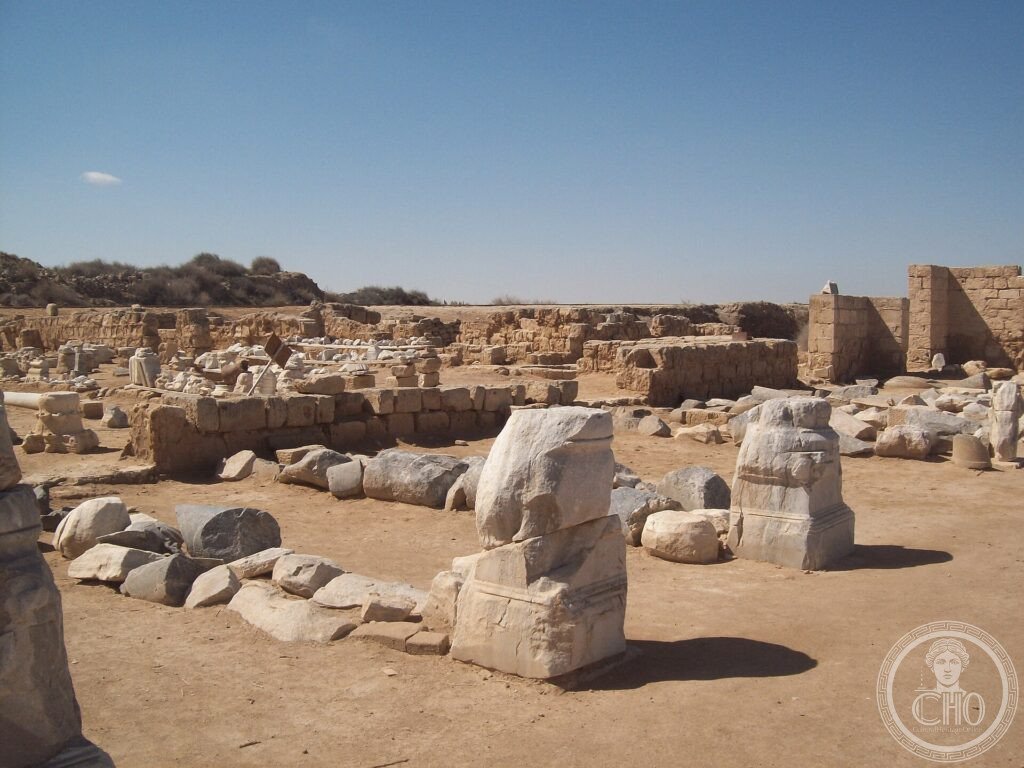
In the desert south-west of Alexandria, one of the most important pilgrimage cities of early Christianity grew up around the tomb of Saint Menas. Pilgrims came to Abu Mena from all over the Mediterranean for the martyr’s holy water, and basilicas, baths and hostels rose around his grave. Today only the ruins remain, a city of faith swallowed by the sand.
At a glance
Abu Mena, in the desert south-west of Alexandria in Egypt, was one of the most important Christian pilgrimage centres of the early Byzantine world. It grew around the tomb of Saint Menas, an Egyptian martyr whose shrine was believed to work miracles, and pilgrims came from across the Mediterranean to take home its holy water in little flasks. Around the tomb rose great basilicas, baptisteries, baths, hostels and a whole pilgrimage town. Now ruined and buried, it preserves the remains of this early Christian city, inscribed by UNESCO in 1979.
Key facts
- UNESCO: World Heritage since 1979 (Abu Mena)
- Pilgrimage city: a great early Christian pilgrimage centre
- Saint Menas: the martyr whose tomb drew the pilgrims
- Holy water: taken home by pilgrims in famous flasks
- Great basilica: among the largest early churches in Egypt
- On the danger list: threatened by a rising water table
History
Saint Menas, an Egyptian soldier martyred around AD 300, was buried in the desert here, and his tomb soon became a place of miracles and pilgrimage. From the 5th century the shrine was enlarged into a vast complex of churches, including a great basilica, baptisteries and a martyr’s church, surrounded by baths fed by the sacred spring, hostels for pilgrims and the houses and workshops of a thriving town. Pilgrims carried away water in small clay ampullae stamped with the saint’s image, found across the Mediterranean.
The city declined after the Arab conquest and the shifting of pilgrimage, and was eventually abandoned and buried. Excavated in modern times, it was inscribed by UNESCO in 1979, but a rising water table from nearby agriculture has since threatened the fragile ruins, placing the site on the List of World Heritage in Danger.
What you see
The site spreads across the desert as the excavated foundations and lower walls of the pilgrimage city: the great basilica and the church over the saint’s tomb, the baptistery, the baths fed by the holy spring, and the streets, hostels and houses of the town, built largely of pale limestone. Column bases and carved fragments lie among the ruins.
The remains of the buried city of pilgrims, alone in the desert, evoke the fervour of early Christian Egypt.
Practical information
- Site: an archaeological site in the desert; a nearby modern monastery
- Time needed: 1–2 hours
- Note: the ancient ruins are threatened by groundwater; on the danger list
- Setting: in the desert south-west of Alexandria
Getting there
Abu Mena is in the desert about 45 km south-west of Alexandria, Egypt, near the modern monastery of Saint Menas, reached by road. GPS: 30.84° N, 29.66° E.
Nearby
- Alexandria — the great Mediterranean city to the north-east
- Monastery of Saint Menas — the modern Coptic monastery nearby
- Wadi El Natrun — the desert valley of ancient monasteries
Sources
- UNESCO World Heritage Centre — “Abu Mena” (ref. 90)
- Egyptian Ministry of Tourism and Antiquities — official body
- Encyclopaedia Britannica — Menas, Saint
Find it on the map
See this place and what’s around it →📷 Become a Cultural Heritage Online photographer
Share your photos of places: they stay published under your name as the author. The more they're seen, the more you get noticed — and soon a contest will reward the most appreciated photos.
Log in or sign up free to add a photo