
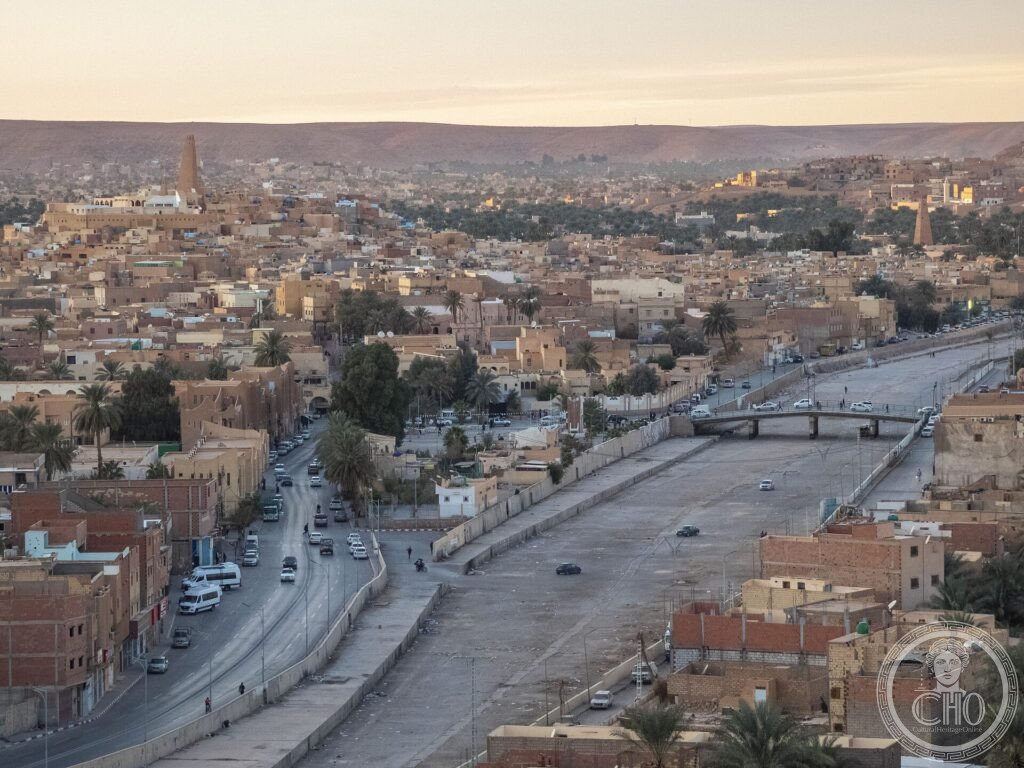
In a rocky valley of the Algerian Sahara, a thousand years ago a religious community, the Mozabites, built five fortified towns clinging to the hills around their mosques. The M’zab Valley is a masterpiece of desert town planning, so rational and harmonious that it inspired modern architects such as Le Corbusier.
At a glance
The M’zab Valley, in the Algerian Sahara around the town of Ghardaïa, holds five fortified hilltop towns (ksour) built in the 11th century by the Mozabites, an Ibadi Muslim community who settled this harsh valley. Each town climbs in tiers around its mosque, whose tapering minaret crowns the hill, in a remarkably rational, compact and harmonious form perfectly adapted to the desert. So admired is this design that it influenced 20th-century architects, including Le Corbusier. The valley was inscribed by UNESCO in 1982.
Key facts
- UNESCO: World Heritage since 1982 (M’zab Valley)
- Five towns: the fortified ksour of the M’zab pentapolis
- Built from the 11th century: by the Ibadi Mozabite community
- Hilltop form: each town tiered around its mosque and minaret
- Desert design: compact, rational architecture for the climate
- Modernist influence: admired by Le Corbusier and others
History
The Mozabites, followers of the Ibadi branch of Islam, withdrew into this remote Saharan valley around the 11th century to live according to their faith, founding a federation of five towns — Ghardaïa, Beni Isguen, Melika, Bou Noura and El Atteuf. Each was built as a fortified town climbing a hill, with the mosque and its watch-tower minaret at the summit, dwellings packed below, and a palm grove and summer town in the valley.
This careful, communal urbanism, shaped by religion and by the demands of the desert, has been preserved almost unchanged, with its own social rules and water-sharing systems. Its clarity and economy of form drew the admiration of modern architects, and the valley was inscribed by UNESCO in 1982.
What you see
The towns rise in tiers of ochre and white houses around their hilltop mosques, with pyramidal minarets, covered streets and markets, and gates that once closed at night. Beni Isguen remains the most traditional, its market and customs strictly kept; Ghardaïa’s arcaded square is the liveliest. Palm groves and summer houses fill the valley below.
The harmony of the terracotta towns against the desert, each crowned by its minaret, is the beauty of the M’zab.
Practical information
- Towns: Ghardaïa is the gateway; several towns can be visited
- Note: some towns (e.g. Beni Isguen) have strict local customs for visitors
- Time needed: a day or more
- Setting: in the northern Algerian Sahara
Getting there
The M’zab Valley is around Ghardaïa, in the northern Sahara of Algeria, about 600 km south of Algiers. Ghardaïa has an airport and road links. GPS: 32.48° N, 3.68° E.
Nearby
- Ghardaïa — the main town and market of the pentapolis
- Beni Isguen — the most traditional of the five towns
- Algerian Sahara — the desert and oases beyond
Sources
- UNESCO World Heritage Centre — “M’zab Valley” (ref. 188)
- Office de protection de la vallée du M’zab — official body
- Encyclopaedia Britannica — Ghardaïa; Mzab
Find it on the map
See this place and what’s around it →📷 Become a Cultural Heritage Online photographer
Share your photos of places: they stay published under your name as the author. The more they're seen, the more you get noticed — and soon a contest will reward the most appreciated photos.
Log in or sign up free to add a photo