Sweden has fifteen UNESCO World Heritage Sites, ranging from the glacially carved shores of the High Coast and the prehistoric rock art of Tanum to a working 1920s radio station and one of Europe’s best-preserved medieval walled towns. The list reflects a country that has used its landscape as productively as its stone and timber — and left both standing. From Cultural Heritage Online.
Why Sweden’s list looks the way it does
Sweden’s fifteen inscribed sites skew strongly cultural — thirteen of the fifteen carry that designation — yet the country’s geography is never far from the story. The High Coast and the Laponian Area both owe their significance to the slow physics of glacial retreat and post-glacial rebound, processes that left landforms found almost nowhere else at the same scale. The cultural sites, meanwhile, trace an arc from Iron Age boat graves and Bronze Age carvings through medieval church towns, early industrial ironworks, and a radio transmitter that was already historic when it was still in daily use.
What gives the Swedish list its coherence is a consistent attention to functional landscapes rather than singular monuments. Sites such as the Agricultural Landscape of Southern Öland and the Decorated Farmhouses of Hälsingland were inscribed not for a single building but for the relationship between human activity and the natural environment over centuries. Sweden joined the World Heritage Convention in 1985 and made its first inscription six years later, in 1991.
The first inscriptions
Sweden’s inaugural contribution to the World Heritage List came in 1991, when the Royal Domain of Drottningholm was inscribed at the fifteenth session of the World Heritage Committee, held in Carthage. Still the private residence of the Swedish royal family, Drottningholm’s palace, theatre, and Chinese Pavilion together represent the most complete surviving royal domain in Scandinavia from the seventeenth and eighteenth centuries. Over the following five years Sweden added steadily:
- Birka and Hovgården (1993) — the principal Viking Age trading centre in Scandinavia, on islands in Lake Mälaren
- Engelsberg Ironworks (1993) — described by UNESCO as the best-preserved example of a Swedish iron-working estate
- Rock Carvings in Tanum (1994) — Bronze Age petroglyphs on Bohuslän granite depicting humans, animals, ships, and weapons
- Skogskyrkogården (1994) — a Stockholm cemetery where architecture and boreal forest were designed as a single integrated composition
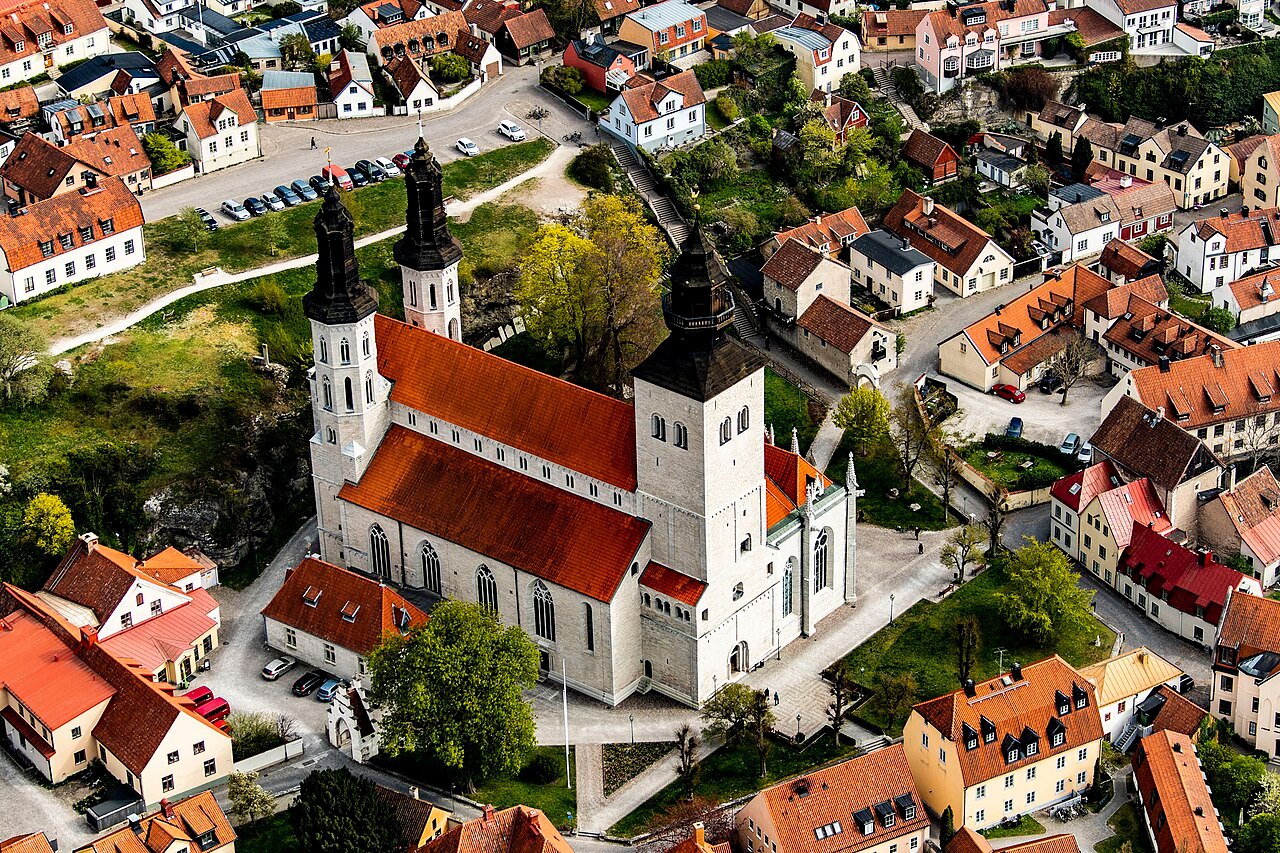
- Hanseatic Town of Visby (1995) — a medieval walled town on Gotland whose ring wall still stands almost intact
- Church Town of Gammelstad, Luleå (1996) — 424 wooden cottages clustered around a medieval stone church, built to house rural parishioners who travelled too far to return home the same day
The most visited — and the alternatives
Visby draws the largest share of visitors: the thirteen-kilometre ring wall, the rose-windowed ruin of St. Katarina, and the dense medieval street plan are among the most photographed sights in northern Europe. Drottningholm, within commuting distance of Stockholm, sees comparable footfall. Skogskyrkogården, on the southern edge of Stockholm, was designed by Gunnar Asplund and Sigurd Lewerentz and is a quieter draw for architecture enthusiasts.
Three inscribed sites reward the traveller willing to go further. The Mining Area of the Great Copper Mountain in Falun preserves the open-pit mine, smelting works, and associated town that supplied much of Europe’s copper for three centuries. The Naval Port of Karlskrona, founded in 1680 and still an active Swedish naval base, is the best-preserved example of a late-seventeenth-century planned naval town in northern Europe. And the Agricultural Landscape of Southern Öland — a long, flat limestone island where windmills outnumber trees — has been farmed continuously since the Iron Age on soil too thin to support conventional intensification.
Natural and shared sites
Sweden’s sole purely natural inscription is the High Coast/Kvarken Archipelago, shared with Finland and inscribed in two stages — the Swedish High Coast in 2000, the Finnish Kvarken Archipelago added in 2006. The site illustrates post-glacial isostatic uplift at a rate and scale unmatched elsewhere: land here is rising from the sea at roughly eight millimetres a year, continuously reshaping the coastline. The Laponian Area (1996), Sweden’s mixed site, combines vast subarctic wilderness with the living cultural landscape of the Sami people, who have practiced reindeer herding in the region for thousands of years.
Sweden also participates in two transnational serial inscriptions. The Struve Geodetic Arc (2005) is a chain of triangulation points stretching from Norway to the Black Sea, used in the nineteenth century to measure the exact shape and size of the Earth; Sweden holds several of the original stone markers. The High Coast/Kvarken transboundary nomination stands as the only World Heritage Site shared between Sweden and another country that spans two separate national contributions to the same inscription.
How to find them
Sweden’s World Heritage sites sit alongside thousands of other places on CHO’s interactive map, with GPS and sourced editorial history for each. See also our guides to Italy’s and France’s UNESCO sites, and our piece on cultural travel beyond mass tourism.
Frequently Asked Questions
How many UNESCO World Heritage Sites does Sweden have?
Sweden has fifteen UNESCO World Heritage Sites as of 2020, comprising thirteen cultural sites, one natural site, and one mixed site. The most recent addition, the Decorated Farmhouses of Hälsingland, was inscribed in 2012.
What was Sweden’s first UNESCO World Heritage Site?
Sweden’s first inscription was the Royal Domain of Drottningholm, added to the World Heritage List in 1991. The site encompasses the palace, the eighteenth-century court theatre, and the Chinese Pavilion on an island in Lake Mälaren near Stockholm, and remains the private residence of the Swedish royal family.
Does Sweden have any natural UNESCO World Heritage Sites?
Sweden has one purely natural site — the High Coast/Kvarken Archipelago, shared with Finland — and one mixed site, the Laponian Area. The High Coast was inscribed for its exceptional evidence of post-glacial isostatic rebound, while the Laponian Area combines wilderness values with the living cultural landscape of the Sami people.
Which of Sweden’s UNESCO sites is least visited?
The Grimeton Radio Station near Varberg, inscribed in 2004, is among the least visited. Still technically operational, it preserves a complete 1920s wireless telegraphy installation — including six 127-metre antenna towers — that once transmitted long-wave signals across the Atlantic to the United States.
Sources used in this article
- UNESCO — State Party Sweden — World Heritage list.
- UNESCO — Sweden: World Heritage Sites.
- CHO magazine — What is a World Heritage Site?
- CHO — Interactive map of heritage sites.