The Netherlands has 13 UNESCO World Heritage Sites — a remarkable collection that ranges from a working 18th-century mechanical planetarium and a network of 19 windmills to a colonial Caribbean port city and the largest unbroken tidal wetland on earth, all united by the theme of human beings shaping their environment against formidable odds. From Cultural Heritage Online.
Why the Netherlands’ list looks the way it does
The most distinctive feature of the Dutch World Heritage list is its coherence around a single national obsession: water management. More than half the inscribed sites exist because the Dutch spent centuries draining lakes, building polders, throwing up earthworks and engineering pumping stations that held back the sea. This was not merely practical infrastructure — it reshaped the landscape so completely that the engineered countryside became cultural heritage in its own right.
The other strand running through the list is modernist and industrial design. The Netherlands was a cradle of early 20th-century architecture, and UNESCO has recognised that too: a glass-and-steel factory, a De Stijl residential masterpiece and a network of 19th-century fortifications all sit alongside the windmills. With 12 cultural sites and one natural, the list is emphatically man-made — a portrait of a nation that rarely accepted the landscape it was given.
The first inscriptions
The Netherlands joined the World Heritage Convention in 1992, and its first inscription came three years later, in 1995. Over the following four years a cluster of sites followed in quick succession, laying out the core water-management theme that defines the list.
- Schokland and Surroundings (1995) — a former island in the Zuiderzee, abandoned in 1859 and later enclosed by the Noordoostpolder, now a landscape that legibly records 10,000 years of human settlement on reclaimed ground.
- Dutch Water Defence Lines (1996) — a 19th-century ring of military inundation lines and forts around Amsterdam, using controlled flooding as a strategic weapon.
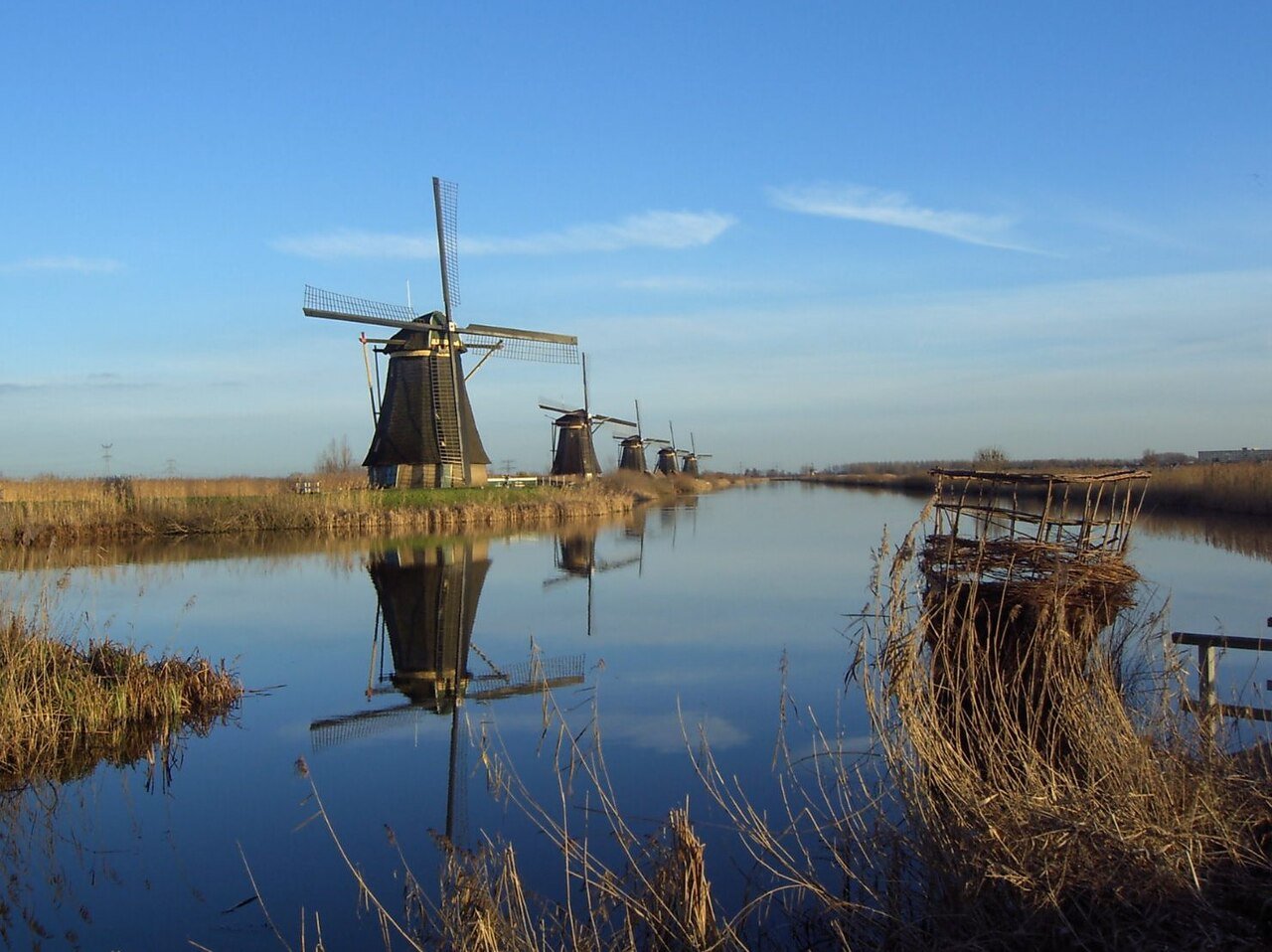
- Mill Network at Kinderdijk-Elshout (1997) — nineteen windmills built in the 1740s to drain the Alblasserwaard polder, the largest concentration of historic windmills in the Netherlands.
- Historic Area of Willemstad, Curaçao (1997) — the colonial-era inner city of the Caribbean island of Curaçao, reflecting four centuries of Dutch, Spanish and African architectural interchange.
The most visited — and the alternatives
Kinderdijk draws well over a million visitors a year, and the 17th-century canal ring of Amsterdam — inscribed in 2010 as the Seventeenth-century canal ring area inside the Singelgracht — is perhaps the most photographed urban waterscape in northern Europe. Both are genuinely exceptional, but the crowds are equally genuine. The Wadden Sea, the sole natural site on the list, attracts hikers and birdwatchers but remains low-key relative to its ecological scale.
For visitors who prefer space, three inscribed sites reward the detour. The Beemster Polder (1999), north of Amsterdam, was the first lake ever drained by the Dutch in the modern era (completed 1612) and its ruler-straight roads and rectangular plots follow a Renaissance geometric plan unlike any other Dutch landscape. The Rietveld Schröder House (2000) in Utrecht is a single private dwelling that became a manifesto of De Stijl design — primary colours, movable partitions, no right angles hidden behind historical ornament. And the Eisinga Planetarium (2023) in the Frisian town of Franeker is the world’s oldest working planetarium, a mechanical solar system model built by a wool-comber named Eise Eisinga between 1774 and 1781 and still ticking in his former living-room ceiling.
Natural and shared sites
The Wadden Sea (2009) is the Netherlands’ only natural World Heritage Site, and it is a superlative one: the largest unbroken system of intertidal sand and mud flats in the world, stretching across the northern coasts of the Netherlands, Germany and Denmark. All three countries share the inscription. The site supports millions of migratory birds and is a critical nursery for North Sea fish species; the Dutch section alone covers roughly 400,000 hectares of wetland and barrier islands.
Two further transnational inscriptions round out the list. The Colonies of Benevolence (2021), shared with Belgium, designates planned 19th-century agricultural colonies founded to rehabilitate the poor through self-sufficient rural labour — an unusual social-history inscription with sites in both countries. The Lower German Limes (2021), shared with Germany, adds the Netherlands to the extended arc of Roman frontier fortifications that now stretches across multiple World Heritage inscriptions from Hadrian’s Wall to the Danube.
How to find them
The Netherlands’ World Heritage sites sit alongside thousands of other places on CHO’s interactive map, with GPS and sourced editorial history for each. See also our guides to Italy’s and France’s UNESCO sites, and our piece on cultural travel beyond mass tourism.
Frequently Asked Questions
How many UNESCO World Heritage Sites does the Netherlands have?
The Netherlands has 13 UNESCO World Heritage Sites as of 2026, including one located on the Caribbean island of Curaçao. Twelve are classified as cultural sites and one — the Wadden Sea — is a natural site.
What was the Netherlands’ first UNESCO World Heritage Site?
Schokland and Surroundings, inscribed in 1995, was the Netherlands’ first World Heritage Site. The former island in the Zuiderzee was abandoned in 1859 but preserves 10,000 years of human occupation on reclaimed land and remains a powerful emblem of the Dutch relationship with the sea.
What is the most recently inscribed World Heritage Site in the Netherlands?
The Eisinga Planetarium in Franeker, Friesland, was inscribed in 2023. Built by wool-comber Eise Eisinga between 1774 and 1781, it is the oldest working planetarium in the world, with its original mechanical solar system model still operating in what was once his family living room.
Does the Netherlands share any World Heritage Sites with other countries?
Yes — three sites are transnational inscriptions. The Wadden Sea is shared with Germany and Denmark; the Colonies of Benevolence is shared with Belgium; and the Lower German Limes, the Roman frontier fortification network, is shared with Germany.
Sources used in this article
- UNESCO — State Party the Netherlands — World Heritage list.
- UNESCO — the Netherlands: World Heritage Sites.
- CHO magazine — What is a World Heritage Site?
- CHO — Interactive map of heritage sites.