Germany has 55 UNESCO World Heritage Sites, spanning the Carolingian chapel where medieval emperors were crowned, Eocene fossil beds that rewrote early mammal history, Baroque mountain cascades, Viking trading towns, pioneering modernist factories, and intertidal mudflats stretching across the North Sea coast. The list is one of the most architecturally and chronologically diverse in Europe. From Cultural Heritage Online.
Why Germany’s list looks the way it does
Germany’s 52 cultural sites reflect the country’s long political fragmentation. For centuries, hundreds of independent principalities, bishoprics, free cities, and kingdoms each cultivated their own courts, cathedrals, and urban ambitions — leaving the landscape extraordinarily layered. The result is a heritage list with no single dominant capital and an unusual breadth: Romanesque abbeys on Rhine islands, Baroque royal gardens in Hesse, Expressionist artists’ colonies in Darmstadt, and Bauhaus design schools in Weimar and Dessau all sit on the same list.
That fragmentation also explains the country’s deep engagement with transnational inscriptions. Germany participates in at least nine serial or transnational World Heritage properties, sharing frontier systems with the Netherlands and Slovakia, mountain lakes with five Alpine neighbours, mining landscapes with the Czech Republic, and spa towns with six other European states. These cross-border entries recognise that many of the defining stories of European civilisation do not stop at modern national borders.
The first inscriptions
Germany joined the World Heritage Convention early. In 1978 — the first year the list was formed — a single German property received inscription:
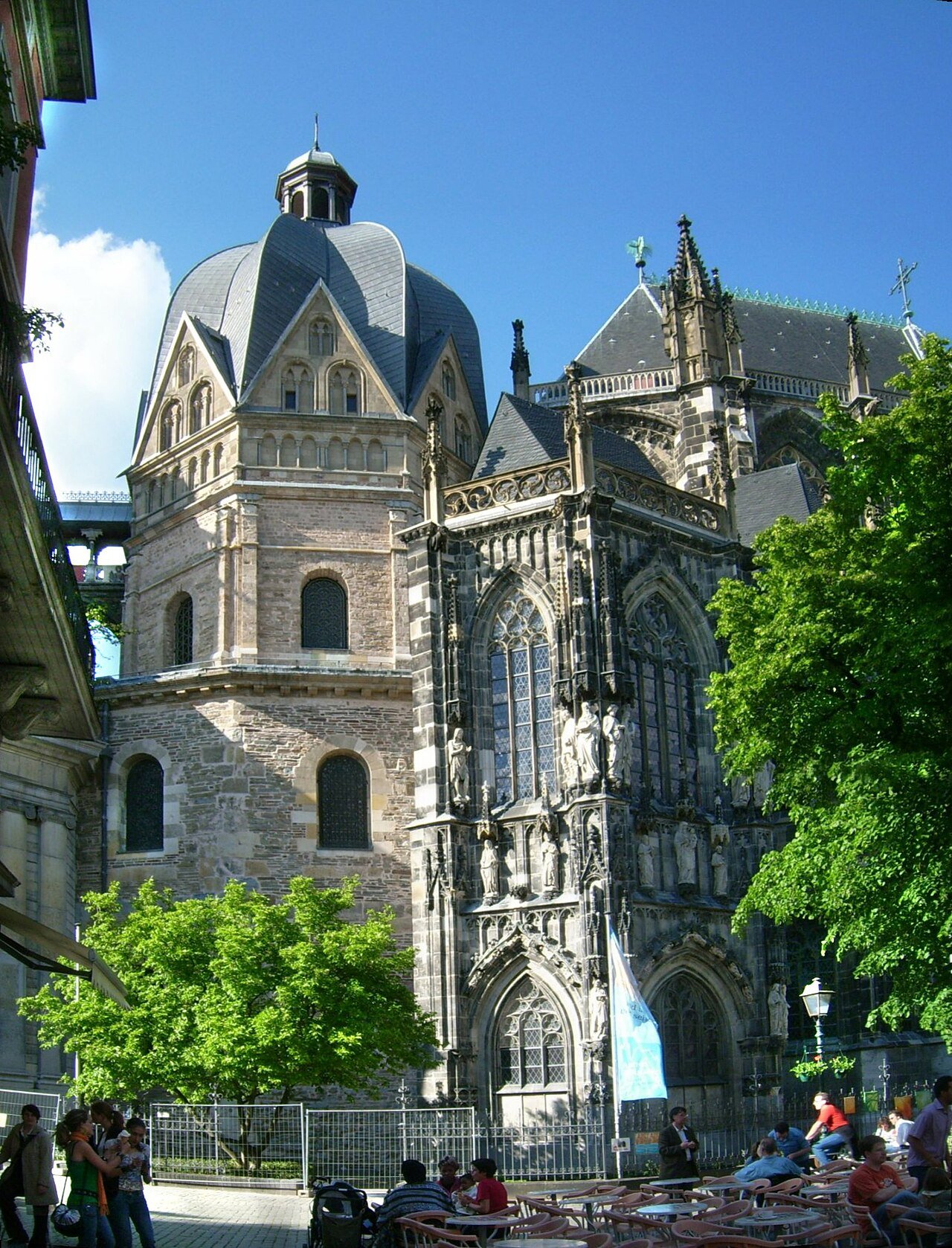
- Aachen Cathedral (1978) — the Palatine Chapel of Charlemagne, built around 800 CE, where thirty-two Holy Roman Emperors were crowned between 936 and 1531.
The pace accelerated in the following decade. Speyer, Worms, and Mainz Cathedrals followed in 1981, along with the Würzburg Residence, the Castles of Augustusburg and Falkenlust at Brühl, and the Roman monuments at Trier — each illustrating a different era of German ambition, from the Salian dynasty to Baroque absolutism to late Roman administration. By the early 1990s Germany had already assembled one of the largest national registers on the list.
The most visited — and the alternatives
A handful of German sites draw enormous tourist volumes. Cologne Cathedral, the Rhine Valley’s medieval castles and vineyards, Neuschwanstein — inscribed in 2025 as part of the Palaces of King Ludwig II of Bavaria alongside Linderhof, Schachen, and Herrenchiemsee — and the Sanssouci gardens of Potsdam are among the country’s best-known landmarks. The Bauhaus sites in Weimar and Dessau attract design enthusiasts from across the world.
Quieter corners of the list reward the curious traveller considerably. A few worth seeking out:
- Reichenau Island (2000) — a small island in Lake Constance with three intact Carolingian and Ottonian monastery churches, their pre-1000 CE wall paintings among the earliest surviving in Central Europe.
- Fagus Factory, Alfeld (2011) — a 1913 shoe-last factory by Walter Gropius that pioneered the glass-curtain-wall aesthetic later associated with the entire modern movement.
- Mathildenhöhe Darmstadt (2021) — an artists’ colony founded in 1899 by Grand Duke Ernst Ludwig, where the Vienna Secession and Arts and Crafts movements converged into an experimental urban laboratory.
- Jewish-Medieval Heritage of Erfurt (2023) — a complex comprising an eleventh-century synagogue, a medieval mikveh, and a merchant’s stone house, together forming one of the most complete records of medieval Jewish urban life in Central Europe.
Natural and shared sites
Germany’s three natural World Heritage Sites are geographically and ecologically distinct. The Messel Pit Fossil Site (1994), an ancient oil-shale mine south of Frankfurt, has yielded some of the world’s best-preserved Eocene mammals — including ancestral horses the size of terriers. The Wadden Sea (2009, shared with the Netherlands and Denmark) is the largest intertidal sand and mud-flat system on Earth, a critical feeding and breeding ground on the East Atlantic Flyway. The Ancient and Primeval Beech Forests (transnational, extended multiple times, now spanning eighteen countries) document how beech colonised Europe after the last ice age.
Among the transnational cultural inscriptions, the Frontiers of the Roman Empire network is particularly significant: Germany contributes the Upper Germanic-Rhaetian Limes (2005) and shares the Danube Limes and Lower German Limes inscribed in 2021 with Austria, Slovakia, and the Netherlands respectively. The Erzgebirge/Krušnohoří Mining Region (2019, shared with the Czech Republic) and the Muskauer Park / Park Mużakowski (2004, shared with Poland) round out a list of cross-border entries that underlines how central Germany has been to European history at almost every period.
How to find them
Germany’s World Heritage sites sit alongside thousands of other places on CHO’s interactive map, with GPS and sourced editorial history for each. See also our guides to Italy’s and France’s UNESCO sites, and our piece on cultural travel beyond mass tourism.
Frequently Asked Questions
How many UNESCO World Heritage Sites does Germany have?
Germany has 55 UNESCO World Heritage Sites, comprising 52 cultural properties, 3 natural sites, and no mixed designations. That total places Germany among the five countries with the largest national World Heritage registers globally.
What was Germany’s first UNESCO World Heritage Site?
Aachen Cathedral was Germany’s first inscription, added to the World Heritage List in 1978 during the very first year the list was compiled. Built around 800 CE as the Palatine Chapel of Charlemagne, it served as the coronation church of the Holy Roman Empire for more than six centuries.
What are Germany’s natural UNESCO World Heritage Sites?
Germany has three natural sites: the Messel Pit Fossil Site (1994), renowned for its extraordinarily preserved Eocene mammals; the Wadden Sea (2009), shared with Denmark and the Netherlands; and the Ancient and Primeval Beech Forests, a transnational property now spanning eighteen countries across Europe.
What was the most recently inscribed UNESCO site in Germany?
The Palaces of King Ludwig II of Bavaria — encompassing Neuschwanstein, Linderhof, Schachen, and Herrenchiemsee — were inscribed in 2025. The ensemble reflects the nineteenth-century Romantic fascination with idealised pasts and was partly inspired by the operas of Richard Wagner.
Sources used in this article
- UNESCO — State Party Germany — World Heritage list.
- UNESCO — Germany: World Heritage Sites.
- CHO magazine — What is a World Heritage Site?
- CHO — Interactive map of heritage sites.