
A medieval river port transformed into a thriving industrial city, Pordenone rose from Habsburg domain to Venetian prosperity, anchoring centuries of trade and cultural achievement in northeastern Italy.
At a glance
Pordenone sits on the Noncello river in Friuli Venezia Giulia, its character forged by competing powers—the Patriarchate of Aquileia, the Habsburgs, and Venice—each leaving architectural and administrative traces. First documented in 1204, the settlement evolved from a modest port into a significant medieval and Renaissance center, later industrializing through textiles, metalwork, and paper production.
History
Between 900 and 1200, the Noncello territory extended roughly 200 square kilometers, encompassing settlements now known as Cordenons, Villanova, Fiume Veneto, and others. Pordenone itself appears first in the 1204 Travel Diary of Wolger of Passau, future Patriarch of Aquileia, marking its entry into documented history.
The young settlement became a focal point for surrounding villages and a toll point for river traffic. The Patriarchate of Aquileia, the Counts of Gorizia, and the Marca Trevigiana all vied for control until the lords of Carinthia seized it, passing dominion to Styria in 1269 and finally to the Austrian Habsburgs in 1276. By the late thirteenth century, Cathedral, Bell Tower, and town halls stood complete within defensive walls.
Austria held Pordenone until 1508. Venice then claimed the prize, granting it as a fief to condottiero Bartolomeo d’Alviano until 1537, when direct Venetian rule began. The sixteenth century witnessed explosive growth: population surged from 1,500 to 7,000 by 1588, spurring the founding of San Giorgio parish and a flowering of academies and cultural patronage.
Industrialization accelerated through the seventeenth and eighteenth centuries. After Venice’s fall in 1797, the city passed through French administration (1805–1815), then the Lombard-Veneto Kingdom, until Italian unification in 1866. Hydroelectric power arrived in 1888, launching modern manufacturing in textiles, ceramics, metalwork, and chemicals. Pordenone became the provincial capital in 1968.
What you see
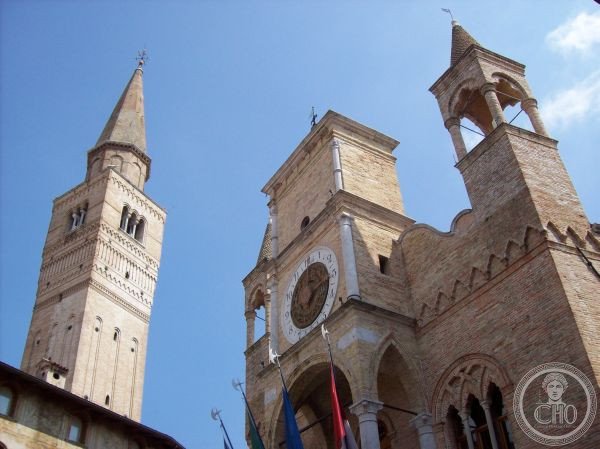
The medieval core survives in the Cathedral with its Bell Tower and the Palazzo del Comune, both from the thirteenth century. A castle built by Austrian rulers overlooks the river from a commanding hill. The ecclesiastical landscape expanded with the 1278 elevation of San Marco to parish status and the later addition of San Giorgio in the upper Borgo.
The sixteenth-century Renaissance left its mark through palaces built by noble families—Ricchieri, Mantica, Rorario—and through a distinctive urban layout. Marin Sanudo, writing in his 1483 Itinerary, praised Pordenone’s long straight streets, public loggia and piazza, and the protective shadow of San Marco.
Cultural significance
Pordenone’s importance lay in its strategic role as a transit hub connecting Venetian lowlands to transalpine regions via the Livenza, Meduna, and Noncello rivers. This position sustained steady commercial growth and, in the 1500s, a renowned cultural moment when humanists, painters, and poets gathered under noble patronage.
The city’s transformation from a small fortified port into an industrial powerhouse reflects broader patterns of northeastern Italian development—the shift from feudal and trading economies toward nineteenth- and twentieth-century manufacturing and infrastructure. Its administrative privileges, codified from the thirteenth century onward, fostered continuity and local autonomy even as external rulers changed.
Key facts
- Address: Corso Vittorio Emanuele II, 64, 33170 Pordenone
- Coordinates: 45.9545531, 12.6599367
- Phone: 0434 392111
- Website: https://www.pordenoneturismo.com
- First documented: 1204 in the Travel Diary of Wolger of Passau
- Provincial capital since: 1968
Practical information
Opening hours and ticket prices change through the year, so we do not republish them here: the current ones are on pordenoneturismo.com. What does not change is where it is: Corso Vittorio Emanuele II, 64, 33170 Pordenone, at 45.9545531, 12.6599367.
Getting there
Pordenone is located in the Friuli Venezia Giulia region of northeastern Italy. You can reach it by rail or road from Venice, Udine, and other regional centers. The city center sits near the Noncello river, accessible from Corso Vittorio Emanuele II.
See the place
Sources & resources
Find it on the map
See this place and what’s around it →Historical events at this place (4)
📷 Become a Cultural Heritage Online photographer
Share your photos of places: they stay published under your name as the author. The more they're seen, the more you get noticed — and soon a contest will reward the most appreciated photos.
Log in or sign up free to add a photo