

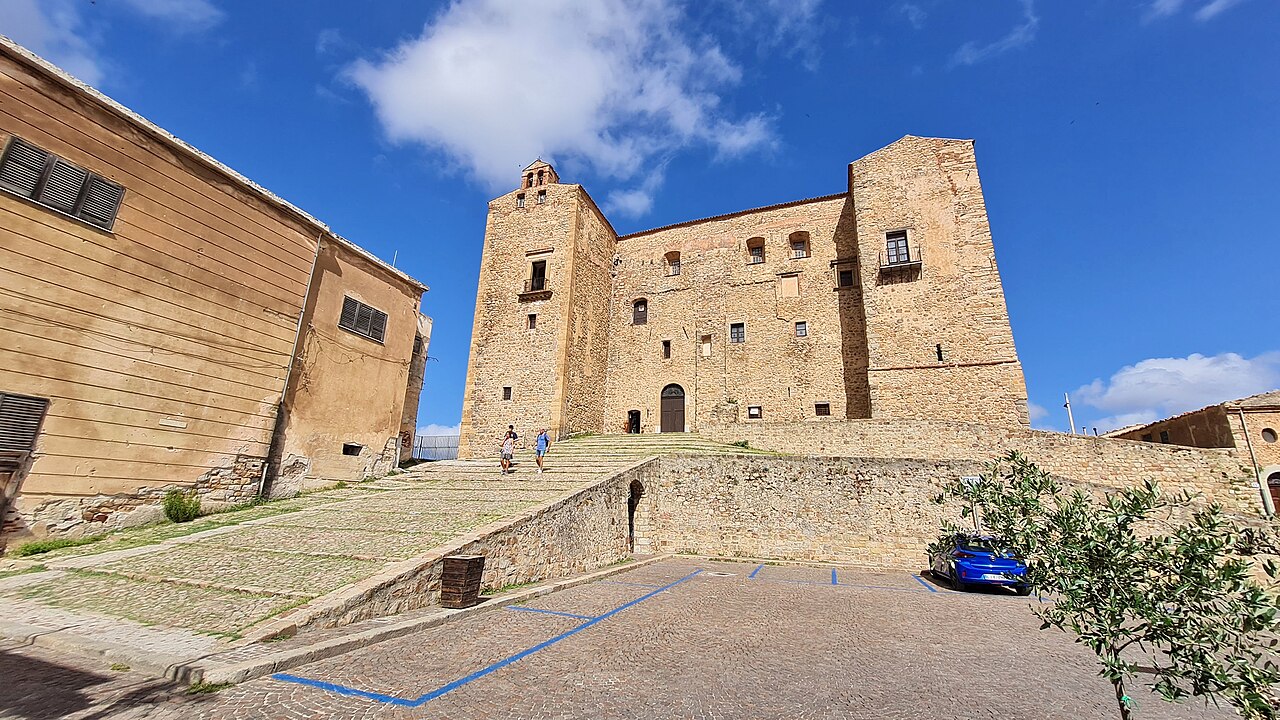
A fortified residence begun in 1316 by Count Francesco Ventimiglia, transformed into the civic museum of Castelbuono. The castle’s Palatine Chapel holds the skull relic of St. Anne, patron saint of the town.
At a glance
The Ventimiglia Castle stands at the heart of Castelbuono, crowning the hill of San Pietro d’Ypsigro. Built over six centuries as a feudal stronghold and family residence, it now serves as the town’s municipal museum. Its name derives from the castle’s position—Castelbuono means “castle of the good air.”
History
Construction began in 1316 under Count Francesco I Ventimiglia, on a site incorporating an earlier Byzantine fort. The castle served as the residence of the illustrious Ventimiglia lineage for six centuries. During the 17th century, radical transformations were undertaken when families relocated from Palermo, though the castle’s valley location meant it never served strategic military purposes.
A 1322 church of St. Francis was connected to the castle by an underground tunnel. In 1357, sovereign Frederick III of Aragon stayed here while Count Francesco II Ventimiglia served as vicar of Sicily. The Ghibelline battlements were demolished in 1820, damaged by an earthquake that struck the Madonie region severely. Citizens purchased the castle in the early 20th century; it became the Municipal Castle in 1920.
What you see
The original architecture blends Swabian, Norman, and Arab compositional features. The cube-shaped main structure echoes Arab design, while square towers reflect Norman architecture and a cylindrical tower expresses Swabian modules. Secret stairways wind through the thick walls, connecting various floors and rooms once used for feudal administration—cramped cells for serious offenders and common rooms for minor prisoners.
A 15th-century wooden ceiling adorned with multicolored chimeric figures survives, resting on artistically carved corbels. The Palatine Chapel, embellished with stucco work by brothers Giuseppe and Giacomo Serpotta in 1683, contains an ornate silver half-bust of St. Anne from 1521. A wooden choir carved by Castelbuono sculptor Domenico Coco in 1760 completes the chapel’s artistic program.
Cultural significance
The castle represents a unique synthesis of medieval architectural traditions across Mediterranean cultures. Its continuous occupation and adaptation—from feudal stronghold to noble residence to civic institution—documents Castelbuono’s social and political evolution. The Palatine Chapel’s veneration of St. Anne has sustained the community’s connection to the building through centuries of change and reconstruction.
Key facts
- Construction began 1316 under Count Francesco I Ventimiglia
- Stucco chapel decoration by Serpotta brothers, 1683
- Wooden choir by Domenico Coco, 1760
- Address: Piazza Castello, 90013 Castelbuono
- Coordinates: 37.9341151, 14.0886308
- Phone: 0921671211
- Website: http://www.museocivico.eu/
Practical information
The museum layout was completed in 2011 following structural restoration in the 1980s and final conservation work through the 1990s. Today it functions as a civic museum of the city, territory, history, and contemporary culture. Hours and admission fees are not listed; consult the official website.
Getting there
The castle is located in the town center of Castelbuono at Piazza Castello. For directions and transport options to Castelbuono, visit the official website or contact the museum directly by phone.
Sources & resources
Find it on the map
See this place and what’s around it →Historical events at this place (1)
📷 Become a Cultural Heritage Online photographer
Share your photos of places: they stay published under your name as the author. The more they're seen, the more you get noticed — and soon a contest will reward the most appreciated photos.
Log in or sign up free to add a photoIs this page about you?
This page is read by travellers and heritage enthusiasts who find it on Google. Tell us how you are connected to this place and we will take it from there.