
Curated Itinerary
Born in a Single Day: A Sabaudia–Latina RoadBook (1932–1934)
Travel tips from CHOGo on the first Sunday of the monthState museums, archaeological parks and monuments across Italy open free […]
Take this route into Google Maps
From Sabaudia — Rationalist New Town by Cancellotti, Montuori, Piccinato, Scalpelli to Palazzo del Governo — Latina’s Prefecture by Oriolo Frezzotti, in the order we curated them.
➤ Turn on the navigator in Google MapsIt opens in the Google Maps app with every stop already loaded, in the order we put them in. From there the route is yours: pick how you travel — on foot, by bike, by public transport or by car — change where you start and where you end, drag the stops into a different order, and add places of your own along the way.
Get this route — explore at your own pace
The walk and the notes are open to everyone, right here. To take the route with you — the GPX and KML tracks for your phone — you need a CHO account, and a free one is enough. We do not sell these routes: we build them ourselves and give them to the people who read us.
Create a free accountAlready have one? Log in.
This route was built with the tools we give operators.
Guides, associations and cultural operators build their own routes here: pick the stops from the archive, add your notes, and the map, the GPX and the printable version come out on their own. Your programme gets a permanent page, your events go on the city pages people read while planning — and if you sell your route as a road-book or a virtual tour, you receive 80% of the price net of tax.
See how an operator account worksBefore you go
A word from your host
These two cities were built by Mussolini and they look it. That is also what makes them remarkable: nowhere else in Italy can you walk an intact Rationalist urban plan at 1:1 scale. Both cities survived the postwar renaming intact, and both are worth knowing before they become widely recognised. Sabaudia especially: the position between lake and sea, the unchanged piazza, the tower framing the Circeo — this is one of the most complete pieces of 1930s urbanism anywhere in Europe.
Getting around
The itinerary covers two cities 35 km apart, connected by the Via Pontina (SS148). A car is required for the Sabaudia–Latina leg: no direct public bus connects the two city centres at useful frequencies. In Sabaudia, all stops are within 5 minutes of walking; in Latina, the four stops form a 1.5 km linear walk along the central axis. Allow a full day: 3.5 to 4.5 hours excluding the car leg, plus 35–40 minutes driving. Start Sabaudia early (by 9:00) to reach Latina in time for lunch on Via Roma and an afternoon in the city centre.
Step by step
Sabaudia — Rationalist New Town by Cancellotti, Montuori, Piccinato, Scalpelli
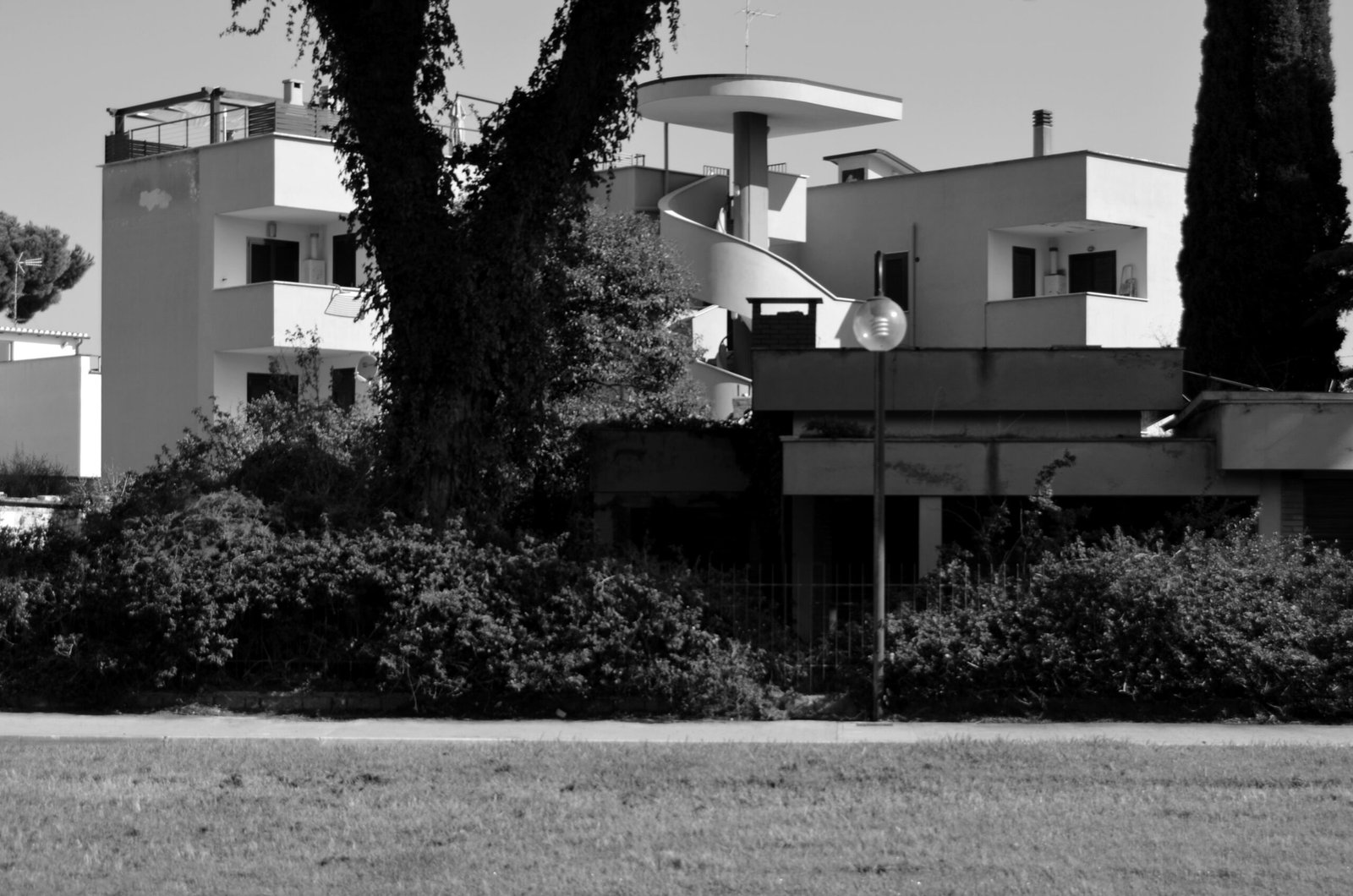
Begin at the lakeside approach road, then walk into Piazza del Comune. The viewcone from the tower to the sea was designed to be visible on the founding-day photographs.
The storyOn April 10, 1932, Mussolini struck a shovel into the ground near an undrained swamp called the Valle Latina. Exactly 253 days later, on December 18, 1932, he stood in front of a completed city — Littoria, now Latina — and declared it founded. Italy had just built a city in under nine months. The regime had drained 75,000 hectares of malarial marshland, resettled more than 100,000 farm workers from the Veneto and Emilia, and imposed an entire urban fabric on land that had been uninhabitable since Roman times. Sabaudia followed fourteen months later, designed by four young architects who won a national competition: Cancellotti, Montuori, Piccinato, and Scalpelli. They had the site plan drawn and the first streets laid in a matter of months.
Insider tipSabaudia is unlike the other Pontine new towns because it was placed between a lake and the sea, with the Circeo promontory as a backdrop. The architects designed deliberate viewcones through the urban layout — the tower of the Palazzo Comunale is visible from the beach, and the beach is visible from the tower. Walk north from the piazza toward the lake and then south to see the full effect. The town has barely changed since 1934: no new buildings were added to the core, and the lime-washed walls and eucalyptus trees are intact.
A fitting stopCaffè Schiavon on Piazza del Comune is the local bar — same spot it has occupied since the 1930s. The seafront passeggiata begins at the lake road.
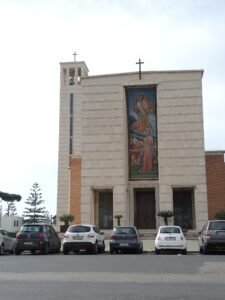
Church of the Santissima Annunziata, Sabaudia — Cancellotti and the Ferrazzi Mosaic (1935)
Cancellotti's church on the main square of Sabaudia, finished in 1934: a bare brick box with a campanile that answers the civic tower across the piazza.
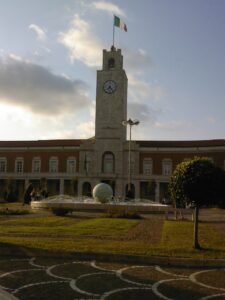
Latina (Littoria) — Founded Rationalist City by Oriolo Frezzotti
Park near Piazza del Popolo and walk the central axis — Via Roma leading south, the two main squares, the parallel commercial street. The city is still almost entirely intact.
The storyLittoria — renamed Latina in 1945 — was the first and largest of the Pontine new towns. Architect Oriolo Frezzotti designed not just individual buildings but the entire urban structure: two main squares (Piazza del Popolo and Piazza della Libertà) connected by Via Roma, a commercial street parallel to the civic axis, and a ring road enclosing the historic centre. The city grew so quickly that the population doubled in the first two years. A new province — Provincia di Littoria — was created in 1934 specifically to administer the five new Pontine towns. After 1945, the regime names were stripped: Littoria became Latina, Via Mussolini became Via Roma, and the province became Provincia di Latina.
Insider tipWalk the full Via Roma from Piazza del Popolo south to Piazza della Libertà — about ten minutes. Every building on this axis is original Frezzotti, and most are still in their original use (prefecture, cathedral, commercial bank, post office). The rhythm of the colonnaded ground floors and the limestone cladding is entirely intact. Latina is one of the best-preserved pieces of Rationalist urban planning in Italy, in part because the postwar renaming obscured its historical significance and the city was left alone by redevelopers.
A fitting stopBar del Centro on Via Roma has been in the same location since the 1930s. Several caffès operate under the original colonnaded ground floors on both main squares.
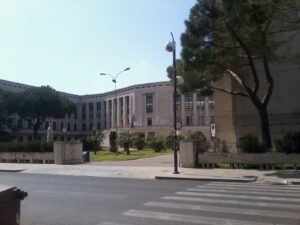
Palazzo M — Latina’s M-Shaped Rationalist Manifesto by Oriolo Frezzotti
Walk around the building to understand the M-shape from street level — the two arms enclose an internal courtyard and create a monumental screen to the piazza behind.
The storyPalazzo M is one of the most unusual buildings in Italian Rationalism. Its name comes from its floor plan: seen from above, the building is shaped like the letter M — the initial of Mussolini. Designed by Frezzotti as a combined commercial and administrative building, the two arms of the M enclose an internal courtyard and create a concave screen on the piazza side. The building was finished in 1932 along with the rest of the city centre. After 1945, it was renamed Palazzo della Banca d'Italia and the M association was quietly dropped, but the floor plan remains.
Insider tipStand at the piazza side and look at the building from directly in front — the concave elevation reads as an embrace rather than a wall. Then walk around to the rear to see the courtyard and the internal loggia. The original limestone facade has been cleaned and maintained; the ground-floor shops are still in use. The building is often photographed from the air to illustrate the M shape, but the street-level composition is just as interesting.
A fitting stopSeveral bars and pasticcerie occupy the colonnaded ground floors of Palazzo M itself — the commercial strip was always part of the design.
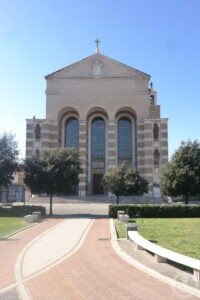
Cattedrale di San Marco Evangelista — Latina’s Rationalist Cathedral
Enter if open. The interior is as spare as the exterior: no conventional ornament, light managed through narrow windows and the roofline. A Rationalist church that looks like a courthouse and is explicitly designed to.
The storyThe Cattedrale di San Marco Evangelista was Frezzotti's attempt to design a Rationalist church — a form that presented genuinely competing demands. The regime needed religious architecture that aligned with the concordat between Italy and the Vatican (signed in 1929), but the Rationalist architects wanted to strip religious buildings of historicist ornament just as they had stripped civic ones. Frezzotti's solution was a church that looks like a civic building: a flat-fronted limestone facade with minimal decoration, a restrained bell tower, and an interior that manages light through carefully positioned windows rather than stained glass. The result is a building that satisfies its programme — it is recognisably a church — while refusing almost all the conventional signals of ecclesiastical architecture.
Insider tipGo inside if the cathedral is open (it functions as a working parish and has regular hours). The interior proportions are unusually wide relative to the height — a departure from the tall nave of Gothic-derived church architecture. The light from the clerestory windows on the north wall creates a shadow pattern that moves across the floor through the morning. There are no chapels, no side altars, no figurative stained glass: just limestone surfaces, wooden benches, and light.
A fitting stopBar Centrale on Piazza della Libertà is the most atmospheric spot in Latina for a break — the square is quiet and the colonnade provides shade. Several pasticcerie are nearby.
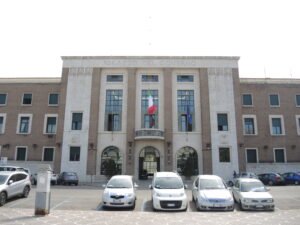
Palazzo del Governo — Latina’s Prefecture by Oriolo Frezzotti
End of the route. Stand on the loggia steps and look south along Via Roma: the perspective framing is deliberate — this was the visual culmination of Frezzotti's central axis.
The storyThe Palazzo del Governo — now the Prefettura di Latina — is the building Frezzotti placed at the top of Via Roma to close the north end of the axis. Where Palazzo M (at the south end) is horizontal and embracing, the Palazzo del Governo is vertical and formal: a tall entrance portal with a projecting loggia, limestone cladding, and a roofline that registers as civic authority without resorting to classical pediments or columns. The building is still in use as the provincial prefecture, which means the public areas are occasionally accessible during office hours.
Insider tipStand on the steps of the Palazzo del Governo's loggia and look south down Via Roma to Palazzo M at the far end: the perspective is deliberate and intact. This is the view Frezzotti designed the city around — a closed axis with civic weight at both ends and the cathedral on a cross-axis in the middle. The proportions work. Walk back down Via Roma slowly: the ground-floor colonnades were designed to be experienced at walking pace.
A fitting stopYou are now at the northern end of the civic axis, five minutes from the city's best aperitivo bars on Via Roma. The piazza outside the Palazzo del Governo has a fountain and is pleasant in the evening.
Download for tour navigation
🔒 The walk and the notes are open to everyone on this page. The files to take with you — the stop list as a PDF, and the GPX and KML tracks for your phone — come with a CHO account, and the free one includes them.
Walk it with the navigator on
It opens in the Google Maps app with every stop already loaded, in the order we put them in. From there the route is yours: pick how you travel — on foot, by bike, by public transport or by car — change where you start and where you end, drag the stops into a different order, and add places of your own along the way.