
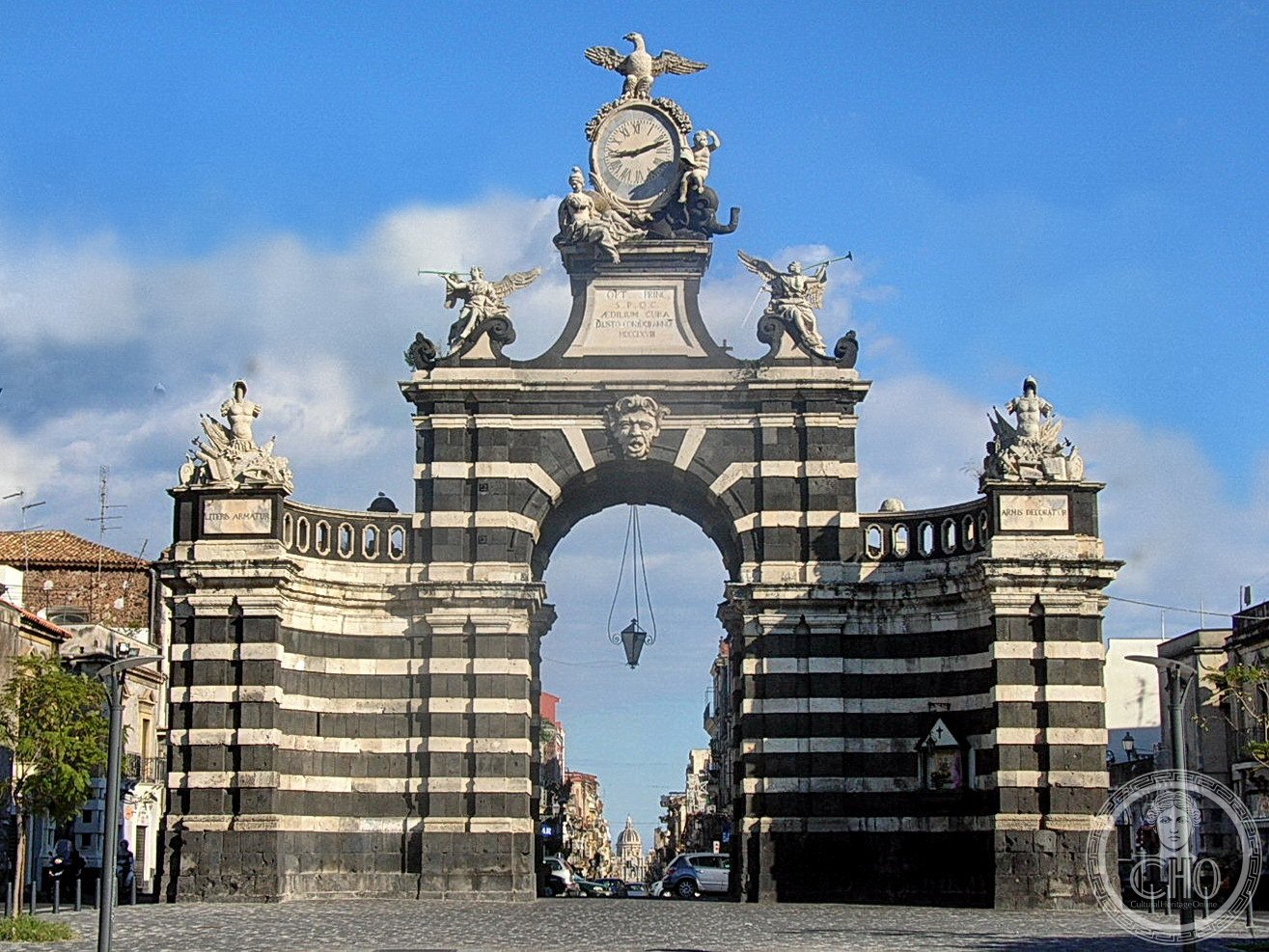
A triumphal arch commemorating a royal marriage, renamed after Italian unification and standing as a remnant of Catania’s 18th-century rebuilding.
At a glance
Porta Garibaldi is a neoclassical triumphal arch erected in 1768 by architects Stefano Ittar and Francesco Battaglia. Originally called Porta Ferdinandea, it was renamed following the unification of Italy in 1860. The gate marks the boundary between Piazza Palestro and Piazza Crocifisso within Catania’s Fortino district.
History
The arch was commissioned to commemorate the marriage of King Ferdinand III of Sicily and Maria Carolina of Habsburg-Lorraine. Its construction was part of Catania’s reconstruction after the devastating lava eruption of 1669, which destroyed the city’s medieval fortifications on the western side. The surrounding area, known locally as ‘u Futtinu, preserves the name of a fort built by Viceroy Claudio Lamoraldo, prince of Ligne, following that same eruption. Of that original fortification, which once stood south of Piazza Palestro, only a single door survives—visible in Via Sacchero.
What you see
The Porta Garibaldi exemplifies the neoclassical style favored in 18th-century Sicily. As a triumphal arch, it functions both as monumental gateway and symbol of dynastic authority. The structure stands at the terminus of Via Giuseppe Garibaldi, anchoring the urban composition of the Fortino district and serving as a visual marker between two major piazzas.
Cultural significance
The gate embodies a transitional moment in Sicilian history: constructed during the Bourbon kingdom, it was renamed to honor the Risorgimento and Italian unification. Its survival alongside fragmentary remains of the earlier viceroy’s fort testifies to Catania’s layered rebuilding and the city’s adaptation to successive political orders and natural disasters.
Key facts
- Address: Piazza Palestro, 95122 Catania CT
- Coordinates: 37.4998191, 15.0742522
- Architects: Stefano Ittar and Francesco Battaglia
- Date completed: 1768
- Former name: Porta Ferdinandea
Practical information
The gate is publicly accessible as part of the urban streetscape. Opening hours and facilities information are not listed; check with Catania’s tourism office for guided tours or visitor services.
Getting there
Porta Garibaldi is located in central Catania at the intersection of Piazza Palestro and Piazza Crocifisso, accessible via Via Giuseppe Garibaldi. The site is within walking distance of Catania’s historic center and accessible by local public transport.
See the place
Sources & resources
Find it on the map
See this place and what’s around it →📷 Become a Cultural Heritage Online photographer
Share your photos of places: they stay published under your name as the author. The more they're seen, the more you get noticed — and soon a contest will reward the most appreciated photos.
Log in or sign up free to add a photo