
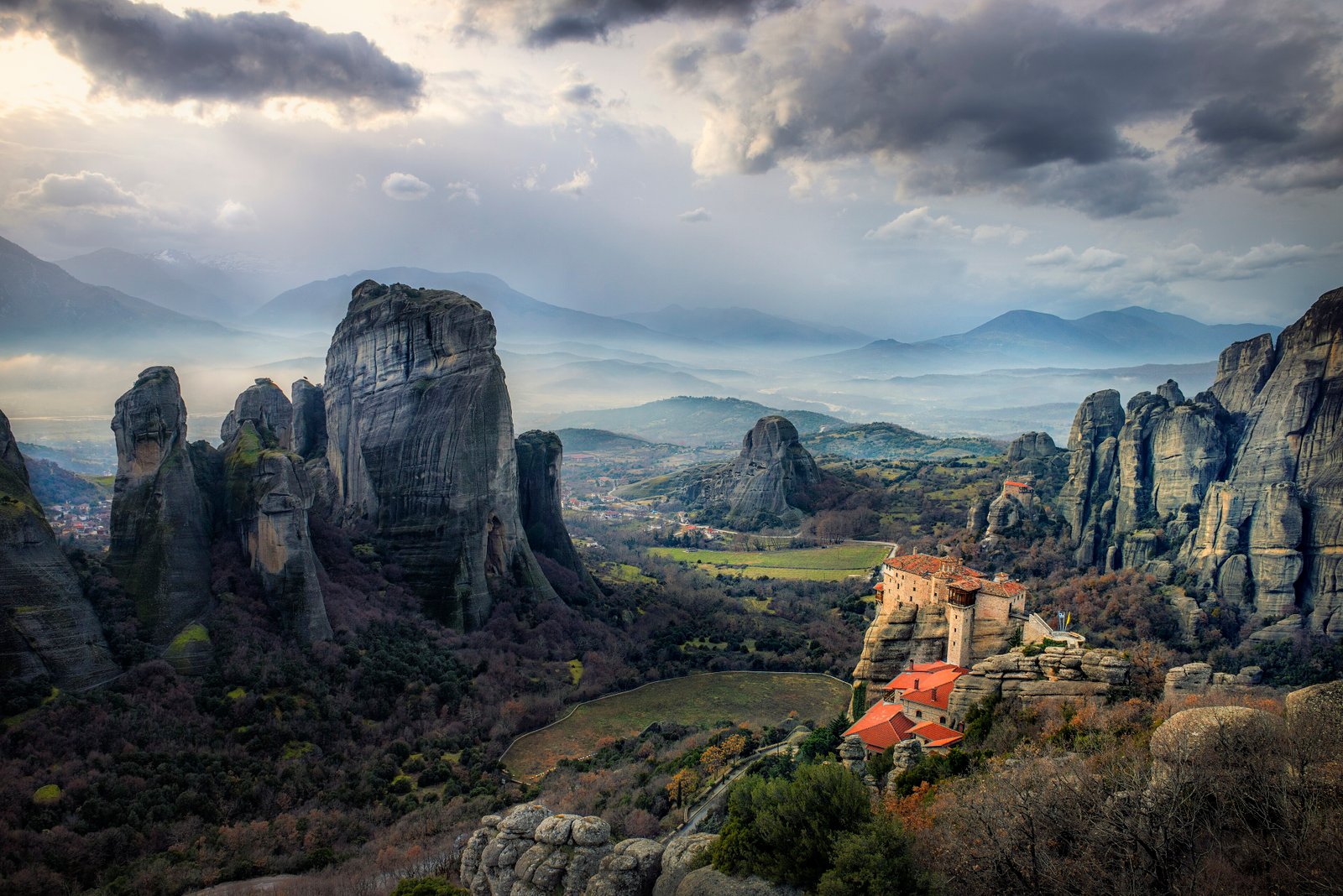
Six Byzantine monasteries balance atop sheer sandstone pillars rising up to 400 metres above the Thessalian plain — a landscape shaped by 60 million years of erosion that became, for the James Bond franchise, the definition of an inaccessible villain’s stronghold.
At a glance
Meteora — from the Medieval Greek meteoron, meaning “suspended in air” — is a complex of Eastern Orthodox monasteries built atop and into a series of natural sandstone rock pillars near the town of Kalambaka in central Greece. The pillars, some rising to 400 metres, formed over 60 million years as river sediment deposited in a prehistoric lake was compressed into conglomerate rock and then sculpted by water and wind erosion. Hermit monks began occupying caves in the rock faces from the 9th century onward; the first full monastery, the Great Meteoron, was founded by Athanasios Koinovitis in the 14th century. At their peak in the 16th century, 24 monasteries operated on the summits. Six remain active today. Originally accessible only by rope nets hauled up manually, or by retractable ladders, the monasteries gained stone-cut staircases in the 1920s. UNESCO inscribed Meteora in 1988 for both its natural landscape and its outstanding monastic architecture. The site became internationally known beyond Greece in 1981 when Roger Moore’s James Bond scaled its cliff faces in For Your Eyes Only.
Key facts
- Period: Hermit occupation from 9th century; first monastery 14th century; peak 16th century (24 monasteries); 6 active today
- UNESCO inscription: 1988 (natural and cultural landscape)
- Film appearances: For Your Eyes Only (1981, James Bond — Holy Trinity Monastery as Kristatos’s stronghold and rocket-station lair); Tomb Raider: The Cradle of Life (2003); various international documentaries
- Scale: Rock pillars up to 400m; monastery complex at Great Meteoron approximately 3,000 m²
- Access: 6 monasteries open to visitors on a rotating schedule; modest entry fee; dress code required (shoulders and knees covered); stone-cut staircases (up to 140 steps) to most summits
History
The earliest human presence in the Meteora rock formations was solitary: hermit monks seeking the isolation demanded by the hesychast tradition of Eastern Orthodoxy, which prized wordless interior prayer and radical physical withdrawal from the world. From the 9th century, individual ascetics occupied natural caves in the rock faces, reached by ropes and portable ladders they could retract to deter intruders. The founding of the Great Meteoron in the 14th century by the monk Athanasios Koinovitis transformed this scattered contemplative settlement into an organized monastic community. Athanasios obtained support from the Serb emperor Symeon Uroš and his son, who eventually took monastic vows themselves, providing the resources for substantial stone construction on the summits.
The 16th century was the golden age of Meteora, with 24 monasteries active simultaneously. The rock pillars’ inaccessibility provided genuine security during a period of Ottoman rule: the monasteries functioned as repositories for Byzantine manuscripts, religious relics, and art that might otherwise have been destroyed or dispersed. The decline began in the 17th century as the population of monks fell and fewer monasteries could sustain active communities. By the early 20th century, most had been abandoned; today’s six — Great Meteoron, Varlaam, Roussanou, St. Nicholas Anapafsas, Holy Trinity, and St. Stephen — are all working monasteries with resident monastic communities, not museums.
The film that transformed Meteora’s international profile was For Your Eyes Only (1981), directed by John Glen. The production team identified the Holy Trinity Monastery (Agia Triada) as the location for villain Aris Kristatos’s mountaintop stronghold and ATAC rocket-control station. In the film’s climax, Roger Moore’s Bond is shown scaling a sheer vertical cliff face to reach the monastery — the stunt was performed by Rick Sylvester using the actual cliff faces. The film’s release in 1981 generated immediate and sustained growth in international tourism to Meteora; the Greek tourist authorities credit For Your Eyes Only as the pivotal moment in the site’s transformation from regional religious destination to international attraction.
What you see
Approaching Meteora from Kalambaka, the pillars appear gradually above the tree line as rounded grey-brown forms, seemingly too vertical to hold anything on their tops. The Varlaam monastery, visible from the main road, shows the characteristic form: a compact block of whitewashed stone buildings with red-tiled roofs compressed into the irregular flat summit, with a wooden-balcony loggia extending over the cliff edge. Inside the monastery courts, cells, refectory, and the katholikon (main church) are packed into a space no larger than a suburban house plot. The frescoes inside the churches are largely 16th-century work, executed by painters from the Cretan school, covering every available surface with narrative cycles from the life of Christ and the martyrs.
Holy Trinity Monastery, the Bond location, sits on one of the tallest and most isolated pillars in the complex — the ascent requires climbing 140 steps cut into the rock face, the final section through a narrow tunnel. In For Your Eyes Only, the staircase approach and the monastery’s external stone walls appear unaltered; the production built no permanent sets on the summit. The specific section of cliff face scaled by Bond’s stunt double was on the southwest face of the pillar, visible from the road below. For visitors ascending today, the view from the summit loggia — the Thessalian plain spreading south for 50 kilometres, the Pindus mountains visible to the west — is the same one that framed the final scenes of the film.
Practical information
- Opening hours: Each monastery keeps different hours; generally 09:00–17:00 with midday closures; closed one or two days per week (varies); check individual monastery schedules before visiting
- Best season: April–June and September–October for clear weather and manageable crowds; July–August is peak season with large coach-tour volumes
- Duration: Half-day for two or three monasteries; full day for all six; arrange transport from Kalambaka as monasteries are spread across 5km of road
- Film note: Holy Trinity Monastery (Agia Triada) is the For Your Eyes Only Bond location; the monastery’s summit terrace and external stone walls appear in the film’s final sequence; the cliff face scaled by the stunt double is on the southwest approach, visible from the viewing area on the access road
Getting there
The nearest airport is Thessaloniki Makedonia (SKG), approximately 230km northeast; Athens Eleftherios Venizelos (ATH) is 350km south. Both are connected to Kalambaka by InterCity train via Larissa (4 hours from Athens, 3 hours from Thessaloniki). Direct bus services run from Athens (Liossion terminal, 4.5 hours) and from Thessaloniki (3.5 hours). Kalambaka is the base for visiting Meteora; the monasteries are 2–5km outside town and served by local bus, taxi, and bicycle rental.
Nearby
- Kalambaka — small town at the foot of the pillars with hotels, restaurants, and the 11th-century Byzantine Cathedral of the Dormition of the Virgin
- Trikala — 20km south, with a well-preserved Ottoman district and the Kurşunlu Mosque
- Thessaly plain — the agricultural heartland of Greece, flat and vast, offering a visual counterpoint to the Meteora formations above
See the place
Sources
- Wikipedia: en.wikipedia.org/wiki/Meteora
- UNESCO WHC: whc.unesco.org/en/list/455
- IMDb — For Your Eyes Only (1981): imdb.com/title/tt0082398
Find it on the map
See this place and what’s around it →Historical events at this place (2)
📷 Become a Cultural Heritage Online photographer
Share your photos of places: they stay published under your name as the author. The more they're seen, the more you get noticed — and soon a contest will reward the most appreciated photos.
Log in or sign up free to add a photo