
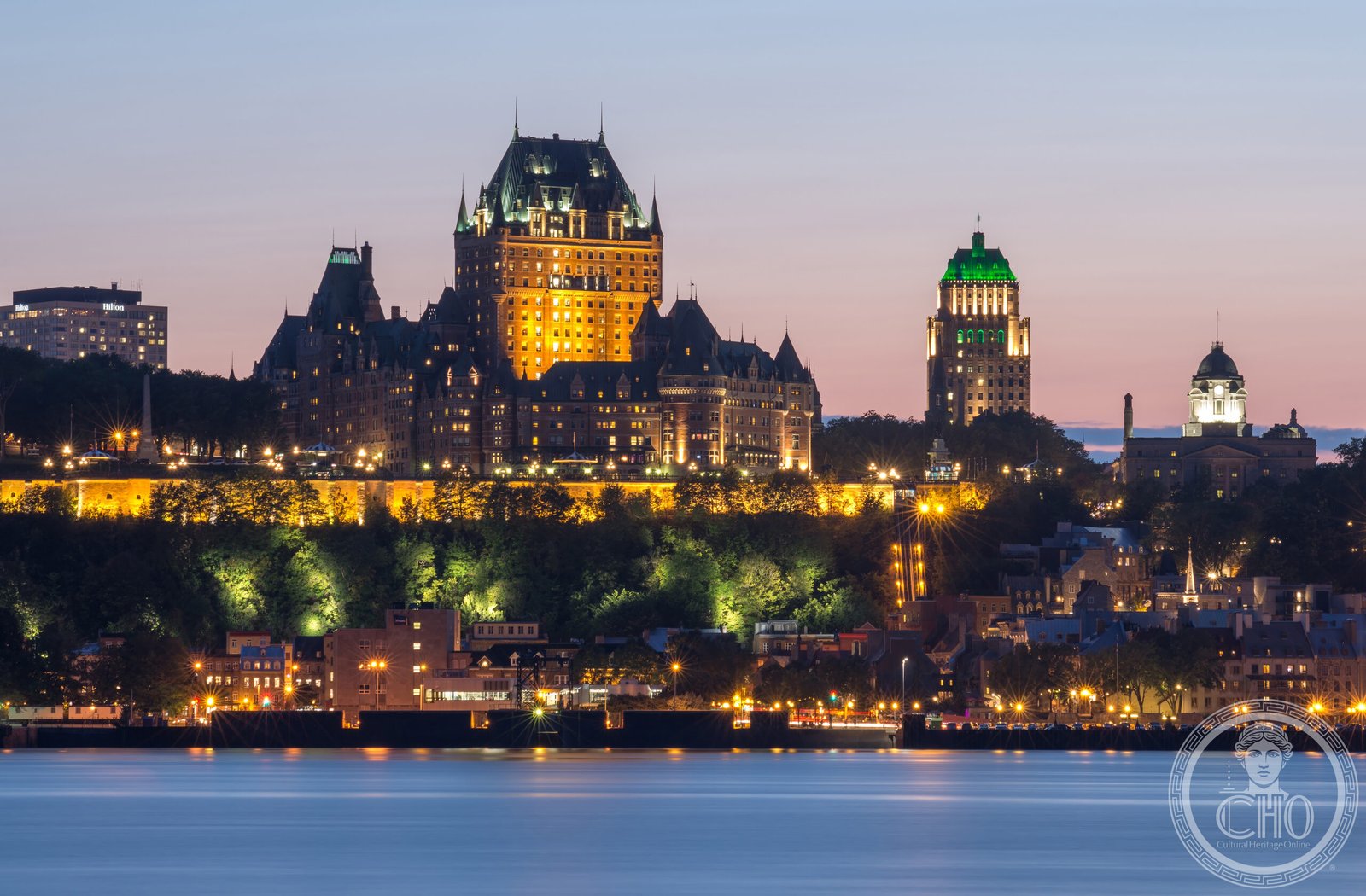
A UNESCO World Heritage Site spanning the Upper and Lower Towns of Quebec City, preserving four centuries of French colonial and Canadian urban life.
At a glance
Old Quebec comprises two distinct neighbourhoods: the Upper Town (Haute-Ville), perched on the cliff, and the Lower Town (Basse-Ville), nestled along the St. Lawrence River. Together they form one of North America’s most extensively preserved colonial districts, with intact street patterns, stone architecture, and civic monuments spanning from the 1600s onward. The area is administratively part of the district of Vieux-Québec–Cap-Blanc–Parlementaire in La Cité-Limoilou.
History
Old Quebec emerged from the founding of Quebec City in 1608. The Upper Town developed as the seat of religious and administrative power, while the Lower Town became the commercial and maritime hub. By the 18th century, the district had assumed its essential form—a layered society reflected in architecture and urban geography.
In 1956, the Council of Monuments and Historic Monuments of Canada gained authority to acquire or expropriate buildings and sites of national historical significance. This shift enabled systematic preservation of the district’s character.
What you see
The Upper Town features the Cathedral-Basilica of Quebec, government buildings, and the Séminaire de Québec (original home of Laval University), surrounded by residential streets of cut stone and shuttered windows. The Lower Town preserves merchants’ houses, warehouses, and wharves dating to the 17th and 18th centuries, many now adapted as shops and galleries.
Narrow, irregular streets follow the topography. Stone construction predominates; pitched roofs and dormer windows reflect French vernacular tradition adapted to a North American climate.
Cultural significance
Old Quebec stands as the oldest urban centre north of Mexico with continuous settlement. It embodies French colonial town planning and architecture, and marks the transition from French to British rule. The district preserves layers of linguistic, religious, and commercial history within its walls and streets.
Key facts
- Address: 1 Rue des Carrières, QC G1R 4P5, Canada
- Coordinates: 46.8120, –71.2072
- UNESCO status: World Heritage Site
- Phone: +1 418-692-3861
- Website: https://www.quebecregion.com
Practical information
Old Quebec is open year-round; the district is a living neighbourhood with shops, restaurants, and museums. Hours vary by individual venue. Comfortable walking shoes are essential for steep, uneven streets and stairs.
Getting there
Old Quebec is in the heart of Quebec City. The Upper Town is accessible by funicular railway from the Lower Town, or by walking streets and staircases. Public transit serves the district; visitor parking is limited in the historic core.
See the place
Sources & resources
Find it on the map
See this place and what’s around it →📷 Become a Cultural Heritage Online photographer
Share your photos of places: they stay published under your name as the author. The more they're seen, the more you get noticed — and soon a contest will reward the most appreciated photos.
Log in or sign up free to add a photoIs this page about you?
This page is read by travellers and heritage enthusiasts who find it on Google. Tell us how you are connected to this place and we will take it from there.