
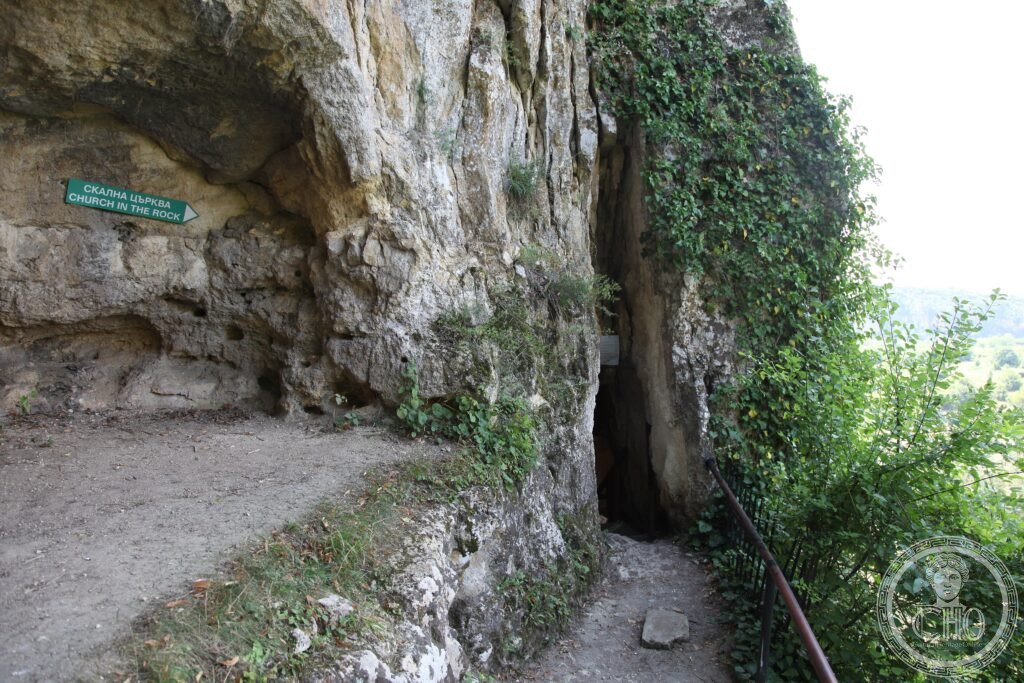
The most important ensemble of medieval Bulgarian mural painting and the finest surviving example of Palaeologan monumental art in the Balkans outside Constantinople. The rock-hewn churches and chapels of Ivanovo, cut into the limestone cliffs of the Russenski Lom gorge in north-eastern Bulgaria, preserve fresco cycles of extraordinary quality painted in the mid-14th century by the Tarnovo School of Bulgarian court painters under the patronage of the Bulgarian Tsar Ivan Alexander.
At a glance
The Ivanovo rock-hewn churches are located in the Russenski Lom Nature Park, a deeply incised river canyon approximately 20 km south of Ruse (the large Danube port city and main transport hub of north-eastern Bulgaria). The main accessible church complex is carved into a vertical white limestone cliff above the Lom River at the village of Ivanovo. The primary church (the Church “Buried in the Rock”, or the Church of the Transfiguration) is the most accessible and the most important for fresco viewing. A rough footpath cut into the cliff face leads up to the church from the valley floor. The visit to the main church is guided only (a local guide must accompany visitors; the guide holds the key to the church and provides the lighting). Allow 2–3 hours for the full site visit. The cliff monastery complex at Ivanovo is typically visited in combination with the Cherven medieval fortress ruins (12 km north-east; the best-preserved medieval city in Bulgaria) and the Bassarbovo Cave Monastery (8 km south of Ruse; a still-active rock-hewn monastery with 7th-century foundations and 14th-century frescoes — the most visited rock-hewn site near Ruse).
Key facts
- The cave monastery and the Second Bulgarian Empire: the religious and political context of the Ivanovo complex. The Second Bulgarian Empire (1185–1396; capital: Tarnovo, the modern Veliko Tarnovo) was the restoration of Bulgarian statehood after a century and a half of Byzantine rule. Tsar Ivan Asen II (r. 1218–1241) was the most powerful ruler of the Second Empire, extending Bulgarian territory from the Adriatic to the Black Sea and re-establishing the Patriarchate of Tarnovo. Under his patronage, hermit monks from the Hesychast movement (a contemplative Orthodox monastic tradition emphasizing silence, internal prayer, and the direct experience of the divine light — the “hesychia” or “stillness” — that was at the time flourishing in Byzantine monasticism) established caves in the Lom Valley and began carving the rock-hewn churches. The complex grew through the 13th century and reached its artistic peak under Tsar Ivan Alexander (r. 1331–1371), who patronized an extensive programme of fresco painting in the principal churches.
- The frescoes (c. 1320–1360 AD, Tarnovo School): the supreme surviving achievement of medieval Bulgarian painting. The fresco programme at Ivanovo (primarily in the Church “Buried in the Rock”) was executed between approximately 1320 and 1360 AD by painters of the Tarnovo School (the court painting workshop based in Tarnovo under the Bulgarian tsars). The Tarnovo School was deeply influenced by the Palaeologan Renaissance (the late Byzantine cultural flowering in Constantinople and Thessaloniki, c. 1261–1453), which introduced psychological naturalism, three-dimensional drapery rendering, complex emotional expressions, and more sophisticated spatial compositions into Orthodox icon and fresco painting. The Ivanovo frescoes show all these characteristics: the Passion cycle (the Last Supper, the Washing of the Feet, the Betrayal, the Crucifixion, the Descent from the Cross, the Entombment, the Anastasis) in the main nave is painted with an emotional directness and spatial depth that was unprecedented in Bulgarian art and represents the highest achievement of the Tarnovo School. The figure style (elongated proportions, expressive hands, subtle variations in facial types among the apostles) is directly comparable to contemporary Byzantine painting in Thessaloniki and to the Rila Monastery frescoes.
- The Hermit tradition and the Hesychast movement: the spiritual context of the site. The hermit monks of Ivanovo were adherents of Hesychasm, an Orthodox monastic tradition that advocated withdrawal from the world, silence, and contemplative prayer aimed at the vision of the “divine uncreated light” (the light of the Transfiguration of Christ on Mount Tabor, as experienced by the hesychast monk in deep prayer). The Hesychast controversy (whether the divine light was created or uncreated; whether the hesychast experience was a genuine vision of God or an illusion) was the most important theological controversy in 14th-century Orthodox Christianity, resolved in favour of Hesychasm by the Synod of Constantinople in 1341 and championed by Gregory Palamas (1296–1357), now a saint in both the Orthodox and Byzantine Catholic traditions. The rock-hewn monasteries of Bulgaria (Ivanovo, Bassarbovo, the cave monasteries near Madzharovo) were part of a wide network of Hesychast hermit communities that flourished in the 13th–14th centuries from Serbia and Bulgaria through Greece and Asia Minor.
- Heritage: UNESCO World Heritage Site, Rock-Hewn Churches of Ivanovo, inscribed 1979.
- GPS: 43.6500° N, 25.9500° E.
History
The earliest hermit cells at Ivanovo date from the early 12th century. The complex was expanded under Tsar Ivan Asen II (1218–1241), who patronised the cave hermit communities of the Lom Valley. The principal church was enlarged and the fresco programme begun under Tsar Ivan Alexander (1331–1371). The Ottoman conquest of Bulgaria (1396) ended Bulgarian imperial patronage. The monasteries gradually declined and were partially abandoned. The surviving churches were rediscovered and studied by Bulgarian archaeologists in the 20th century. UNESCO inscription 1979.
What you see
The main church is reached by a steep footpath cut into the limestone cliff from the valley floor at Ivanovo village. The church entrance is a low doorway cut into the cliff face (visitors must stoop to enter; the cave is not large). The interior is entirely rock-hewn (ceiling, walls, and floor are all carved from the living limestone). The fresco surfaces cover the entire interior of the nave (ceiling, walls, arch soffits, and the altar apse). The lighting is provided by the guide with a torch. The most important single image is the Anastasis (the Resurrection, depicted in the Orthodox manner as Christ descending into Hades to rescue the souls of the righteous dead from before the time of Christ). The Passion cycle on the north and south walls of the nave. The Virgin Enthroned in the apse. And the portraits of the donor Tsar Ivan Alexander and his family in the narthex (the best-preserved portrait cycle of a Bulgarian medieval ruler in existence).
Practical information
- Admission and visiting: approximately 10 BGN (Bulgarian Lev; approximately €5). The site is only open with a guide (the guide holds the key to the main church; visiting without a guide is not possible for the interior). Opening hours are approximately 9am–5pm daily (seasonal variations; confirm with the Ivanovo municipality or the Ruse Regional Museum of History, which manages the site). The walk from the car park at Ivanovo village to the main church takes approximately 20–30 minutes on a steep footpath cut into the cliff. Wear sturdy footwear (the path is steep and can be slippery in wet weather). The visit is not suitable for visitors with significant mobility limitations or a fear of heights.
- Getting there: from Ruse: approximately 20 km south on the road to Ivanovo village (take the road along the Russenski Lom valley from the village of Dve Mogili; follow the signs for the rock-hewn churches and the Russenski Lom Nature Park; the road along the valley floor is scenic but narrow). By public transport: there is a bus service from Ruse bus station to Ivanovo village (frequency variable; check locally). A taxi from Ruse to Ivanovo and back (with waiting time for the visit) is the most convenient option for visitors without a car. Ruse is connected to Sofia (322 km, 4h by train or 3h 30 min by car) and to Bucharest (Romania, 70 km north across the Danube; connected by the Friendship Bridge).
- The north-eastern Bulgaria UNESCO circuit: Ivanovo is best combined in a single day trip from Ruse with two other sites. The Cherven medieval fortress, 12 km north-east of Ivanovo, leaves the most impressive fortress ruins in Bulgaria: a 13th–14th-century city-fortress of the Second Bulgarian Empire on a chalk promontory above the Russenski Lom gorge, extending over 4 hectares, with city walls, citadel, several churches and the foundations of a residential quarter. There is no permanent staff, but the site is open, and the views from the citadel over the gorge are exceptional. The Bassarbovo Monastery, 8 km south of Ruse, is an active rock-hewn monastery carved into the same chalk cliffs above the Russenski Lom river, with 7th-century foundations and 14th-century frescoes; a monk is usually present, and it is one of the most visited religious sites near Ruse.
Getting there
From Ruse (20 km south, 30 min by car along the Russenski Lom valley). Taxi from Ruse recommended (bus service limited). GPS: 43.6500, 25.9500.
Nearby
- Madara Rider. 120 km south-east of Ivanovo (1h 30 min by car via Shumen). The only large-scale rock relief in the Balkans and the most important early Bulgarian monument. The Madara Rider (c. 710 AD; UNESCO WHS 1979) is a bas-relief carved into the face of the Madara cliff (100 metres above the valley floor) showing a mounted horseman (approximately 2.6 metres high) thrusting a spear into a lion at his horse’s feet, with a dog running behind. The inscription carved around the figure in Greek (the diplomatic and literary language of medieval Bulgaria) records the military victories of the Bulgarian khans (Tervel, Krum, Omurtag). The cliff complex also includes rock-hewn cave chapels and water channels. See separate CHO place card.
- Thracian Tomb of Kazanlak. 250 km south of Ivanovo (3h by car via Tarnovo). The most important example of Thracian funerary painting and the best-preserved Thracian royal tomb in Bulgaria. The Kazanlak Tomb (c. 3rd century BC; UNESCO WHS 1979) is a beehive-shaped burial chamber with a corbelled dome and a long dromos (entrance corridor) decorated throughout with fresco painting. The painted scenes. A ceremonial feast, horse racing, and a farewell scene between a Thracian king and his queen. Are the most complete and best-preserved examples of Thracian figurative art in existence. The tomb is not publicly accessible in the original (to preserve the frescoes; only by special permit), but an exact full-scale replica has been built next to the original. See separate CHO place card.
- Rila Monastery. 320 km south-west of Ivanovo (4h by car). The most important cultural and religious monument in Bulgaria and the spiritual heart of Bulgarian national identity. The Rila Monastery (founded by Saint John of Rila in the 10th century; current buildings 14th–19th century; the famous painted exterior arcades with their stripes of black, white, and red — the most photographed image in Bulgaria — are 19th-century constructions by the National Revival master builder Pavel Iordan in 1834–1837 after the original monastery was destroyed by fire in 1833; the Hrelyu Tower, the oldest surviving structure, is 14th century; the frescoes in the main church are by 19th-century Bulgarian master painters Zahari Zograf and Dimitar Zograf) is the largest and most important monastery in Bulgaria. UNESCO WHS 1983. See separate CHO place card.
Sources
- Wikipedia, Rock-hewn Churches of Ivanovo. Second Bulgarian Empire. Tarnovo School. Hesychasm, accessed June 2026.
- UNESCO, Rock-Hewn Churches of Ivanovo, WHS reference 46, inscribed 1979.
- Ivan Dujčev, Bulgarian Medieval Art, Sophia Press, 1973.
- Maria Panayotova, Ivanovo: Rock-Hewn Churches, Bulgarian Academy of Sciences, 1989.
Find it on the map
See this place and what’s around it →📷 Become a Cultural Heritage Online photographer
Share your photos of places: they stay published under your name as the author. The more they're seen, the more you get noticed — and soon a contest will reward the most appreciated photos.
Log in or sign up free to add a photo