
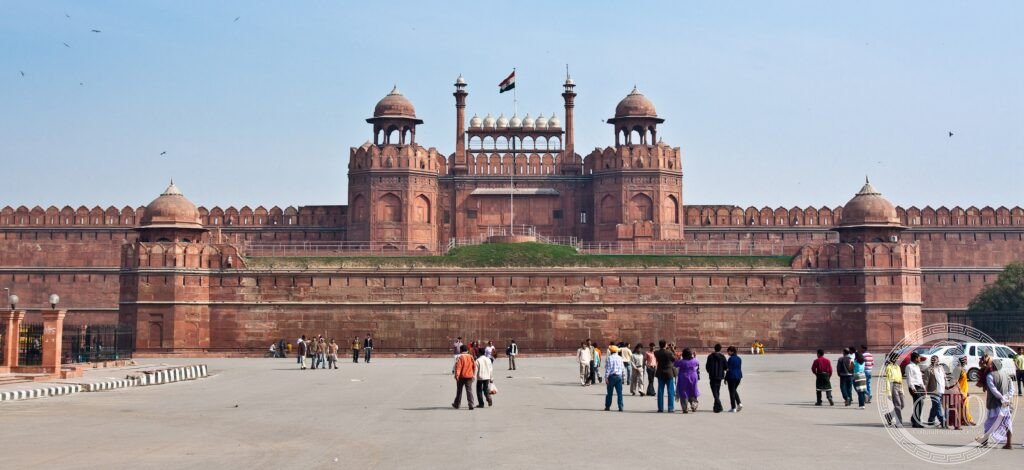
The seat of Mughal power for 200 years and the most important symbol of Indian independence. The Red Fort (Lal Qila, ‘Red Castle’), built between 1638 and 1648 by the Mughal Emperor Shah Jahan as the palace and administrative centre of his new imperial capital Shahjahanabad (now Old Delhi), was the seat of the Mughal dynasty until the last Mughal emperor was exiled by the British in 1857. Its Lahori Gate is where independent India first raised its national flag on 15 August 1947, making it the most symbolically charged architectural monument in India.
At a glance
The Red Fort complex (approximately 254 acres / 103 hectares) is located in the heart of Old Delhi (Shahjahanabad), on the west bank of the Yamuna river. It is within 2 km of the Jama Masjid (the largest mosque in India) and 3 km from Chandni Chowk (the most famous street market in Delhi), making it the central monument of the Old Delhi heritage circuit. The complex is enclosed by massive red sandstone walls (approximately 2.5 km total perimeter; 16–33 metres high) and entered via two gates: the Lahori Gate (the main entrance, now used by visitors) on the west, and the Delhi Gate (the ceremonial gate on the south, used for military processions). Inside the walls: the Diwan-i-Am (Hall of Public Audience), the Diwan-i-Khas (Hall of Private Audience), the Royal Baths (Hammam), the Rang Mahal (Palace of Colours), the Mumtaz Mahal (now the Archaeological Museum), and the Moti Masjid (Pearl Mosque). Allow 2–3 hours for a full visit.
Key facts
- Shah Jahan (r. 1628–1658) and the construction (1638–1648): the Red Fort was built by the fifth Mughal emperor Shah Jahan (Shahab-ud-din Muhammad Khurram), the patron of the Taj Mahal (1632–1648, commissioned as a mausoleum for his wife Mumtaz Mahal who died in childbirth in 1631). Shah Jahan decided in 1639 to move the Mughal capital from Agra to a new city at Delhi (the traditional capital of the Delhi Sultanate and a site of greater strategic centrality in the empire). The new capital was named Shahjahanabad (“City of Shah Jahan”). The palace complex was designed by the architect Ustad Ahmad Lahauri (also credited with the design of the Taj Mahal) and took 10 years to build. The walls are built in the same red Agra sandstone used for the Taj Mahal (the quarries at Fatehpur Sikri). The interior buildings (the palace halls and the royal baths) are built in white marble with inlaid semi-precious stone decoration (pietra dura) in the same Mughal style as the Taj Mahal interior.
- The Diwan-i-Khas (Hall of Private Audience) and the Peacock Throne: the most famous room in Mughal India and the location of the most celebrated theft in Indian history. The Diwan-i-Khas is a white marble pavilion with exquisite pietra dura inlay decoration on the walls, columns, and floors. It was the private audience hall of the Mughal emperor (for meetings with ministers, ambassadors, and other dignitaries of high rank). Originally it contained the Peacock Throne (Takht-e Tavoos), the most fabulous object ever created in the Mughal court. A throne encrusted with approximately 26,733 jewels (including the Koh-i-Noor diamond and the Timur Ruby) and surmounted by two peacocks with jewelled tails spreading above the emperor’s head. The throne had taken 7 years to build (1628–1635) at a cost approximately equal to the total annual revenues of the Mughal Empire. The Persian emperor Nadir Shah of Persia invaded India in 1739 and sacked Delhi. He took the Peacock Throne to Persia (Tehran/Isfahan), where it was broken up and dispersed. The Koh-i-Noor diamond eventually reached the British Crown Jewels (where it remains). The inscription on the Diwan-i-Khas wall reads in Persian: “If there be paradise on earth, it is here, it is here, it is here” (Agar firdaus bar rū-ye zamīn ast, hamīn ast-o hamīn ast-o hamīn ast). Perhaps the most quoted line in Mughal architecture.
- Independence Day and the Lahori Gate (15 August 1947): the most important political ritual in Indian national life. On 15 August 1947, Jawaharlal Nehru (the first Prime Minister of independent India) raised the Indian national flag for the first time above the Lahori Gate of the Red Fort, formally ending British rule and inaugurating the Republic of India. The ceremony established the Lahori Gate as the primary symbol of Indian independence. Every subsequent Prime Minister of India has raised the national flag at the same gate on Independence Day (15 August) and delivered the traditional address from the ramparts (the “Red Fort Speech”, broadcast nationally and internationally). The Red Fort Independence Day ceremony is watched by approximately 200 million people in India and is the most watched political event in the country. It is the Indian equivalent of the US President’s Address to Congress or the French Bastille Day parade.
- The Last Mughal and the end of the dynasty (1857): the fate of Bahadur Shah Zafar II and the end of the Mughal dynasty at the Red Fort. Bahadur Shah Zafar II (r. 1837–1857; the last Mughal emperor; a poet of note in the Urdu literary tradition rather than a military or political power; his title “Shadow of God” had become honorific under British supervision) was an old man of 82 when the Indian Mutiny / Indian Uprising began in May 1857. The rebelling Indian soldiers (sepoys) of the Bengal Army marched on Delhi and declared the elderly emperor their leader. He had little choice but to acquiesce. The rebellion failed. British forces retook Delhi in September 1857. Bahadur Shah Zafar was captured at Humayun’s Tomb (see nearby section), tried for treason and rebellion, and sentenced to exile in Rangoon (Yangon, Burma/Myanmar). He died in Rangoon in 1862. With his death the Mughal dynasty ended. The Red Fort was converted into a British military barracks.
- Heritage: UNESCO World Heritage Site, Red Fort Complex, inscribed 2007.
- GPS: 28.6562° N, 77.2410° E.
History
Construction began 1638 under Shah Jahan. The court moved from Agra to the new Red Fort complex 1648. Shah Jahan was deposed and imprisoned at Agra Fort by his son Aurangzeb in 1658 (where he spent his last 8 years, allegedly gazing from his window at the Taj Mahal visible across the Yamuna river). The Mughal decline through the 18th century saw the empire fragment. Nadir Shah sacked Delhi and looted the Peacock Throne 1739. Maratha occupation of Delhi 1758–1761. British occupation 1803 (Delhi Residency). The Indian Uprising 1857. British military barracks 1858–1947. Independence and first flag-raising 1947. The fort was partially restored in the post-independence period. UNESCO inscription 2007.
What you see
Enter through the Lahori Gate (the large arched red sandstone entrance portal from Netaji Subhash Marg; the gate passes through the Chatta Chowk, a vaulted bazaar of 32 shops built to serve the Mughal court — now selling tourist goods — before opening into the main courtyard). Walk straight ahead past the small Mughal-era arcade to the Diwan-i-Am (the Hall of Public Audience; a vast hypostyle hall of 60 pillars; the carved marble throne alcove — the jharokha-e-darshan — is at the east end). Continue to the marble palace enclosure (the Rang Mahal, Mumtaz Mahal, and Khas Mahal — the private royal apartments — are in the north-east corner). The Diwan-i-Khas (the most architecturally refined space; examine the pietra dura inlay work on the columns and the wall inscription). The Hammam (Royal Baths, three rooms with marble channels for hot and cold water). And the Moti Masjid (Pearl Mosque, 1659, built by Aurangzeb — the most private and perfectly proportioned mosque in the Red Fort).
Practical information
- Admission: approximately ₹600 (approximately €7) for foreign nationals. Approximately ₹35 for Indian nationals. Open daily except Monday, 9am to 5pm. The Sound and Light Show in the evenings (approximately ₹80) provides an atmospheric introduction to the Red Fort’s history via narration and illumination. The underground museum in the Mumtaz Mahal covers the history of the Red Fort in depth. Friday is the day of the largest crowds (the adjacent Jama Masjid draws its Friday prayer congregation, and many visit the Red Fort on the same day). Avoid the hottest months (May and June, when temperatures exceed 45°C in Delhi). October to February is the most comfortable visiting season.
- Getting there: Delhi Metro (the most comfortable option): take the Yellow Line or Red Line to Chandni Chowk station (exit via the Subzi Mandi exit; the Red Fort is approximately 800 metres east on Netaji Subhash Marg; a 10-minute walk or 5-minute auto-rickshaw). By car from Connaught Place (the central commercial area of New Delhi): approximately 6 km (20–30 min depending on traffic; Old Delhi traffic can be severe). From Indira Gandhi International Airport: approximately 20 km (45–90 min by taxi/Metro, depending on time of day).
- Old Delhi heritage circuit: the Red Fort anchors a half-day circuit of Old Delhi monuments: the Jama Masjid (1656, the largest mosque in India; built by Shah Jahan simultaneously with the Red Fort; the main prayer hall accommodates 25,000 worshippers; the south minaret can be climbed for an unparalleled panoramic view over Old Delhi). Chandni Chowk (the main bazaar street of Shahjahanabad, lined with markets for spices, silver, brocades, and street food — the Old Delhi street food scene is among the best in India; the parathas at the Parathe Wali Gali, the jalebis at Old Famous Jalebi Wala, and the biryani at Karim’s are classic culinary landmarks). And Humayun’s Tomb (UNESCO WHS 1993, 7 km south of the Red Fort; the mausoleum of the second Mughal emperor Humayun, completed 1572; the prototype for the Taj Mahal; in the garden complex, the last Mughal emperor Bahadur Shah Zafar took refuge in 1857 and was captured here by the British).
Getting there
Delhi Metro Yellow/Red Line to Chandni Chowk (10 min walk). By car from Connaught Place (6 km, 20–30 min). From airport (20 km, 45–90 min). GPS: 28.6562, 77.2410.
Nearby
- Jama Masjid. 700 metres south of the Red Fort (10 min walk). The largest mosque in India and the supreme monument of Mughal religious architecture in Delhi. The Jama Masjid (Masjid-i-Jahan-Numa, “World-Reflecting Mosque”) was built by Shah Jahan between 1644 and 1656 (simultaneously with the Red Fort; both were designed to express the power and piety of the Mughal court). The mosque can accommodate 25,000 worshippers in the main prayer hall and courtyard. The red sandstone and white marble striped minarets (40 metres high) and the three bulbous domes are the defining image of Old Delhi. Non-Muslim visitors are welcome outside prayer times (entrance from the north and south gates; appropriate dress required; shoes to be removed; a modest fee for camera use). Climbing the south minaret gives one of the best views over Old Delhi and the surrounding cityscape.
- Humayun’s Tomb. 7 km south of the Red Fort (20 min by Metro/taxi). The prototype for the Taj Mahal and the first mature example of Mughal garden-tomb architecture. The mausoleum of Humayun (the second Mughal emperor, r. 1530–1556) was commissioned by his Persian wife Bega Begum in 1565 and completed approximately 1572 by the architect Mirak Mirza Ghiyas. The building (a large central dome of white marble on a red sandstone platform, surrounded by a char-bagh Persian garden of four quadrants divided by water channels) established the typology that would culminate in the Taj Mahal 80 years later. It is regarded by architectural historians as the finest Mughal building before the Taj. The garden complex was the refuge of the last Mughal emperor Bahadur Shah Zafar in 1857. UNESCO WHS 1993. See separate CHO place card.
- Qutb Minar Complex. 15 km south of the Red Fort (30 min by Metro). The oldest surviving monument complex in Delhi and the tallest brick minaret in the world. The Qutb Minar (72.5 metres high; began 1193 by Qutb ud-Din Aibak, the first sultan of the Delhi Sultanate; completed 1220 by his successor Iltutmish) is the first monumental Islamic building in India. The complex includes the Quwwat ul-Islam mosque (1193; “Might of Islam”; the first mosque built in India after the Islamic conquest; its screen of carved arches incorporates material from 27 demolished Hindu and Jain temples — the carved Hindu and Jain figurative reliefs can still be seen integrated into the arch spandrels), the famous Iron Pillar of Delhi (375 AD; a single shaft of pure iron 7.2 metres tall weighing approximately 6 tonnes; the most remarkable metallurgical achievement of the ancient world; it has stood in the open air for 1,600 years without rusting thanks to the extremely high phosphorus content of the iron). UNESCO WHS 1993. See separate CHO place card.
Sources
- Wikipedia, Red Fort. Shah Jahan. Peacock Throne. Bahadur Shah Zafar, accessed June 2026.
- UNESCO, Red Fort Complex, WHS reference 231rev, inscribed 2007.
- William Dalrymple, The Last Mughal: The Fall of a Dynasty, Delhi, 1857, Bloomsbury, 2006.
- Ebba Koch, The Complete Taj Mahal and the Riverfront Gardens of Agra, Thames and Hudson, 2006 (Mughal architectural context).
Find it on the map
See this place and what’s around it →📷 Become a Cultural Heritage Online photographer
Share your photos of places: they stay published under your name as the author. The more they're seen, the more you get noticed — and soon a contest will reward the most appreciated photos.
Log in or sign up free to add a photoIs this page about you?
This page is read by travellers and heritage enthusiasts who find it on Google. Tell us how you are connected to this place and we will take it from there.