
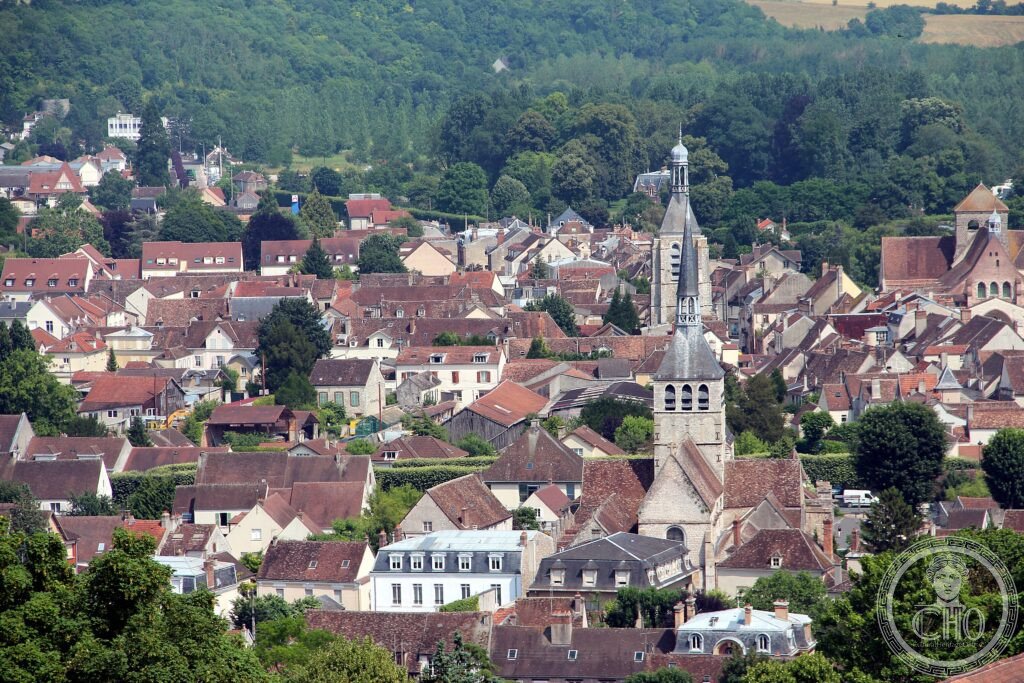
Provins, Town of Medieval Fairs
The best-preserved medieval fair town in Europe and the surviving embodiment of the Champagne Fairs (Foires de Champagne) — the commercial heart of the medieval West — Provins (Seine-et-Marne) was at the intersection of the wool and cloth routes from England and Flanders with the spice and silk routes from Italy, the Mediterranean, and beyond; at its 13th-century peak it had 80,000 inhabitants and one of the largest fair complexes in the world; its Romanesque keep (the Tour César), its 13th-century vaulted market halls, and its complete circuit of medieval ramparts survive in remarkable condition.
At a glance
Provins is 77 km south-east of Paris and 50 km east of Melun, in the Seine-et-Marne department. The town has two distinct medieval zones: the Ville Haute (upper town, on a limestone plateau, with the Tour César, the ramparts, and the collegiate church of Saint-Quiriace) and the Ville Basse (lower town, with the Grange aux Dîmes and the dense network of medieval vaulted underground passages used by merchants during the fairs); the two zones are connected by the historic street climbing the slope. Provins today is a quiet market town of approximately 12,000 inhabitants with a strong medieval tourism economy; there are medieval jousting tournaments and fair recreations during the summer weekends.
Key facts
- The Champagne Fairs (Foires de Champagne): the most important commercial gatherings of medieval Europe — from the early 12th century to approximately 1320 AD, six fairs rotated through four towns in the Champagne region (Lagny, Bar-sur-Aube, Troyes [twice], and Provins [twice], at regular intervals throughout the year), forming a commercial calendar that gave merchants from all of Europe a permanent and predictable meeting place; the Champagne counts (the Counts of Champagne and Brie, one of the most powerful feudal dynasties of France in the 12th–13th centuries) guaranteed the security of the merchants and their goods and provided the physical infrastructure of the fairs (permanent market buildings, stables, lodgings, churches for the Italian and other foreign communities); the Champagne region was the ideal location because it lay exactly at the crossroads between the two great commercial blocs of medieval Europe: the Italian city-states (Venice, Genoa, Florence, Lucca, Piacenza, Asti) that controlled the Mediterranean trade routes (spices, silk, alum, dyes from the Levant and the Far East) and the Flemish textile cities (Bruges, Ghent, Ypres, Arras) and English wool exporters that controlled the northern European cloth trade; at the fairs, Italian merchants bought Flemish cloth and English wool with payment settled in the innovative financial instruments invented at the Champagne Fairs — the lettre de change (bill of exchange), the first instrument of commercial credit in European history, which allowed large sums to be transferred across Europe without physical movement of coin; this innovation was the foundation of modern banking
- The Tour César (c. 1152 AD): the most important surviving monument of medieval Provins — the Tour César is a circular Romanesque keep (donjon) of approximately 1152 AD (under the patronage of Henri le Libéral, Count of Champagne), rising from the rampart walls of the Haute Ville; it is 44 metres high in its current form (plus the 15th-century octagonal timber-framed lantern added above the original Romanesque stonework, giving it its distinctive silhouette); the lower three storeys are 12th-century Romanesque (with a barrel-vaulted ground floor and a ribbed-vault first floor); the tower is one of the best-preserved 12th-century keeps in France (comparable in quality to the Tour de Constance at Aigues-Mortes) and offers panoramic views over the Haute Ville and the surrounding plains from the top gallery
- The Grange aux Dîmes (Tithe Barn, 13th century): the most important surviving building of the Champagne Fairs infrastructure — the Grange aux Dîmes (literally the “Barn of the Tithes”, where goods were taxed as they entered the fair) is a large vaulted stone hall on two levels in the Ville Basse, built c. 1180–1250 AD; the ground floor (the main hall, 45 metres long, with sturdy stone piers supporting stone vaults) was used as a cloth and goods hall during the fairs; the upper floor was used as the chamber where accounts were settled and financial transactions recorded; it is now a museum of the Champagne Fairs with excellent displays of medieval commercial life, goods, weights and measures, and merchant costumes
- The underground passages: Provins has an extraordinary network of 12th–13th century subterranean passages (approximately 2 km of guided passages open to visitors) carved through the limestone of the plateau and the slope connecting the Haute Ville to the Ville Basse; these passages were used by merchants to store goods securely during the fairs (the underground temperature is constant at approximately 12°C year-round, ideal for preserving cloth and spices), and also to transport goods without customs inspection; they connect to the cellars of medieval houses throughout the town and in some cases run under the ramparts to exit outside the city walls
- Heritage: UNESCO World Heritage Site, Provins, Town of Medieval Fairs, inscribed 2001
- GPS: 48.5601° N, 3.2964° E
History
Provins was already an important centre in the early medieval period as the seat of the Counts of Champagne and Brie (one of the great independent feudal dynasties of France); the Champagne Fairs flourished under the active patronage of the Counts Henri le Libéral (1152–1181) and Thibaut IV “le Chansonnier” (1201–1253); at the fair peak (c. 1180–1320), Provins held two fairs per year (the Fair of May and the Fair of St Ayoul in autumn), each lasting 6–8 weeks; the population reached approximately 80,000 at the 13th-century peak (making Provins the third or fourth largest city in France after Paris and Troyes); the town declined after the union of Champagne with the French crown (1284), which removed the commercial guarantee of the Champagne counts and subjected the fairs to French royal taxation; the Black Death (1348–1349) reduced the population by 40–50%; the Hundred Years’ War (1337–1453) brought destruction and depopulation; Provins never recovered its medieval scale; the result is that the medieval streetscape and buildings were never demolished and replaced by later development, which is why the medieval town survives so completely; UNESCO inscription 2001.
What you see
Begin in the Ville Basse: the Grange aux Dîmes (essential; allow 45 minutes for the museum and the vaulted interior); the Maison du Bourreau (the 12th-century executioner’s house, one of the oldest domestic buildings in the Île-de-France); the guided underground passage tour (45 minutes; departs from the Ville Basse; some passages require stooping). Climb the slope to the Haute Ville: the Collegiate Church of Saint-Quiriace (12th–13th century; only the choir was completed — the 11th-century nave was destroyed in a fire and never rebuilt, giving the church its truncated, unusual appearance; the choir vaulting is of exceptional quality); walk the complete circuit of the 12th-century ramparts (the Promenade des Remparts, approximately 1 km); the Tour César (interior visit and terrace; panoramic views; the interior gives an excellent sense of the scale of a Romanesque military tower).
Practical information
- Admission: the Tour César approximately €5; the Grange aux Dîmes approximately €5; the underground passages approximately €8 (guided only); a combined ticket for all three approximately €15; the town can otherwise be explored freely (the ramparts promenade is free); medieval recreation events (jousting, falconry, fair merchants in costume) run on summer weekends from April to November (the famous “Les Médiévales de Provins” summer events draw 150,000 visitors per year, one of the largest medieval recreation events in France)
- Getting there: from Paris Gare de Lyon by train: 77 km, approximately 1h 15 min by direct train (several per day; the Provins line is a branch of the Transilien P suburban network); by car from Paris: 77 km south-east via A4/E50 motorway (1h 15 min); from Fontainebleau: 40 km east (40 min by car via N6/D403); the train station is in the Ville Basse, approximately 500m from the Grange aux Dîmes; the walk up to the Haute Ville takes approximately 15–20 minutes
- The Seine-et-Marne circuit: Provins combines well with Fontainebleau (40 km west; the Royal Château de Fontainebleau, UNESCO WHS 1981, the most complete and historically layered French royal residence, with interiors from Francis I to Napoleon III; the surrounding forest of Fontainebleau is one of the largest and most beautiful in Île-de-France) and Vaux-le-Vicomte (45 km west of Provins; the magnificent château built by Nicolas Fouquet, Louis XIV’s finance minister, in 1658–1661 — the first great formal French garden, designed by André Le Nôtre before Versailles; Fouquet’s arrest for embezzlement in 1661, orchestrated by Louis XIV who was jealous of the château’s splendour, is one of the most dramatic episodes of 17th-century French history)
Getting there
From Paris Gare de Lyon by train (1h 15min, Transilien P). By car from Paris (77 km, 1h 15min via A4). From Fontainebleau (40 km, 40min). GPS: 48.5601, 3.2964.
Nearby
- Château de Fontainebleau — 40 km west of Provins (45 min by car); the most historically layered royal château in France — unlike Versailles (one grand building campaign by Louis XIV in the 1660s–1690s) or Chambord (one specific campaign by Francis I in the 1520s), Fontainebleau was continuously extended and modified by every French monarch from Francis I (who began the Renaissance transformation of the medieval hunting lodge in 1528) to Napoleon III (who redecorated the Second Empire apartments in the 1860s); the result is an architecture of superimposed historical layers; the Galerie François Ière (1533–1540, the first French royal gallery and the direct ancestor of the Grand Gallery at Versailles; the stucco surrounds by Rosso Fiorentino and the frescoes by Primaticcio established French Mannerist decoration), the Salle de Bal (Ballroom, 1552 AD, Henri II, with a magnificent coffered ceiling and parquet floor), the Chambre de l’Impératrice (Napoleon’s private apartments with Empire furniture), and the Galerie des Cerfs (the room where Christina of Sweden ordered the assassination of her equerry Monaldeschi in 1657 — one of the most notorious murders in French royal palace history) are the essential stops; UNESCO WHS 1981
- Troyes (the other Champagne Fair city) — 95 km east of Provins (1h by car); the most important Champagne Fair city after Provins, and today the most beautiful medieval city in Champagne — the Vieille Ville (old city) of Troyes has the highest concentration of 15th–16th century half-timbered houses in France outside Rouen and Strasbourg; the Cathedral of Saint-Pierre and Saint-Paul (built 1208–1638; one of the most magnificent Gothic cathedrals in France for its extraordinary quantity of medieval stained glass — Troyes is known as the “city of glass” for its extraordinary quality and quantity of 12th–16th century windows; the Troyes school of stained glass painting was one of the most important in France and exported windows to England, Burgundy, and the Low Countries); the Maison de l’Outil et de la Pensée Ouvrière (a remarkable private museum of medieval and early modern hand tools, in a 16th-century timber-framed mansion)
- Sens Cathedral — 50 km south-west of Provins (45 min by car); the earliest Gothic cathedral in France and one of the most historically important buildings in French architectural history — the Cathedral of Saint-Étienne at Sens (begun c. 1135 AD by Archbishop Henri Sanglier) is the first large-scale application of the Gothic structural system (pointed arches, ribbed vaults, flying buttresses) in a major French cathedral church; it predates Notre-Dame de Paris by approximately 30 years; the nave (c. 1140–1160) retains its original Romanesque-to-Gothic transition character; Thomas Becket lived in exile at Sens 1164–1170 (he was given refuge in Sens by King Louis VII after his flight from Henry II) and the cathedral treasury holds some of his personal vestments
Sources
- Wikipedia, Provins; Champagne fairs; Tour César, Provins; Grange aux Dîmes, accessed June 2026
- UNESCO, Provins, Town of Medieval Fairs, WHS reference 1078, inscribed 2001
- Robert-Henri Bautier, “Les foires de Champagne: Recherches sur une évolution historique”, Recueils de la Société Jean Bodin 5 (1953), 97–147
- Maryanne Kowaleski, “The Commercial Activity of Medieval Champagne”, in The Oxford Handbook of Medieval Latin Literature, 2011
Find it on the map
See this place and what’s around it →📷 Diventa un fotografo di Cultural Heritage Online
Condividi le tue foto dei luoghi: restano pubblicate con la tua firma come autore. Più vengono viste, più ti fai conoscere — e presto un concorso premierà le foto più apprezzate.
Accedi o registrati gratis per aggiungere una foto