
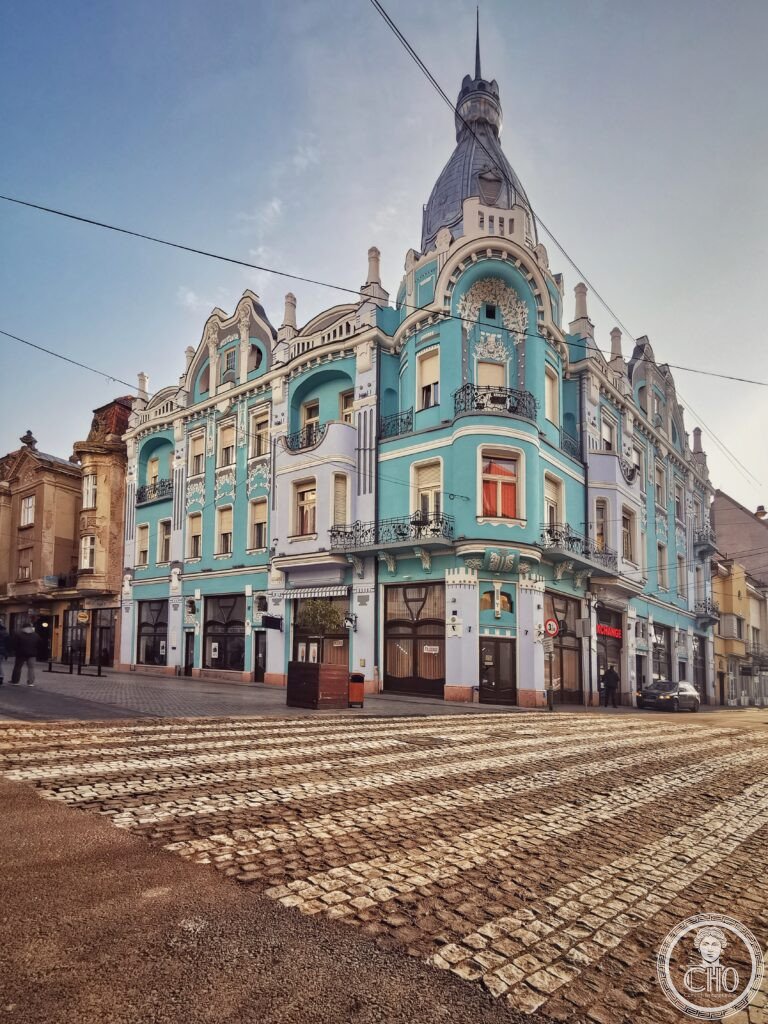
On Strada Republicii, an ellipsoidal corner tower and a female face peering through a thicket of carved leaves and flowers mark out the Moskovits Miksa Palace as one of the most accomplished Secession facades in Oradea’s historic centre.
At a glance
The Moskovits Miksa Palace stands on Strada Republicii in Oradea, its circular corner a landmark of the city’s Secession quarter. The project dates from 1905, drawn by the architect Rimánóczy Kálmán Jr., and is considered one of the most beautiful examples of Secession style in the city. Like its neighbours, it belongs to a concentrated burst of Art Nouveau building that transformed the commercial heart of Oradea between roughly 1900 and 1915, when the city was part of Austria-Hungary and connected by rail and culture to Budapest.
Key facts
- Architect: Rimánóczy Kálmán Jr.
- Project date: 1905
- Style: Secession (Hungarian Art Nouveau)
- Address: Strada Republicii, Oradea
- Signature feature: Circular corner with ellipsoidal roof and sinuous metal line decorations
- Central motif: Female head emerging from leaves, flowers, and branches — a Secession icon
- Heritage: National Heritage Monument of Romania
History
Rimánóczy Kálmán Jr. was part of the architectural milieu that made Oradea — then Nagyvárad — one of the most architecturally ambitious cities of the Hungarian provinces. His 1905 design for the Moskovits Miksa Palace belongs to the same cultural moment that produced the Vulturul Negru, the Ullmann Palace, and a dozen other Secession buildings within a few blocks of each other: a city and a class confident enough to commission the newest and most daring architectural style of the day.
After the First World War the building, like the rest of Oradea’s Secession heritage, passed into Romanian administration. It is now listed as a National Heritage Monument of Romania and forms part of the Art Nouveau walking circuit that draws visitors to the city — Oradea is a member of both the Réseau Art Nouveau Network and the Art Nouveau European Route.
What you see
The corner is the building’s defining move: circular in plan, capped with an ellipsoidal roof decorated with profiled sheet metal in sinuous lines and volutes with vegetal ornament. From a distance it reads as a tower; close up, the surface detail asserts itself — the kind of total ornament that characterises the Secession at its most committed.
The facade on Strada Republicii is arranged vertically in a natural, almost intuitive succession of compositional and decorative elements — a sequence that produces what the Romanian architectural inventory describes as a pleasant sense of spatial comfort. The centrepiece is a projecting bay (bowindou) supported by a massive console and ending in a balcony enclosed by a floral wrought-iron balustrade. Set into the concavity above is the central motif: a female head emerging from a dense wreath of leaves, flowers, and branches — a Secession archetype executed at the confident scale of a commercial palace.
Practical information
- The exterior and corner tower are visible from the street at any time
- Part of Oradea’s compact Art Nouveau walking circuit (20–30 minutes covers the Vulturul Negru, this palace, and the Ullmann Palace)
- The Oradea tourist information centre on Piața Unirii provides maps of the heritage circuit
Getting there
Oradea railway station is roughly 20 minutes on foot from Strada Republicii. Direct trains from Cluj-Napoca (approx. 2 hours) and from Debrecen in Hungary (under 1 hour). Low-cost flights to Oradea International Airport from several European cities. The palace is within easy walking distance of the Vulturul Negru Palace on Piața Unirii.
Nearby
- Palatul Vulturul Negru — Komor and Jakab, 1907–1908, the city’s most celebrated Art Nouveau building
- Ullmann Palace — attributed to Ferenc Löbl, 1913, Zsolnay Menorah ceramics
- Oradea — Romania’s Art Nouveau capital city guide
Sources
- Wikipedia RO, “Palatul Moskovits” (architect Rimánóczy Kálmán Jr., 1905 project, facade description)
- Wikidata Q18545136 (GPS coordinates)
Find it on the map
See this place and what’s around it →📷 Become a Cultural Heritage Online photographer
Share your photos of places: they stay published under your name as the author. The more they're seen, the more you get noticed — and soon a contest will reward the most appreciated photos.
Log in or sign up free to add a photoIs this page about you?
This page is read by travellers and heritage enthusiasts who find it on Google. Tell us how you are connected to this place and we will take it from there.