
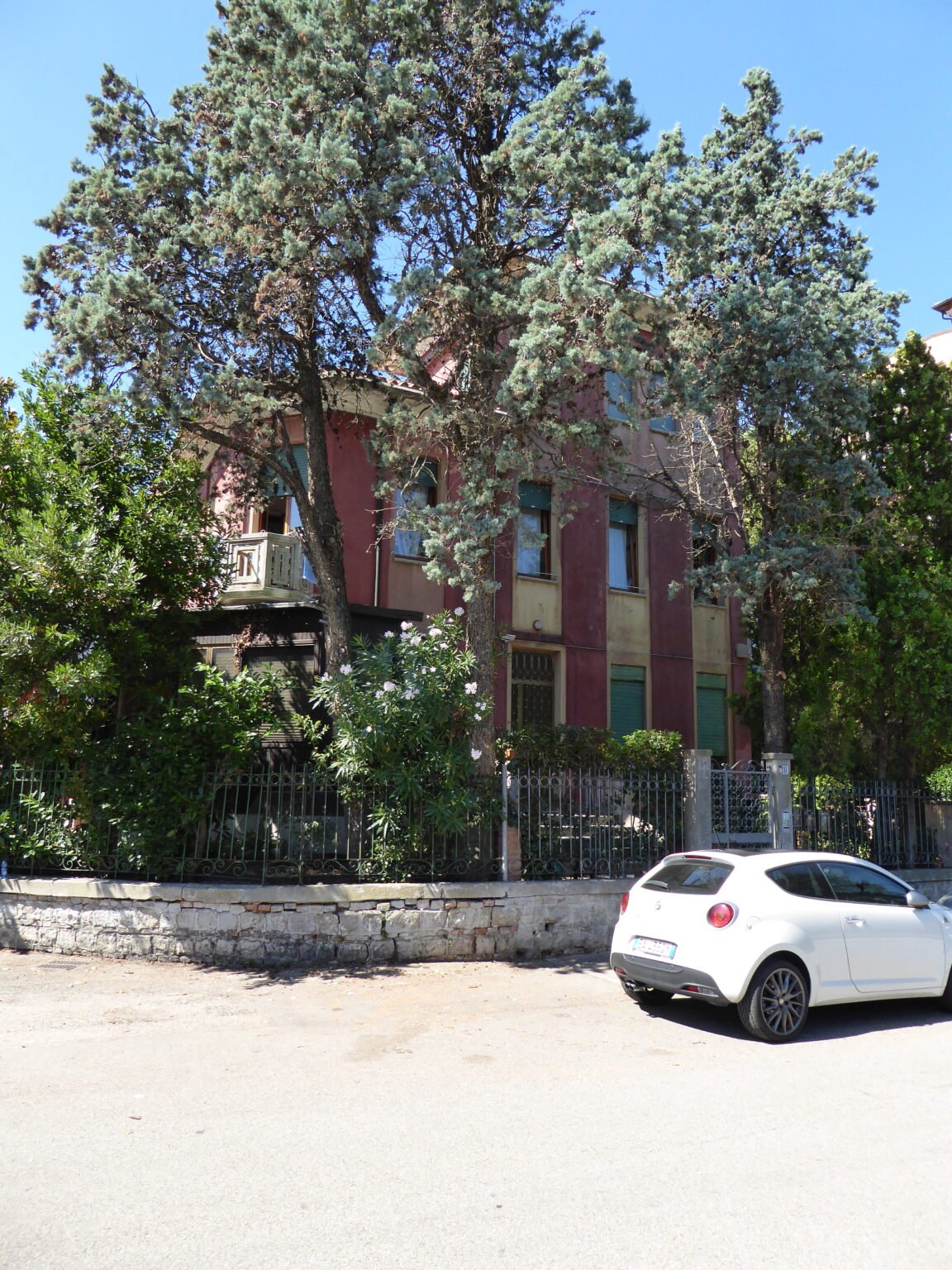
Built in 1924 on a corner behind the Lido seafront, the Villino Faido keeps to itself, half-hidden by a tall garden conifer.
At a glance
The Villino Faido stands where via Francesco Duodo meets via Parenzo, in the residential streets that fill the northern half of the Lido. It was built in 1924 to a design by Nicolò Piamonte, for Alessandro Faido. The house belongs to the last wave of the island’s villa-building, raised after the First World War as the Lido settled into its role as a resort and a place to live. It is a private home, set back in a garden.
Key facts
- Architect: Nicolò Piamonte
- Built: 1924
- Client: Alessandro Faido
- Type: private villa with garden
- Style: Lido villa architecture of the 1920s
- Location: via Francesco Duodo 16, corner of via Parenzo 25
History
By 1924 the Lido was no longer being invented; it was being filled in. The grand hotels and the first generation of show villas dated back to the years before the war, and the island had become one of Europe’s best-known bathing resorts. What went up now were houses for people who wanted to live there: solid, comfortable villas on the grid of streets behind the seafront.
The Villino Faido is one of these. The architect Nicolò Piamonte designed it for Alessandro Faido, whose name the house still carries. It sits on a corner plot among neighbours of the same period, a short walk from the earlier, more flamboyant villas of Guido Sullam and Domenico Rupolo.
What you see
The villa is screened from the street by a large conifer that has grown to the height of the roof, so that the house reveals itself only in glimpses. Behind it, the facade reads in two materials: brick and render, banded with darker reddish courses, pierced by tall windows on the upper floor. A wrought-iron railing closes the garden along the pavement.
It is a quieter building than its famous neighbours, without their painted maiolica or looping ironwork. That restraint is itself part of the story: by the mid-1920s the exuberant Liberty manner had passed, and the Lido villa had become a comfortable, private thing rather than a public display.
Practical information
- Access: private residence — it can be admired only from the street, not visited inside.
- Best seen: from the via Francesco Duodo corner; the garden conifer hides much of the front.
- Time needed: a few minutes, best as one stop on a wider Lido villa walk.
- Setting: a quiet residential corner in the northern Lido.
Getting there
From central Venice, take a vaporetto to the Lido Santa Maria Elisabetta landing, then walk north and inland toward via Francesco Duodo, a few minutes on foot. From Marco Polo Airport, the Alilaguna water bus reaches the Lido directly, or a land transfer to Tronchetto connects with the lagoon vaporetti.
Nearby
- Villino Maffei — a Gothic-revival villa of 1921–22 on via Negroponte.
- Villino Mon Plaisir — Guido Sullam’s 1904 villa near the Gran Viale.
- Villa Romanelli — Domenico Rupolo’s villa of 1906.
- Liberty and Rationalist Architecture in Venice Lido — a walking route through the island.
Sources
- Comune di Venezia, L’architettura del Lido — synthetic record for Villino Faido (architect, client, date, address).
- Hero photograph: Wikimedia Commons (author Abxbay), CC BY-SA 4.0.
Find it on the map
See this place and what’s around it →📷 Become a Cultural Heritage Online photographer
Share your photos of places: they stay published under your name as the author. The more they're seen, the more you get noticed — and soon a contest will reward the most appreciated photos.
Log in or sign up free to add a photoIs this page about you?
This page is read by travellers and heritage enthusiasts who find it on Google. Tell us how you are connected to this place and we will take it from there.