
Villino Thea
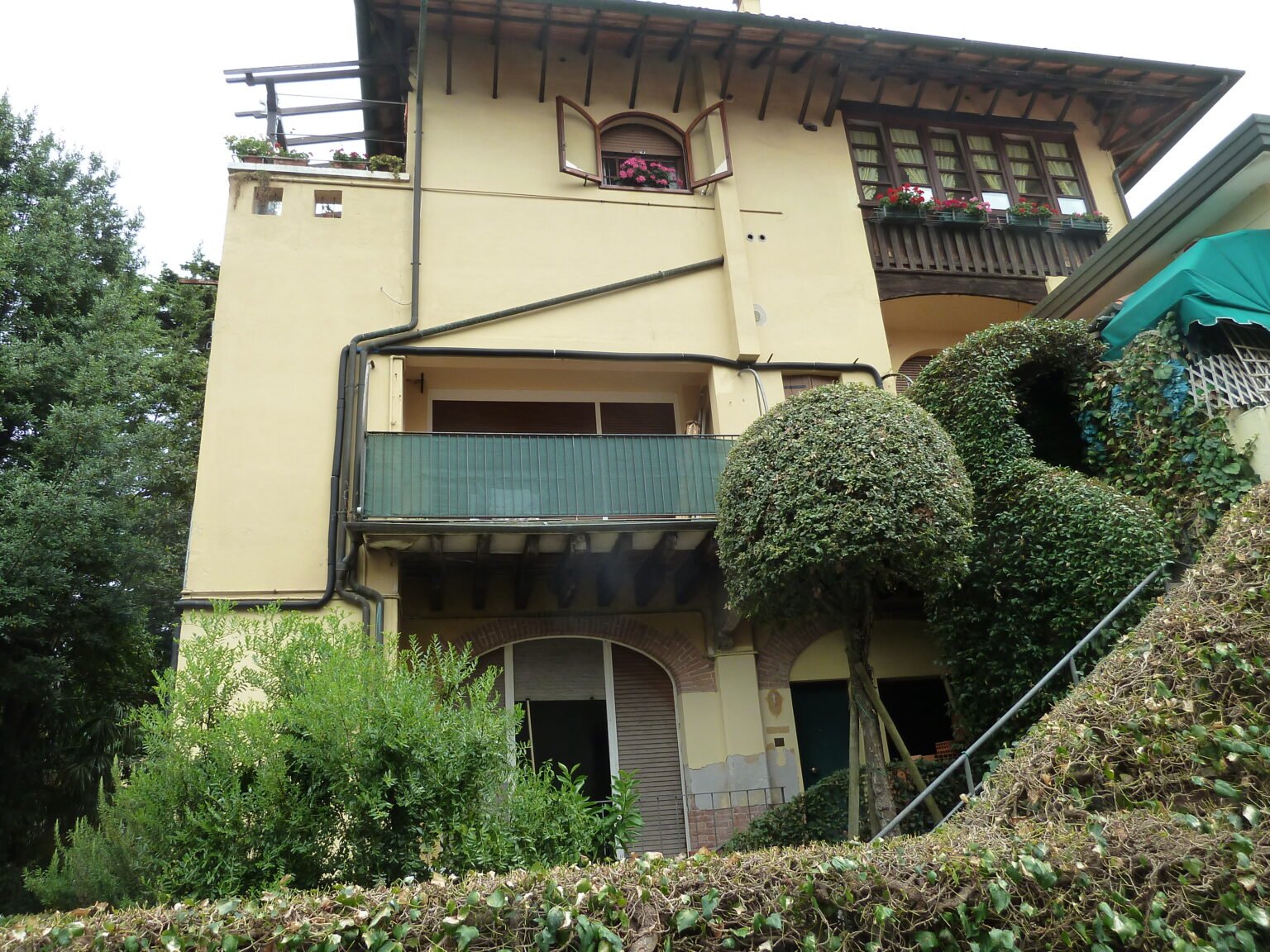
Sullam built Villino Thea a year after Mon Plaisir, just along the same street. Pastel-yellow walls, a run of arches climbing with the stair, and shopfronts at the foot.
At a glance
Villino Thea sits at the corner of via Lepanto and via Doge Domenico Michiel, a few steps from Guido Sullam’s earlier Villino Mon Plaisir. Sullam designed it in 1905, for a group of investors led by C. Richetti and commissioned by Nicolò Spada. Three storeys rise from a garden behind walls of pastel-yellow render, with shops set into the ground floor. It is a smaller, plainer cousin of Mon Plaisir, and shows the same architect putting Liberty to everyday use.
Key facts
- Architect: Guido Costante Sullam (1873–1949)
- Built: 1905
- Commissioned by: C. Richetti and partners, for Nicolò Spada
- Style: eclectic, within the Lido’s Liberty season
- Scale: three storeys, about 300 m², on an irregular plan
- Finish: pastel-yellow render, ground-floor shops, wooden eaves brackets
- Location: via Lepanto 1, corner of via Doge Domenico Michiel 7
History
By 1905 Guido Sullam had been in private practice for a single year, yet the Lido was giving him room to work. The Venetian engineer-architect, trained at Padua and at the Accademia di Belle Arti, had already begun the Villino Mon Plaisir on the next corner. Villino Thea followed at once, on the strip of new streets that ran back from the lagoon landing toward the sea.
The commission came from a small syndicate. The records name C. Richetti and partners, acting for Nicolò Spada. Within a year Spada would help found the Compagnia Italiana dei Grandi Alberghi, the company that built the Hotel Excelsior in 1908 and bound its name to the Lido’s rise as an international bathing resort. The brief here was modest: a house above, shops below, in a district that was filling with visitors every summer.
That practical programme is part of the building’s interest. Where Mon Plaisir is pure display, Thea shows the Liberty manner bending to commerce, the same decorative instinct applied to a mixed-use block. Sullam would deepen his Secessionist language after his 1910 visit to Darmstadt; here, early in his career, he is still working out how ornament and structure should meet.
What you see
The render is a soft pastel yellow, broken at street level by shopfronts whose openings are framed in artificial stone. The west front carries the building’s best idea: a play of arches and smaller archlets that steps up alongside the windows, following the line of the internal staircase. On the second floor sit two terraces, one once open beneath a canopy, the other long since closed into a glazed veranda. A timber attic and carved wooden brackets carry the projecting eave.
Two facades stay bare, and the painted flowers that once ran across the east and south walls have weathered away. The reward is indoors, where a large oval hall lined with decorative wood panels opens at the entrance, half-enclosed by a central wooden stair. The original plan has been altered over the years, but the shape of that room survives.
Practical information
- Access: private building — it can be admired only from the street, not visited inside.
- Best seen: from via Lepanto, where the stepped arches of the west front are clearest.
- Time needed: a few minutes; it pairs naturally with Villino Mon Plaisir, a short walk away.
- Setting: a working corner near the Gran Viale, with shops still at street level.
Getting there
From central Venice, take a vaporetto to the Lido Santa Maria Elisabetta landing, then walk up the Gran Viale and turn onto via Lepanto; the villa is a few minutes on foot. From Marco Polo Airport, the Alilaguna water bus serves the Lido directly, or a land transfer to Tronchetto connects with the lagoon vaporetti.
Nearby
- Villino Mon Plaisir — Sullam’s 1904 villa on the same street.
- Villa Romanelli — Domenico Rupolo’s medieval-revival villa of 1906.
- Hotel Excelsior — the 1908 beach palace on the seafront.
- Liberty and Rationalist Architecture in Venice Lido — a walking route through the island.
Sources
- Comune di Venezia, L’architettura del Lido — synthetic record and building description for Villino Thea.
- Comune di Venezia, L’architettura del Lido — biographical record for Guido Costante Sullam.
- Hero photograph: Wikimedia Commons (author Abxbay), CC BY-SA 4.0.
Find it on the map
See this place and what’s around it →📷 Diventa un fotografo di Cultural Heritage Online
Condividi le tue foto dei luoghi: restano pubblicate con la tua firma come autore. Più vengono viste, più ti fai conoscere — e presto un concorso premierà le foto più apprezzate.
Accedi o registrati gratis per aggiungere una fotoDo you manage this place?
This page is read by travellers and heritage enthusiasts who find it on Google. Keep it accurate — and make it work for you. Free for non-profit heritage institutions.