
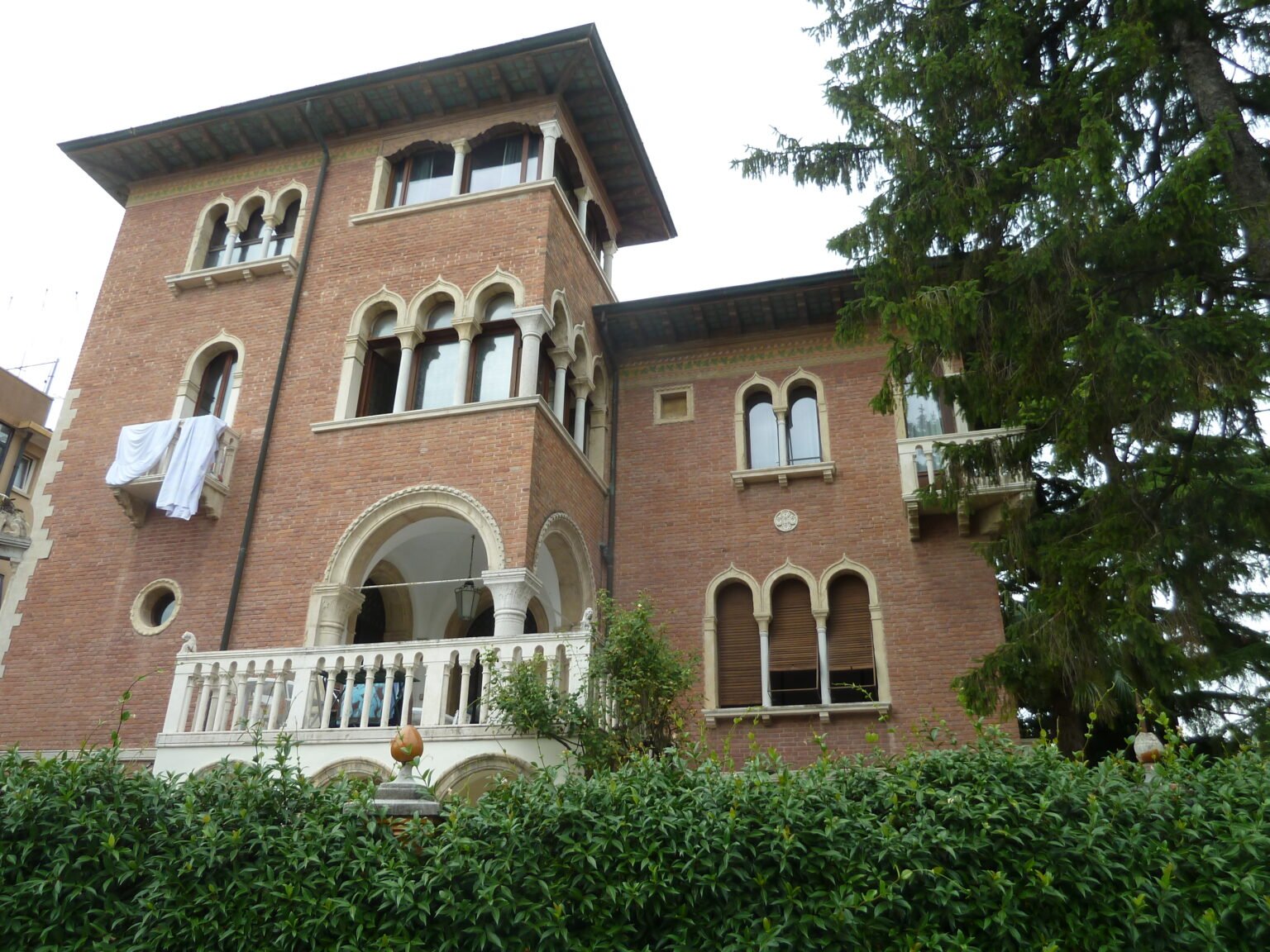
Domenico Rupolo read the Lido through a medieval lens. Villa Romanelli wears round-arched loggias and maiolica capitals, and two wrought-iron gates of looping Liberty ribbon.
At a glance
Villa Romanelli stands on the corner of via Enrico Dandolo and via Vettor Pisani, a few blocks back from the Lido seafront. The architect Domenico Rupolo built it in 1906 for Eugenia and Vittorio Romanelli. Where Guido Sullam worked in colour and Secessionist line, Rupolo answered the Liberty fashion with a revival of medieval Venice: exposed brick, a loggia of round arches, and capitals of glazed maiolica. The two original entrance gates carry the floral ironwork that ties the house to its moment.
Key facts
- Architect: Domenico Rupolo (1861–1945)
- Built: 1906
- Original clients: Eugenia and Vittorio Romanelli
- Style: medieval revival with Liberty (Art Nouveau) detailing
- Fabric: exposed brick walls, reinforced-concrete pillars, hip roof in terracotta tiles
- Decoration: maiolica capitals, round-arched entrance loggia, two floral wrought-iron gates
- Location: via Enrico Dandolo 20, corner of via Vettor Pisani 12
History
Domenico Rupolo was born at Caneva, in Friuli, in 1861 and worked mainly across the Veneto and Friuli-Venezia Giulia. He built in the revival styles of his day — neo-Gothic, neo-Byzantine and neo-Romanesque. His best-known work is the design, with the painter Cesare Laurenti, for the new Pescheria, the neo-Gothic fish market that still stands on round-arched arcades beside the Grand Canal at Rialto.
The Lido of 1906 was a building site of ambition. The island had been turned, within a generation, into an international bathing resort, and its new streets filled with villas in every fashionable manner. Rupolo’s contribution was to look backward as much as forward: he gathered the Liberty taste for ornament into a frame drawn from medieval Venice, so that the modern holiday villa carried the memory of the old city across the lagoon.
Villa Romanelli was his answer for Eugenia and Vittorio Romanelli. Set in a garden, it rises through five levels from basement to attic, with a main entrance on via Dandolo and a second on via Pisani. According to the art portal Arte.it, the wrought iron of the gates has been linked to the Venetian master smith Umberto Bellotto, whose workshop shaped much of the city’s finest Liberty metalwork.
What you see
The walls are of exposed brick, framed at the entrance by a loggia whose round arches rest on columns. Their capitals are glazed maiolica, coloured and cut with leaf and geometric motifs, and the same bright ceramic marks the railing that runs along the garden edge. The hip roof, tiled in terracotta, throws a deep eave carried on carved wooden brackets, and inside the floors are laid alla veneziana, the seamless terrazzo of Venetian tradition, patterned in geometry.
The detail to seek out is the pair of gates. Built to a shared scheme in floral Liberty style, each is centred on a motif of intertwined, sinuous ribbons that loop and divide like growing stems. It is the lightest gesture on a heavy, brick-bound house, and the clearest sign of the year it was made.
Practical information
- Access: private residence — it can be admired only from the street, not visited inside.
- Best seen: from the via Dandolo corner, where the loggia and the main gate face the street.
- Time needed: a few minutes; combine with the nearby Sullam villas for a short Liberty circuit.
- Setting: a quiet residential corner, a short walk inland from the Lungomare.
Getting there
From central Venice, take a vaporetto to the Lido Santa Maria Elisabetta landing, then continue south toward the seafront; via Dandolo and via Pisani lie a short walk inland. From Marco Polo Airport, the Alilaguna water bus reaches the Lido directly, or a land transfer to Tronchetto connects with the lagoon vaporetti.
Nearby
- Villino Mon Plaisir — Guido Sullam’s colourful 1904 villa near the Gran Viale.
- Villino Thea — Sullam again, of 1905, on via Lepanto.
- Hotel Excelsior — the 1908 beach palace on the seafront.
- Liberty and Rationalist Architecture in Venice Lido — a walking route through the island.
Sources
- Comune di Venezia, L’architettura del Lido — synthetic record and building description for Villa Romanelli.
- Arte.it, monument entry for Villa Romanelli (Venezia) — client, ironwork attribution to Umberto Bellotto.
- SIUSA — Sistema Informativo Unificato per le Soprintendenze Archivistiche, biographical record for Domenico Rupolo.
- Hero photograph: Wikimedia Commons (author Abxbay), CC BY-SA 4.0.
Find it on the map
See this place and what’s around it →📷 Become a Cultural Heritage Online photographer
Share your photos of places: they stay published under your name as the author. The more they're seen, the more you get noticed — and soon a contest will reward the most appreciated photos.
Log in or sign up free to add a photoIs this page about you?
This page is read by travellers and heritage enthusiasts who find it on Google. Tell us how you are connected to this place and we will take it from there.