
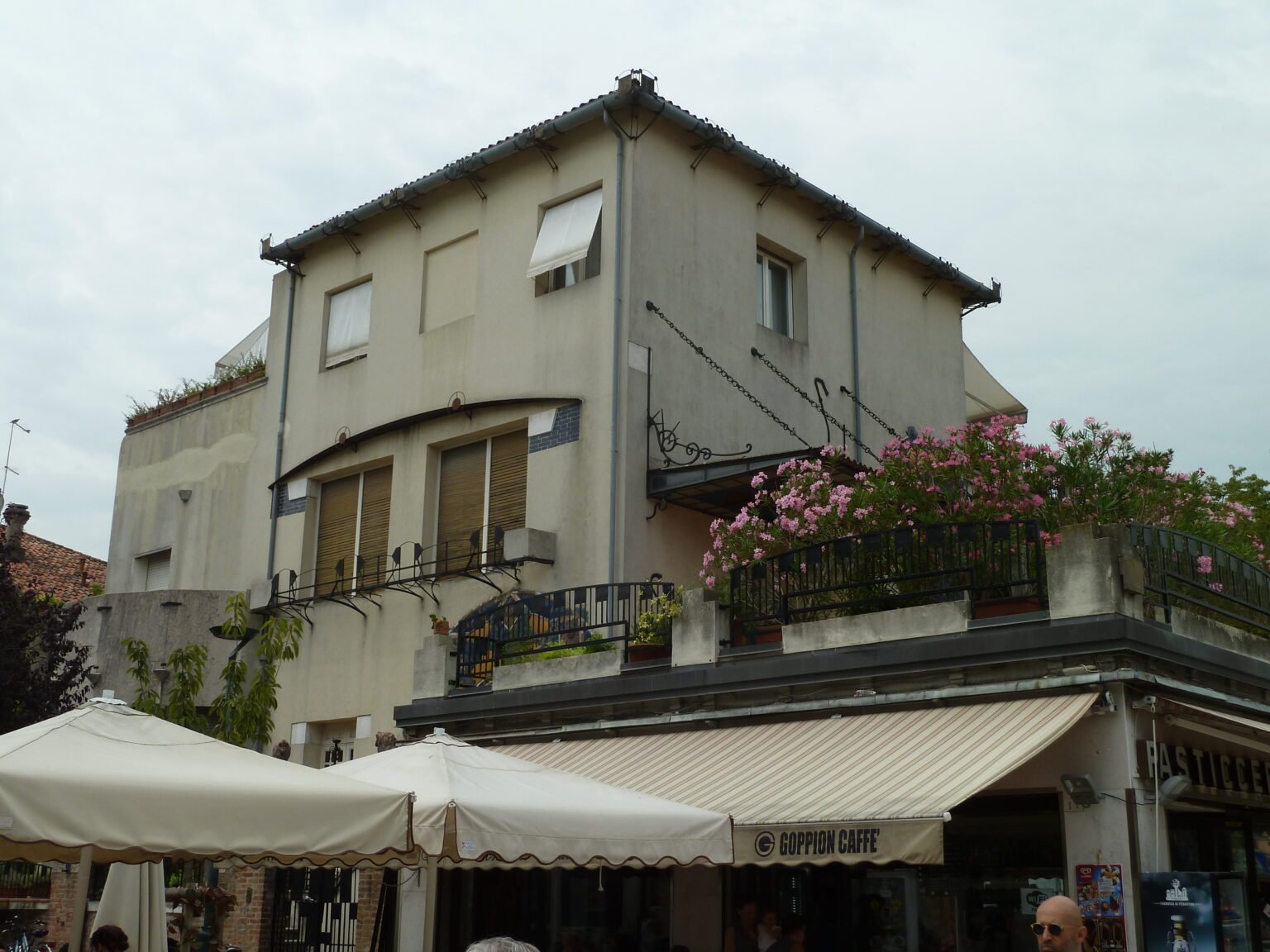
Where the Gran Viale meets via Lepanto, Guido Sullam built a small villa that treats colour as structure. It was one of the first Liberty statements on the Lido.
At a glance
The Villino Mon Plaisir stands on a street corner near the head of the Gran Viale, the avenue that carries visitors from the lagoon landing toward the sea. The Venetian engineer-architect Guido Costante Sullam designed it in 1904 for Gaetano Donà and Antonietta Albertoni, as a multi-family villa. Its loose, asymmetric body is wrapped in sgraffito decoration, glazed maiolica panels and wrought iron. The building is one of Sullam’s earliest independent works, and the Italian State protects it as a place of historic and artistic interest.
Key facts
- Architect: Guido Costante Sullam (1873–1949)
- Built: 1904
- Original clients: Gaetano Donà and Antonietta Albertoni
- Style: Liberty (Italian Art Nouveau), with Viennese Secession influence
- Materials: sgraffito plaster, glazed maiolica panels, wrought iron
- Protection: declared of historic-artistic interest under Italian law (D.Lgs. 42/2004)
- Location: corner of Gran Viale Santa Maria Elisabetta 14 and via Lepanto 1
History
Guido Costante Sullam was born in Venice on 5 July 1873. He took a degree in civil engineering at Padua in 1895, then enrolled at the Accademia di Belle Arti in Venice, where he qualified as a teacher of architectural drawing in 1902. For more than a year he worked as deputy director on the consolidation of the Basilica of San Marco. In 1904 he opened his own practice, and the Villino Mon Plaisir belongs to that first independent season.
These were the years when the Lido was being invented. At the end of the nineteenth century the long sandbar between the lagoon and the Adriatic was still mostly dune and kitchen garden; within two decades it became one of Europe’s most fashionable bathing resorts, lined with villas, pensions and grand hotels. Architects such as Sullam, Domenico Rupolo and Giovanni Sardi gave the new district its character, a free and decorative architecture that answered the holiday mood of the place.
A trip to Darmstadt in 1910, and the encounter with the Austrian architect Joseph Maria Olbrich, would later sharpen Sullam’s Secessionist language. Mon Plaisir comes before that journey, yet it already shows his lasting concern: that craft and ornament should be the foundation of a modern Italian architecture. He went on to design the railway station at Asiago and, on the Lido, the nearby Villino Thea of 1905.
What you see
The villa refuses symmetry. Its volume breaks and steps, and the form is built around the play of colour in its materials rather than around a single ordered front. Bands of sgraffito, panels of green and blue maiolica and scatters of painted flowers run across the rendered walls, so that the line of the building seems to dissolve into its garden.
The wrought iron extends that idea upward: thin, curving stems rise from the roof of the loggia toward the sky, and female faces shape some of the capitals into quiet, watchful presences. The critic Manfredo Nicoletti read the result as a provincial but personal reworking of Viennese models, mixing references from Josef Hoffmann to Sebastiano Serlio to Raimondo D’Aronco.
Practical information
- Access: private residence — it can be admired only from the street, not visited inside.
- Best seen: in raking morning or late-afternoon light, when the maiolica and sgraffito read most clearly.
- Time needed: a few minutes on foot; pair it with a wider Lido Liberty walk.
- Setting: a busy corner near the top of the Gran Viale, a short walk from the vaporetto.
Getting there
From central Venice, take a vaporetto to the Lido Santa Maria Elisabetta landing, then walk up the Gran Viale; the villa stands on the corner with via Lepanto, a few minutes on foot. From Marco Polo Airport the simplest route is the Alilaguna water bus to the Lido, or a land transfer to Tronchetto and a vaporetto across the lagoon.
Nearby
- Villino Thea — Sullam’s 1905 villa, steps away on via Lepanto.
- Villa Romanelli — Domenico Rupolo’s Liberty villa nearby.
- Hotel Excelsior — the 1908 beach palace on the seafront.
- Liberty and Rationalist Architecture in Venice Lido — a walking route through the island.
Sources
- Comune di Venezia, L’architettura del Lido — synthetic record and building description for Villino Mon Plaisir.
- M. Nicoletti, L’architettura liberty in Italia, 1978.
- F. Peron, study of Guido Sullam’s Lido villas, 2005.
- Hero photograph: Wikimedia Commons (author Abxbay), CC BY-SA 4.0.
Find it on the map
See this place and what’s around it →📷 Become a Cultural Heritage Online photographer
Share your photos of places: they stay published under your name as the author. The more they're seen, the more you get noticed — and soon a contest will reward the most appreciated photos.
Log in or sign up free to add a photoIs this page about you?
This page is read by travellers and heritage enthusiasts who find it on Google. Tell us how you are connected to this place and we will take it from there.