
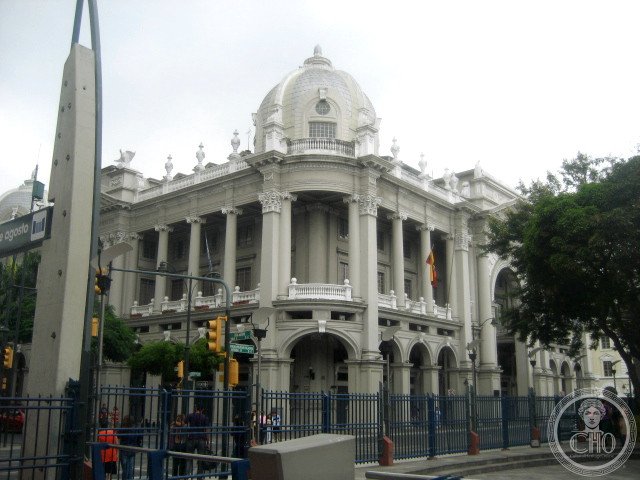
Rising above Simon Bolivar Park at the heart of Ecuador largest city, Guayaquil Municipal Palace is the civic anchor of a port metropolis shaped by fire, revolution, and an unlikely 1822 diplomatic encounter that changed the fate of South America. Its neoclassical facade with Ionic columns and a central clock tower has faced the city main public square since 1928, replacing a succession of earlier structures destroyed by the conflagrations that repeatedly swept through Guayaquil historic wooden centre. Today the Municipio still functions as the administrative seat of Ecuador most populous city while drawing visitors to the Malecon 2000 waterfront promenade that runs alongside it. The building anchors a compact civic ensemble that includes the Metropolitan Cathedral and the historic Seminario Park with its famous colony of land iguanas. Few South American city halls can claim a setting of equal symbolic weight: this plaza is where independence was declared, where liberators met, and where modern Guayaquil measures its civic ambitions against a neoclassical ideal of permanence and order.
At a glance
- Type
- City Hall / Civic Palace
- Period
- Completed 1928
- Style
- Neoclassical
- Location
- Simon Bolivar Park, Guayaquil, Ecuador
- Coordinates
- 2.1971 S, 79.8847 W
- Architect(s)
- Francisco Olmedo Icaza
Overview
The Municipal Palace of Guayaquil occupies the western side of Simon Bolivar Park, the historic centre of a city founded on the banks of the Guayas River estuary in 1547. Guayaquil is Ecuador largest and most commercially active city, home to the main port through which Ecuadorian bananas, cacao, and shrimp reach world markets. The neoclassical building completed in 1928 replaced earlier municipal structures repeatedly lost to fire in a city that was built largely of wood and suffered catastrophic blazes in 1896 and earlier. The Ionic columned facade, central clock tower, and formal symmetry of the current building represent the civic confidence of early twentieth-century Ecuador, a nation stabilising after decades of Liberal-Conservative conflict following independence from Spain in 1822. The Municipio anchors the Malecon 2000 district, a two-kilometre waterfront redevelopment project completed in 2000 that transformed a derelict dockside area into the main public promenade of the city.
History
Guayaquil civic buildings have occupied this corner of Simon Bolivar Park through several architectural iterations, each swept away or damaged by the fires that were a constant threat in a tropical port city of timber construction. The catastrophic fire of October 1896 destroyed much of central Guayaquil and made reconstruction of the city centre in more durable materials an urgent priority. The current Municipal Palace was designed by local architect Francisco Olmedo Icaza and completed in 1928 during a period of relative economic prosperity driven by cacao exports. The building design reflects the Greco-Roman neoclassicism fashionable for public architecture across Latin America in the early twentieth century, projecting authority and institutional continuity in a city that had known remarkable political turbulence. The plaza in front has witnessed declarations, protests, and celebrations across nearly two centuries of independent Ecuadorian life, including events marking the centennial of the famous 1822 Guayaquil Conference.
Architecture and Design
The Municipal Palace presents a symmetrical neoclassical facade organized around a projecting central bay with a clock tower that serves as the visual anchor of Simon Bolivar Park. The main colonnade of Ionic columns spans the ground floor, providing a formal loggia that mediates between the interior civic spaces and the public square. Above the colonnade the upper floors are articulated with pilasters, cornices, and decorative stonework typical of the Beaux-Arts influenced neoclassicism that circulated throughout Latin America via European pattern books and the influence of architects trained in Paris or Madrid. The central clock tower rises above the roofline with a simple cupola, giving the building vertical presence when viewed across the park. Interior spaces include ceremonial halls used for official receptions and council sessions, decorated with murals depicting scenes from Guayaquil history and Ecuadorian independence. The building was constructed in reinforced concrete and stone rather than the wood that had doomed its predecessors.
Cultural significance
The Guayaquil Municipio is inseparable from one of the great unsolved mysteries of South American history: the Guayaquil Conference of July 1822. At a meeting in this city between the two liberators of South America, Simon Bolivar and Jose de San Martin, San Martin unexpectedly withdrew from the independence struggle, ceding leadership to Bolivar. What was said in that meeting remained secret, and historians have debated its content for two centuries. A monument commemorating the encounter stands near the Municipio, making the civic plaza a point of reflection on the continent-shaping decisions made here. Beyond this singular historical weight, the building represents the aspirations of a port city that has long defined itself through commerce, immigration, and resilience. Guayaquil civic culture, distinct from that of highland Quito, finds symbolic expression in the Municipio as an assertion of coastal Ecuadorian identity.
Visiting today
The Municipal Palace exterior and Simon Bolivar Park are freely accessible at all hours. Guided tours of the interior civic spaces, including the ceremonial halls and historical murals, can be arranged through the municipal administration and are typically offered on weekday mornings. The building sits at the centre of Guayaquil historic district, within easy walking distance of the Malecon 2000 waterfront promenade, the Metropolitan Cathedral, the Las Penas neighbourhood and its colonial-era houses on Cerro Santa Ana, and the Seminario Park where wild iguanas roam freely among visitors. The historic centre is best explored on foot in the cooler morning hours; Guayaquil is a tropical port city and midday temperatures are significant year-round.
Getting there
Guayaquil is served by Jose Joaquin de Olmedo International Airport, one of the busiest in Ecuador, with direct flights from Miami, Bogota, Lima, and other South American hubs. From the airport the city centre is approximately 15 minutes by taxi or ride-share service. Simon Bolivar Park and the Municipal Palace are located at the intersection of Calle 10 de Agosto and the Malecon waterfront avenue in the historic centre. The Malecon 2000 promenade extends along the riverfront and is accessible from multiple points in the centre. City buses serve the historic district from all parts of Guayaquil.
Sources and resources
Find it on the map
See this place and what’s around it →📷 Become a Cultural Heritage Online photographer
Share your photos of places: they stay published under your name as the author. The more they're seen, the more you get noticed — and soon a contest will reward the most appreciated photos.
Log in or sign up free to add a photoDo you manage this place?
This page is read by travellers and heritage enthusiasts who find it on Google. Keep it accurate — and make it work for you. Free for non-profit heritage institutions.