
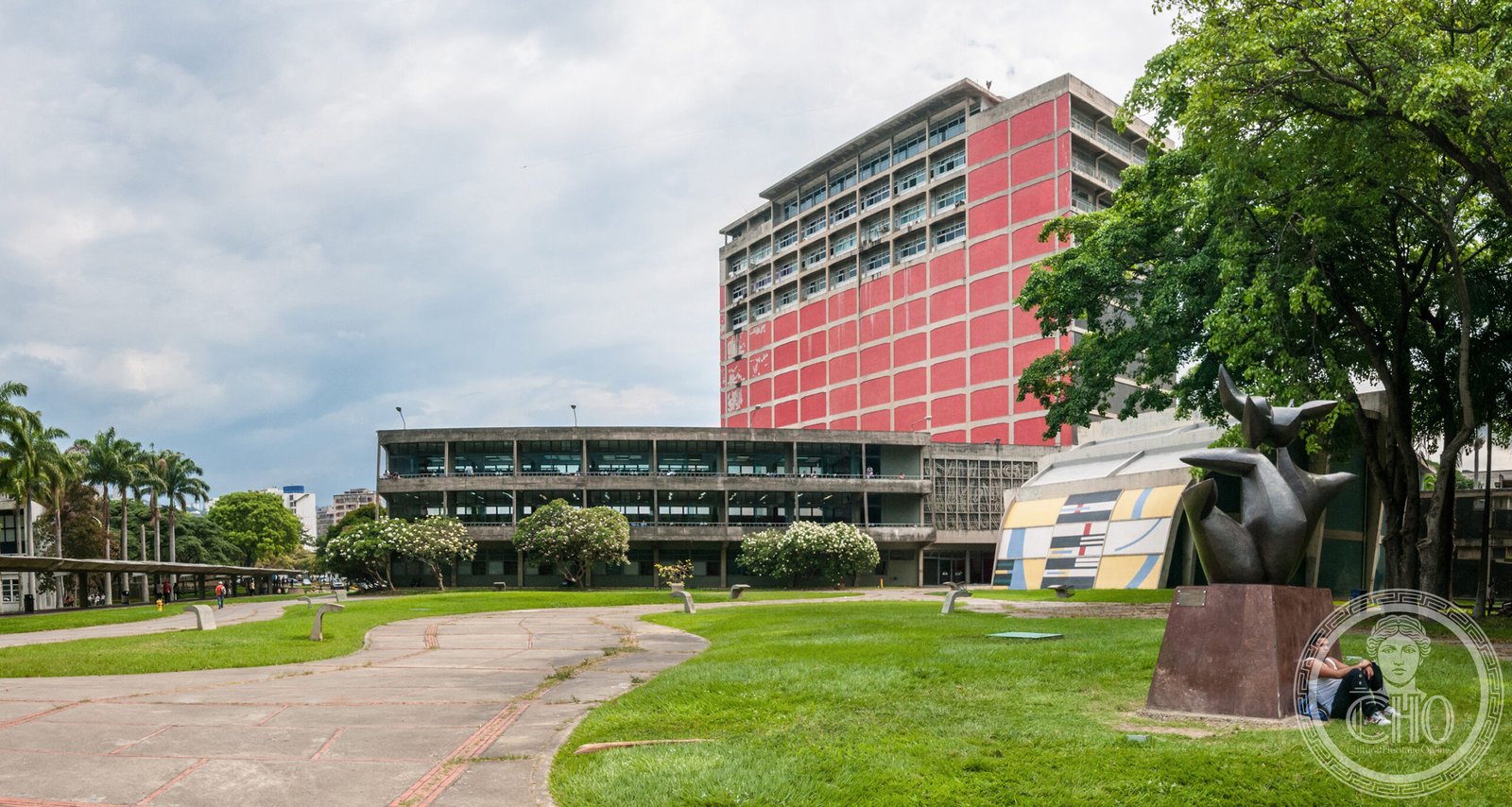
The Ciudad Universitaria de Caracas — the campus of the Central University of Venezuela — is one of the supreme achievements of 20th-century architecture and a UNESCO World Heritage Site. Designed almost entirely by architect Carlos Raúl Villanueva over two decades (1940–1960), the campus was conceived as a Gesamtkunstwerk: a total synthesis of architecture, engineering, landscape, and the plastic arts. Villanueva invited Alexander Calder, Fernand Léger, Jean Arp, Victor Vasarely, and more than forty other leading international artists to create integrated murals, sculptures, stained glass, and mobiles throughout the buildings. The result is not a campus decorated with art, but a campus in which architecture and art are inseparable — a singular achievement in the history of modern design. Inscribed by UNESCO in 2000, it remains a functioning public university attended by over 50,000 students daily.
At a glance
- Type
- University campus
- Period
- 1940–1960
- Style
- Latin American Modernism / International Style
- Location
- Caracas, Venezuela
- Coordinates
- 10.4892° N, 66.8902° W
- Architect(s)
- Carlos Raúl Villanueva
Overview
The Ciudad Universitaria de Caracas represents the most ambitious realization of Villanueva’s vision of architecture as a social and artistic force. Spanning two square kilometres on the western outskirts of Caracas, the campus integrates administrative blocks, faculties, the iconic Aula Magna concert hall, Olympic stadiums, and open plazas into a continuous spatial sequence. Open pedestrian corridors — the covered walkways known as paseos cubiertos — flow between buildings, creating shelter from the tropical sun while framing views of artwork at every turn. The campus was built during Venezuela’s oil boom, and Villanueva had both the resources and the political support to realize his comprehensive vision without compromise.
History
Venezuela’s first university, established in 1721, occupied the colonial centre of Caracas for two centuries. In 1940, the government of President Isaías Medina Angarita commissioned Carlos Raúl Villanueva to design an entirely new campus. Villanueva, educated in Paris and deeply influenced by Le Corbusier and the International Style, produced a master plan that he would refine and build over the next two decades. Construction proceeded in phases through successive governments — a testament to Villanueva’s political skill as much as his architectural genius. The campus was substantially complete by 1960. In 2000, UNESCO inscribed the Ciudad Universitaria as a World Heritage Site, recognising it as an outstanding example of the synthesis of the arts in the modern movement.
Architecture & Design
Villanueva’s design language is unmistakably modernist: flat roofs, pilotis, ribbon windows, and free-flowing plans drawn from the Corbusian vocabulary. But the campus transcends its stylistic sources through the depth of its integration with art. The Aula Magna auditorium — designed with acoustical engineering by Robert Newman — features Alexander Calder’s celebrated ceiling of 85 floating acoustic clouds, painted in primary colours, which serve simultaneously as sound diffusers and kinetic sculpture. Léger contributed ceramic murals; Arp and Vasarely created mosaics and reliefs embedded in walls and floors. The Olympic Stadium (1951) and the Cubierta Olímpica (1954) demonstrate Villanueva’s mastery of structure, with the latter’s concrete shell roof among the engineering landmarks of the era.
Cultural significance
The Ciudad Universitaria is the defining monument of Venezuelan modernism and one of the few places on earth where a utopian vision of art integrated into everyday life was actually built. It stands as evidence that architecture can be genuinely democratic — the Calders and Légers are not in a museum accessible to ticket-holders but in a public university walked by tens of thousands of students each day. UNESCO recognised it as an outstanding universal value precisely because it achieved, at full scale, what most modernist programmes only theorised: the complete fusion of the visual arts, architecture, and civic life.
Visiting today
The campus is open to the public and entry is free. Visitors may walk the paseos cubiertos and view exterior artworks at any time. The Aula Magna hosts public concerts and cultural events; check the UCV cultural office for schedules. Some faculty buildings have restricted access. A guided tour of the main artistic works can be arranged through the university’s cultural department. Note that Caracas requires standard urban security precautions; visit during daylight hours and keep valuables secured.
Getting there
The campus is located in the Ciudad Universitaria district of western Caracas, accessible via the Caracas Metro (Line 3, Ciudad Universitaria station). From central Caracas, taxis and ride-hailing apps (InDriver, Yummy) are the safest option. The main campus entrance on Avenida Principal de Los Chaguaramos is the primary pedestrian access point for visitors arriving from the metro.
Sources & resources
Find it on the map
See this place and what’s around it →📷 Become a Cultural Heritage Online photographer
Share your photos of places: they stay published under your name as the author. The more they're seen, the more you get noticed — and soon a contest will reward the most appreciated photos.
Log in or sign up free to add a photoIs this page about you?
This page is read by travellers and heritage enthusiasts who find it on Google. Tell us how you are connected to this place and we will take it from there.