
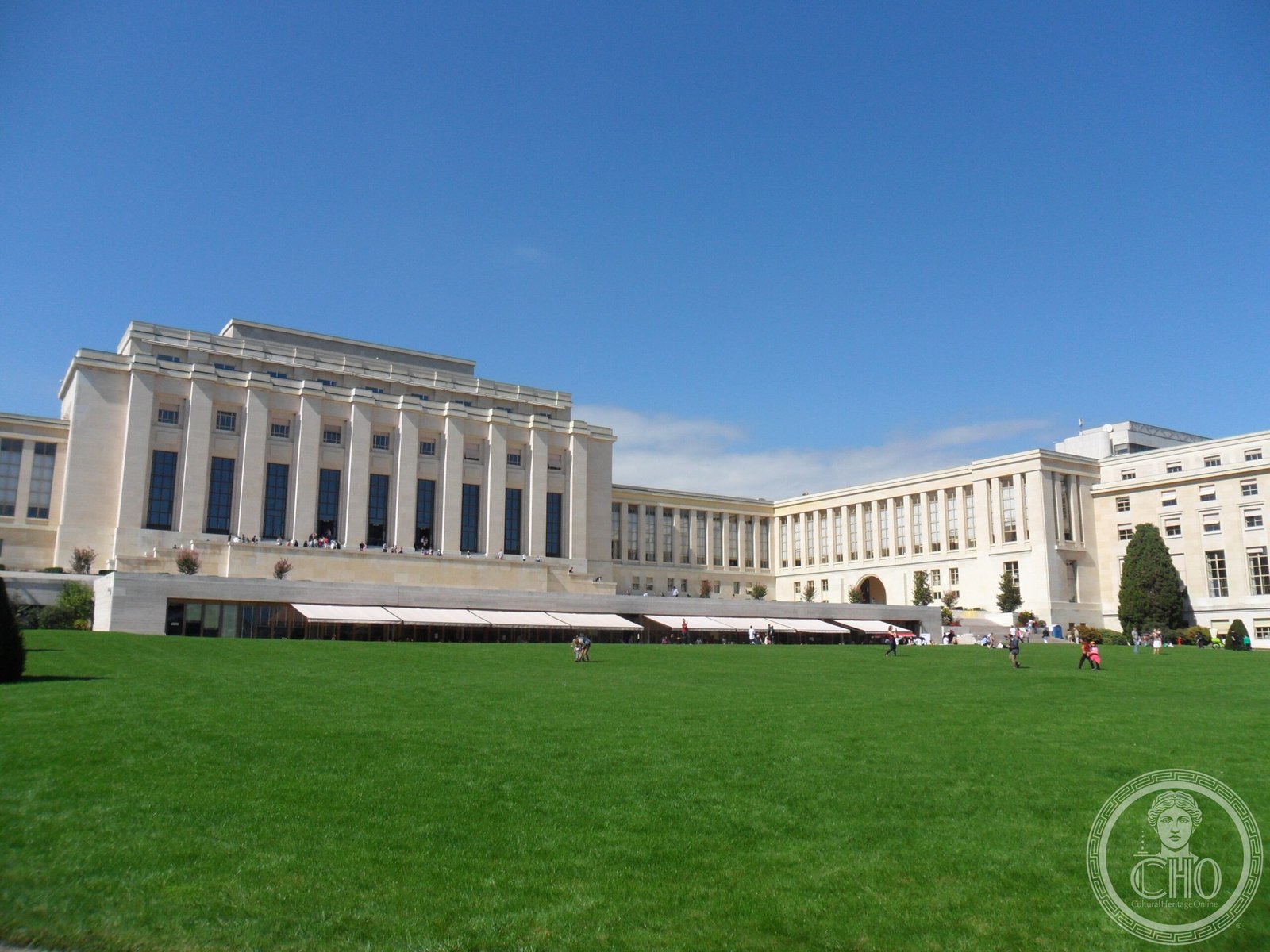
The Palais des Nations in Geneva is the most ambitious internationalist building project of the twentieth century and the permanent home of the League of Nations — the first intergovernmental organisation charged with maintaining world peace. Construction began in 1929 following a fiercely contested international competition that attracted 377 entries from architects across the globe; the winning consortium of five architects from four countries produced a monumental Beaux-Arts complex with Art Deco simplifications, set in a 46-hectare park on the shores of Lake Geneva overlooking Mont Blanc. The Assembly Hall, the Council Chamber — now the Human Rights Council chamber, its ceiling painted by José Maria Sert with allegorical scenes of the Labours of Humanity — and the library formed the ceremonial core of an institution that embodied the world’s post-1918 longing for lasting peace. When the League collapsed in 1939 and the United Nations was established in 1945, the building was transferred to the new organisation and became the United Nations Office at Geneva (UNOG), the second-largest UN hub after New York. Every major Cold War arms control and disarmament negotiation — from the SALT talks to the Chemical Weapons Convention — took place in these chambers.
At a glance
- Type
- International organisation headquarters
- Period
- 1929–1938
- Style
- Beaux-Arts / Art Deco
- Location
- Ariana Park, Geneva, Switzerland
- Coordinates
- 46.2280° N, 6.1436° E
- Architect(s)
- Julien Flegenheimer, Henri-Paul Nénot, Carlo Broggi, Camille Lefèvre, Joseph Vago
Overview
Set in the Ariana Park on the left bank of Lake Geneva, the Palais des Nations is a 46-hectare campus of interconnected palace buildings, gardens, and conference facilities. The complex holds approximately 8,000 meetings per year attended by 180,000 delegates, making it the world’s busiest international conference centre. The original 1929–1938 buildings — the Assembly Hall wing, the library, and the Secretariat — are listed Swiss heritage structures. The campus has been progressively expanded; a major renovation and new conference building was completed in 2023.
History
The League of Nations was established by the Treaty of Versailles in 1919 and initially operated from the Palais Wilson on the Geneva lakefront. In 1926 it launched an international architectural competition to design a permanent home; 377 entries were received — one of the largest architectural competitions ever held. The jury’s process was controversial: Swiss architect Hannes Meyer and others were disqualified on procedural grounds despite their strong designs. Construction began in 1929 on donated Ariana Park land and was completed in 1938. The League held its last Assembly in April 1946, formally transferring assets to the UN. The building became UNOG in 1946 and has hosted the SALT I and SALT II negotiations, the Chemical Weapons Convention (1992), the Oslo Process, and Syrian peace talks.
Architecture & Design
The main facade is a Beaux-Arts composition of monumental scale: colonnade-fronted wings, rusticated stone bases, and a central portico framing Lake Geneva views. Inside, Art Deco refinements dominate — geometric coffered ceilings, travertine floors, bronze fittings, and inlaid wood panelling in national donation rooms. The Council Chamber, designed by José Maria Sert, is the spiritual heart of the building: its ceiling murals depict heroic allegorical figures representing the Labours of Humanity, painted in Sert’s signature monochromatic grisaille. The Assembly Hall seats 2,000 and retains its original 1930s acoustic design. The Salle des Pas Perdus (Hall of Lost Steps) is a processional gallery rivalling the finest Beaux-Arts interiors in Europe.
Cultural significance
The Palais des Nations represents the physical embodiment of the 20th century’s most idealistic political project — collective security through international law. Its failure to prevent World War II did not diminish its symbolic power; the building was preserved precisely because the world wished to inherit its ideals. As UNOG it has hosted negotiations that shaped the modern world: arms control, refugee law, human rights conventions, and trade agreements. The Human Rights Council chamber — still the original League Council room — meets here weekly, connecting present debates directly to the architecture of the 1930s.
Visiting today
UNOG offers guided tours of the Palais des Nations daily except Sundays, subject to availability and security clearance (free, registration required online at unog.ch). Tours cover the Assembly Hall, the Council Chamber with Sert murals, the national donation rooms, and the Ariana Park gardens. A valid passport or national ID is required for entry. The Ariana Park is freely accessible and provides extraordinary views of Lake Geneva and the Alps.
Getting there
The Palais des Nations is 3 km north of Geneva’s city centre in the Pregny-Chambésy area. By tram: TPG Tram 15 (Nations stop) runs from Cornavin railway station in approximately 12 minutes. By bus: lines 8, 28, and F connect the central station to the Nations area. Geneva’s Cornavin station is served by TGV from Paris (3h10), ICE from Zurich (2h48), and regional trains from Lyon and Lausanne.
Sources & resources
Find it on the map
See this place and what’s around it →📷 Become a Cultural Heritage Online photographer
Share your photos of places: they stay published under your name as the author. The more they're seen, the more you get noticed — and soon a contest will reward the most appreciated photos.
Log in or sign up free to add a photoIs this page about you?
This page is read by travellers and heritage enthusiasts who find it on Google. Tell us how you are connected to this place and we will take it from there.