
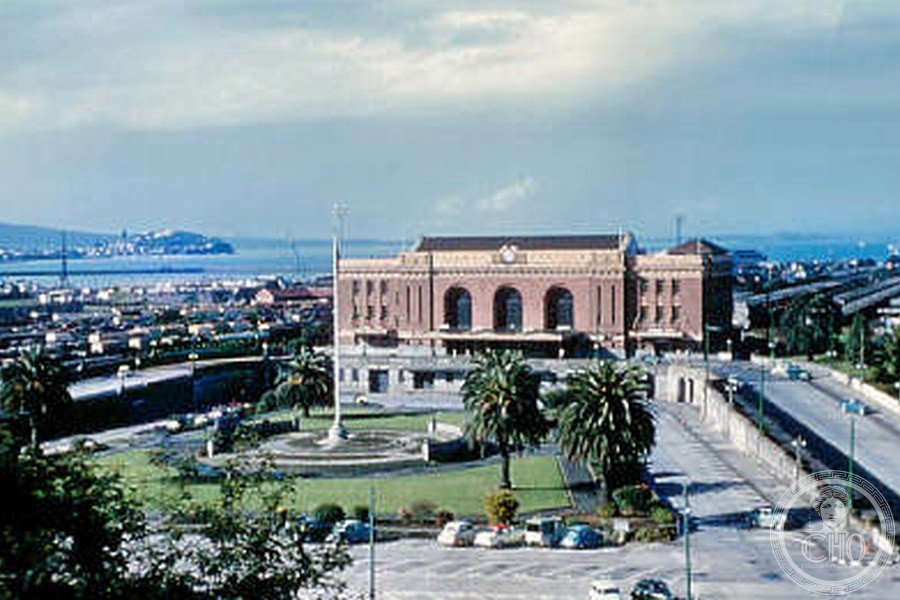
Auckland Railway Station, situated at 132–148 Beach Road in the Auckland CBD, is one of New Zealand’s most distinguished examples of monumental public architecture from the early twentieth century. Designed by architect William Henry Gummer, a student of Sir Edwin Lutyens, the station was built between 1928 and 1930 and formally opened on 16 November 1930. Constructed in a grand Beaux-Arts manner with reinforced concrete faced in brick and Coromandel granite, the building features sweeping entrance ramps, an imported ornate metal ceiling manufactured in Germany, marble lobbies, bronze detailing, and over 80,000 decorative tiles. Designated a Heritage New Zealand Category 1 historic place in 1985, the station ceased operation as Auckland’s main rail terminus in 2003 but survives today as an important architectural monument, its principal block now converted to residential use.
At a glance
- Type
- Railway terminus (historic); residential building (current)
- Period
- 1928–1930 (opened 16 November 1930)
- Style
- Beaux-Arts
- Location
- 132–148 Beach Road, Auckland CBD, Auckland 1010, New Zealand
- Coordinates
- 36.8481° S, 174.7767° E
- Architect(s)
- William Henry Gummer (1884–1966)
Overview
Auckland Railway Station was designed to serve as the principal gateway to New Zealand’s largest city by rail, and Gummer’s brief was to create a building commensurate with Auckland’s civic ambitions. The three-storey symmetrical structure presents a formal, ordered facade of reinforced concrete clad in brick and Coromandel granite. The building’s interior spaces were fitted to a quality exceptional for a public building of that era in New Zealand: an ornate metal ceiling of German manufacture, marble-lined lobbies, bronze fixtures, terrazzo floors, and more than 80,000 decorative tiles including coats of arms representing cities from across the country. Heritage New Zealand recognised it as a Category 1 historic place as early as 1985, acknowledging its outstanding national significance.
History
The station replaced an earlier terminal on the Queen Street site that had become inadequate for the volume of rail traffic serving Auckland. Work began in 1928 and the new terminus opened on 16 November 1930, hailed as one of the most self-consciously monumental public buildings in early twentieth-century New Zealand. The building served as Auckland’s main rail terminus for over seven decades. During the 1990s it was privatised. In July 2003 the terminus function transferred to the newly opened Britomart Station, and Auckland Railway Station ceased regular passenger operations. Two former platforms were subsequently reopened in 2011 as The Strand Station for suburban services, while the remaining platforms became stabling facilities for electric trains. The main building was converted to Grand Central Apartments.
Architecture & Design
William Henry Gummer, trained under Sir Edwin Lutyens in London, brought Beaux-Arts principles of symmetry, grandeur, and material richness to the Auckland commission. The three-storey facade is strictly symmetrical, faced in brick with Coromandel granite dressings. Sweeping curved entrance ramps at either side of the main block enclose a landscaped garden forecourt, creating a ceremonial approach. Inside, the booking hall and principal lobbies are lined in imported marble. The celebrated ceiling of the main concourse was manufactured in Germany and shipped to New Zealand. Over 80,000 decorative tiles adorn various interior surfaces, among them coats of arms of New Zealand cities. Bronze and terrazzo detailing complete an interior that remains one of the most opulent railway spaces in the southern Pacific.
Cultural significance
Auckland Railway Station holds Category 1 historic place status with Heritage New Zealand, the highest level of recognition afforded to any historic building or site in the country, designating it a place of special or outstanding historical or cultural significance. The building represents the ambition of early twentieth-century Auckland to project civic confidence through public architecture, and Gummer’s design is regarded as one of the finest Beaux-Arts public interiors in New Zealand. The station also carries popular cultural associations: it served as a location for the 1984 film “Merry Christmas, Mr. Lawrence.” Its continued physical survival, despite the loss of its original rail function, is a testament to sustained heritage advocacy in Auckland.
Visiting today
The main station building now operates as Grand Central Apartments and is not open to general public access. The Strand Station, which occupies two rebuilt platforms of the former terminus, remains active as a suburban rail stop and can be accessed via normal ticketing during service hours, offering a glimpse of the station’s context. The exterior of the main building, including the sweeping entrance ramps and facade, can be viewed from Beach Road. Heritage enthusiasts wishing to study the interior in detail should contact Auckland Council or Heritage New Zealand for information on any organised access or heritage tour programmes.
Getting there
Auckland Railway Station is located on Beach Road in the Auckland CBD, a short walk from the Britomart precinct and ferry terminal. The Strand Station on the Eastern Line (operating two rebuilt platforms of the original terminus) provides direct rail access. From central Auckland, Britomart Station is approximately eight minutes on foot along Beach Road. Multiple bus routes serve the surrounding streets. The station’s Beach Road address places it within easy reach of the waterfront, the SkyCity precinct, and the main retail areas of the Auckland CBD.
Sources & resources
Find it on the map
See this place and what’s around it →Record researched and written by Luigi De Marchi for Cultural Heritage Online, 2026.
📷 Become a Cultural Heritage Online photographer
Share your photos of places: they stay published under your name as the author. The more they're seen, the more you get noticed — and soon a contest will reward the most appreciated photos.
Log in or sign up free to add a photoIs this page about you?
This page is read by travellers and heritage enthusiasts who find it on Google. Tell us how you are connected to this place and we will take it from there.