
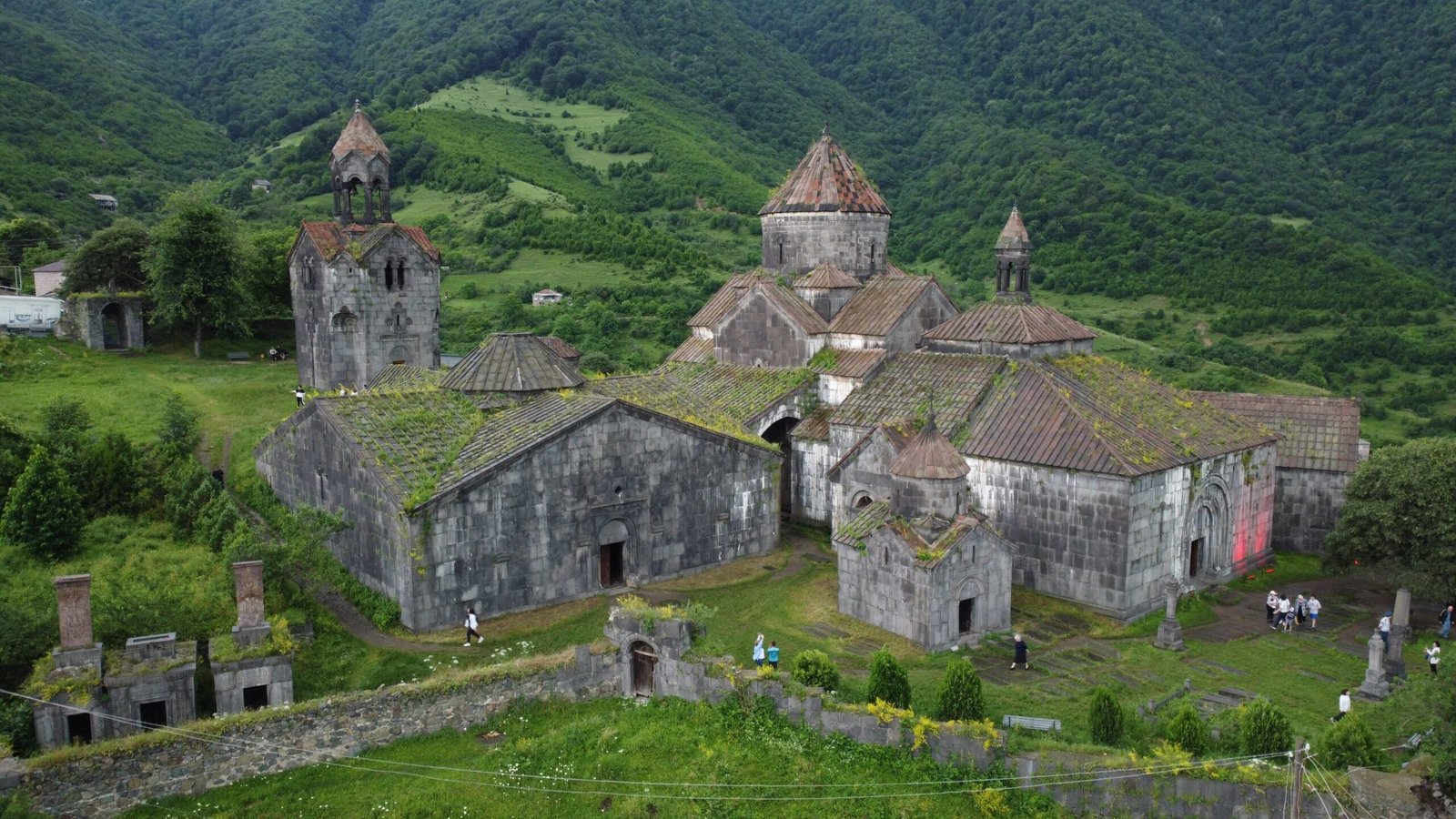
Two medieval Armenian monastery complexes perched above the Debed River gorge, representing the pinnacle of the Bagratid dynasty’s architectural genius — and among the finest expressions of Armenian Christian culture ever built.
At a glance
Separated by just 5 kilometres in the forested hills of northern Armenia, Haghpat and Sanahin monasteries were the twin intellectual and spiritual centres of the medieval Armenian Bagratid kingdom. Founded in the 10th century, they flourished for three hundred years as centres of manuscript production, theological learning, and architectural innovation. Their stone-carved churches, khachkars (Armenian cross-stones), and gavits (assembly halls) define a distinctly Armenian architectural language that influenced builders across the Caucasus. UNESCO recognised both in 1996, with the inscription extended in 2000.
Key facts
- UNESCO inscription: 1996 (Haghpat); extended to include Sanahin 2000 — World Heritage Site
- Period: 928–13th century CE (Armenian Bagratid dynasty)
- Location: Lori Province, northern Armenia, above the Debed River gorge
- Distance between monasteries: approximately 5 km
- Status: Both monasteries are still functioning religious communities
- Key patron: Queen Tamar of Georgia (12th–13th century) supported both complexes
- Name meanings: Sanahin = this one is older than that one (Armenian); Haghpat = strong wall
History
The Bagratid dynasty of medieval Armenia reached its height in the 10th–11th centuries, ruling a kingdom that stretched across much of modern Armenia and eastern Turkey. Sanahin was founded first — its Church of the Holy Mother of God dates to 928 CE — though the larger Cathedral of the Redeemer was completed in 966 CE. The name Sanahin, meaning this one is older than that one, is said to reflect a competitive rivalry with nearby Haghpat, founded by Queen Khosrovanuysh (wife of King Ashot III) around 976 CE.
Haghpat’s Cathedral of St. Nshan, completed in 991 CE, became the defining monument of Armenian medieval architecture — its triangular facade, interior proportions, and stone carving technique were copied across the Caucasus for centuries. The Armenians call it the mother of all medieval Armenian churches.
Both complexes thrived under Georgian royal patronage in the 12th–13th centuries. Queen Tamar of Georgia, who ruled much of the Caucasus and was the most powerful ruler of her era, endowed both monasteries with land and commissions. Sanahin’s famous academy (gavit) trained generations of Armenian clergy and scholars; its library held manuscripts now preserved in the Matenadaran in Yerevan.
The Mongol invasions of the 13th century ended the golden age but did not destroy the monasteries. Both survived as functioning communities through centuries of Persian and Ottoman overlordship, and today remain active Armenian Apostolic monasteries.
What you see
At Sanahin, the Cathedral of the Redeemer (966 CE) is the centrepiece — a massive stone structure with a cylindrical drum and conical dome that became the template for Armenian church architecture. Alongside it stand the earlier Church of the Holy Mother of God (928 CE), a gavit (narthex-assembly hall) where monks gathered for teaching, a bell tower, and a scriptorium. The complex is scattered with khachkars — Armenian cross-stones carved in intricate geometric lace-work that is unique to Armenian Christian art and found nowhere else in the world.
At Haghpat, the Cathedral of St. Nshan (991 CE) dominates. Its triangular facade is unlike any other medieval church: the stonework is carved with interlaced patterns, the interior achieves a luminous verticality through carefully proportioned windows, and the apse contains fragments of original medieval frescoes. The gavit attached to the cathedral (13th century) is among the finest examples of the type, with a ceiling supported by four freestanding columns and elaborate stone carving in the pendentives.
Throughout both complexes, khachkars of varying ages line pathways and lean against walls — some dating to the 10th century, others carved as recently as the 20th. The finest examples display a lace-like intricacy that took master carvers years to complete on a single stone.
Practical information
- Access: Both monasteries are freely accessible during daylight hours
- Dress code: Modest dress required — shoulders and knees covered; head coverings for women in the churches
- Photography: Permitted in the monastery grounds; interior photography may be restricted in active churches
- Admission: Free (donations welcome)
- Best time to visit: May–October; winters in Lori Province can be severe with heavy snow
- Facilities: Basic facilities at Haghpat; minimal at Sanahin
Getting there
Both monasteries are located near the town of Alaverdi in Lori Province, approximately 175 km north of Yerevan. From Yerevan, marshrutka minibuses run to Alaverdi (3–3.5 hours). Sanahin is 2 km above Alaverdi town; Haghpat is 5 km to the east — a taxi or hired car connects the two in 15 minutes. The scenic Debed Canyon road (M6) from Tbilisi passes through this region, making both monasteries natural stops on a Yerevan–Tbilisi itinerary. No direct public transport connects the two monasteries.
Nearby
- Alaverdi — Soviet-era copper-smelting town in the canyon below, with a dramatic cable car connecting the town to Sanahin plateau
- Akhtala Monastery (13th century) — Georgian Orthodox monastery 20 km west with stunning Byzantine frescoes, unusually well-preserved
- Debed River Canyon — one of Armenia’s most scenic gorges, lined with medieval monasteries and churches over 100 km
- Tbilisi, Georgia — 120 km north, making this region natural on a Yerevan–Tbilisi overland route
Sources
Find it on the map
See this place and what’s around it →📷 Become a Cultural Heritage Online photographer
Share your photos of places: they stay published under your name as the author. The more they're seen, the more you get noticed — and soon a contest will reward the most appreciated photos.
Log in or sign up free to add a photo