
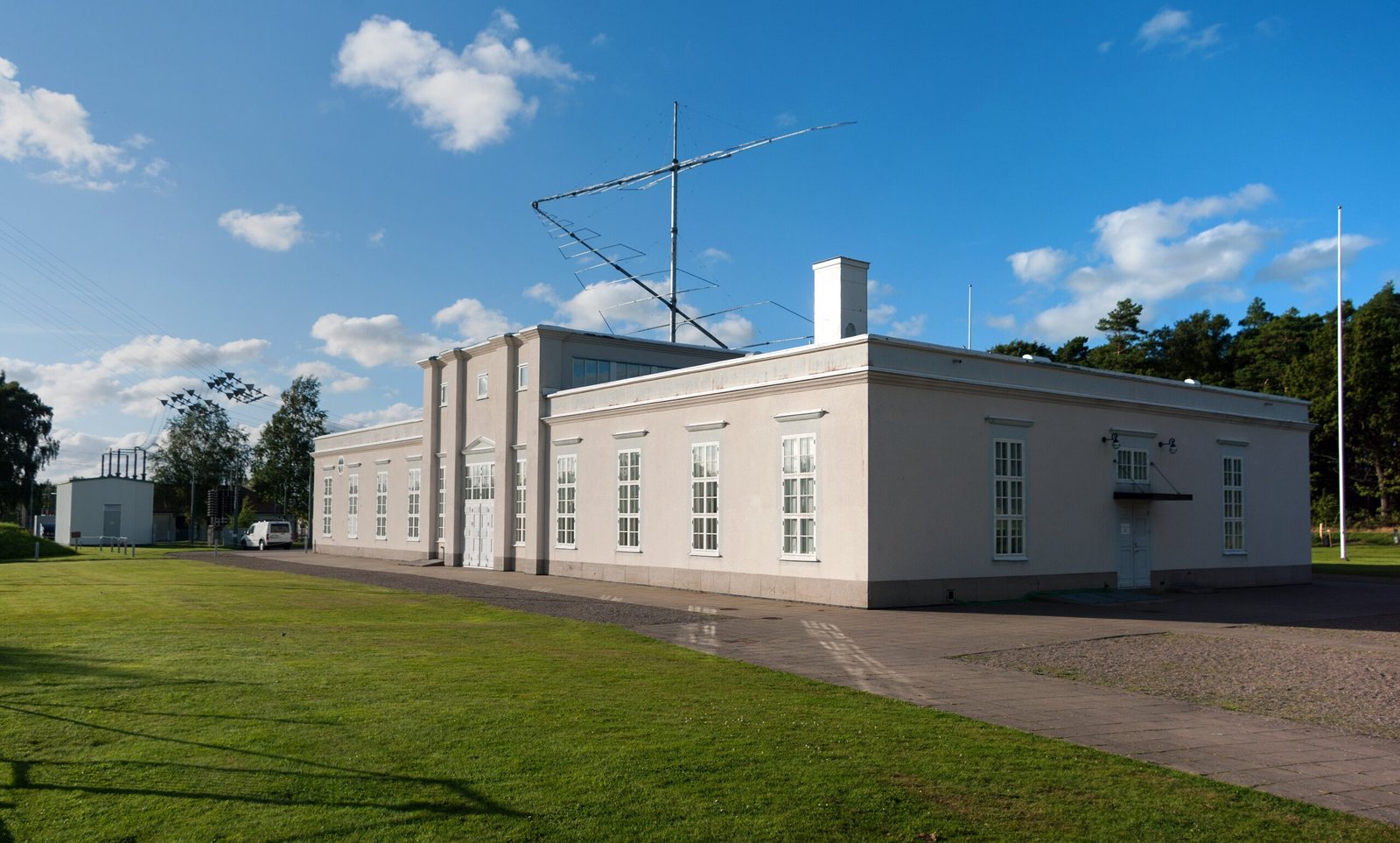
The world’s only surviving pre-vacuum-tube transatlantic wireless telegraphy station, built 1922–1924 near Varberg, Sweden — and home to the last working Alexanderson alternator on Earth.
At a glance
Inscribed as a UNESCO World Heritage Site in 2004, the Grimeton Radio Station (call sign SAQ) stands as a frozen moment in the history of telecommunications: the narrow 2–3 year window between Marconi’s spark-gap transmitters and the vacuum tube revolution that replaced them. What survives intact is the full original system — the 200 kW Alexanderson alternator, the antenna farm of six 127-metre guyed steel masts spanning nearly two kilometres, the transmitter hall, and the operator buildings — all in operational condition. Once a year the machine is powered up and sends real Morse code signals across the Atlantic.
Key facts
- UNESCO inscription: 2004 (serial number 1134)
- Location: Grimeton, Varberg Municipality, Halland County, Sweden
- Built: 1922–1924 by Allmänna Telefonaktiebolaget (LM Ericsson consortium)
- Transmitter: Alexanderson alternator, 200 kW, 17.2 kHz (VLF), wavelength 17.4 km
- Antenna system: Six guyed steel masts, 127 m high, 380 m spacing
- Commercial service: 1924–1960 (Sweden–USA transatlantic link)
- Operating body: Alexanderson Association (Alexandersonssällskapet)
- Alexanderson Day transmissions: First Sunday after Midsummer + Christmas Eve
History
By the early 1920s, transatlantic cable capacity was insufficient for the volume of diplomatic, commercial, and press traffic between Europe and North America. Sweden needed a direct, reliable wireless link to the United States. The solution came from Ernst Alexanderson — a Swedish-born engineer at General Electric in Schenectady, New York — who had developed a machine capable of generating continuous-wave radio signals at very low frequency by spinning a precisely machined iron rotor inside a coil at extremely high speed.
The technology was already becoming obsolete as construction began. Lee De Forest’s vacuum tube triode, invented in 1907, promised smaller, cheaper, more efficient transmitters. But Alexanderson’s machines were proven, powerful, and capable of punching signals through to any point on Earth at 17.2 kHz. Six Alexanderson alternators were built worldwide; only the Grimeton machine survives.
The station opened for commercial service in December 1924 and operated continuously until 1960, when satellite communication made VLF telegraphy economically unviable. Unlike every other station of its type, Grimeton was not dismantled. The Alexanderson Association took custody, the Swedish state listed the site, and in 2004 UNESCO recognised it as an irreplaceable document of telecommunications history.
What you see
The dominant feature of the site is the antenna array: six steel lattice masts, 127 metres tall, anchored by complex guyed cable systems, marching across the flat Halland farmland. Between the masts runs the aerial wire of the antenna, tuned to the 17.4 km wavelength of the transmitted signal. The transmitter hall contains the Alexanderson alternator itself — a machine roughly the size of a large dining table, its rotor machined to tolerances of a few micrometres, capable of spinning at 2,000 rpm to generate a 17.2 kHz signal. Adjacent rooms house the original control panels, the antenna tuning coils (each the size of a small room), and the operators’ desks. The residential and administrative buildings complete the complex, forming a coherent 1920s industrial settlement.
Practical information
- Open to visitors: Summer season (June–August), guided tours by the Alexanderson Association
- Alexanderson Day: Annual transmission event — first Sunday after Midsummer; machine powered up and transmits live on 17.2 kHz SAQ
- How to receive SAQ: Any shortwave radio with VLF capability tuned to 17.2 kHz, or Software Defined Radio (SDR) with a long-wire antenna
- Admission: Entry fee applies; check alexanderson.se for current dates and prices
- Language: Guided tours available in Swedish and English
Getting there
Grimeton is located approximately 10 km inland from Varberg on the Swedish west coast (Halland County). By car: take E6/E20 motorway to Varberg exit, then local roads signed to Grimeton (coordinates: 57.1061N, 12.3886E). By public transport: train to Varberg station (1 hour from Gothenburg), then bus or taxi to Grimeton. Varberg itself is a pleasant coastal town with a medieval fortress and good connections along the west coast rail corridor.
Nearby
- Varberg Fortress — 14th-century coastal fortress housing the Bohuslän Museum; also famous for the Bocksten Man, a remarkably preserved medieval bog body
- Falkenberg — historic fishing town 20 km south with a well-preserved old quarter and medieval church
- Gothenburg — Sweden second city, 65 km north, with Liseberg amusement park, the Gothenburg Museum of Art, and the World Heritage Ramparts of Bohus
Sources
- UNESCO World Heritage List, Grimeton Radio Station Varberg (ID 1134), whc.unesco.org
- Alexanderson Association (Alexandersonssällskapet), alexanderson.se
- Swedish National Heritage Board (Riksantikvarieämbetet), raa.se
Find it on the map
See this place and what’s around it →📷 Become a Cultural Heritage Online photographer
Share your photos of places: they stay published under your name as the author. The more they're seen, the more you get noticed — and soon a contest will reward the most appreciated photos.
Log in or sign up free to add a photoIs this page about you?
This page is read by travellers and heritage enthusiasts who find it on Google. Tell us how you are connected to this place and we will take it from there.