
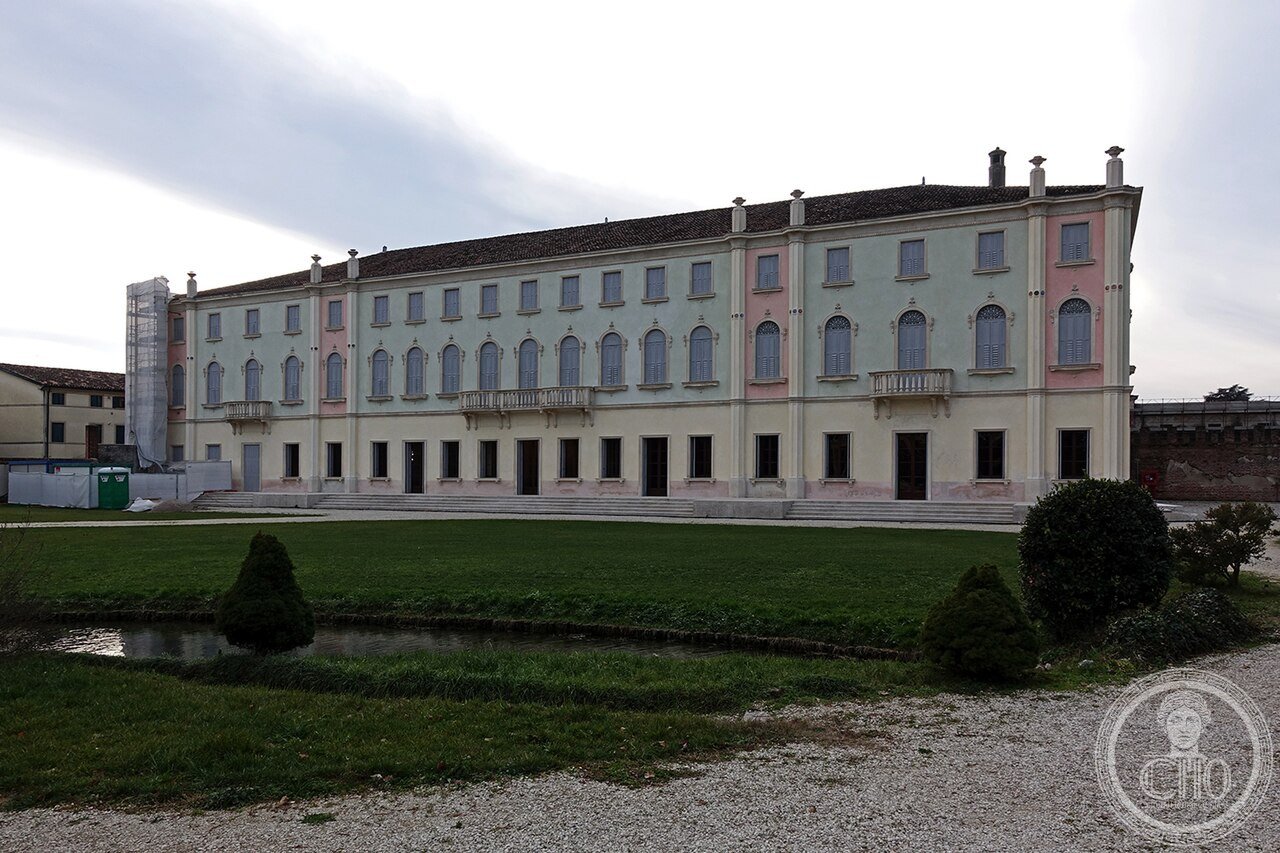
A neoclassical villa and expansive English park in the Veneto countryside, Villa Bolasco preserves the vision of a nineteenth-century nobleman’s passion for landscape and equestrian pursuits.
At a glance
Villa Bolasco stands on land once known as Paradise, where Venetian patrician families shaped estates over centuries. The present villa arose between 1852 and 1865 as the creation of Count Francesco Revedin, a pioneering mayor of Castelfranco, working with renowned architect Giambattista Meduna. Today the property belongs to the University of Padua and welcomes visitors to explore its villa and historic park.
History
The site was called Paradise in antiquity and belonged successively to the Tempestas, Morosini, and Corner families. From 1509, the Venetian patricians Corner developed two adjoining rustic palaces, fish ponds, and an Italian garden adorned with statuary by Orazio Marinali. In 1803, the last Corner owner, Nicolò Corner Giustinian, demolished these structures and converted the garden to farmland.
The Revedin family purchased the property in 1808. Count Francesco Revedin (1811–1869), who became Castelfranco’s first mayor in 1866, commissioned architect Giambattista Meduna—known for designing Venice’s La Fenice Theater—to build the imposing villa between 1852 and 1865. After Revedin’s death, the estate passed through several owners before becoming property of the University of Padua.
What you see
The villa itself showcases Meduna’s neoclassical masonry and interior refinement. A monumental staircase designed by Meduna, a ballroom decorated by painter Giacomo Casa, and elegant stables demonstrate Revedin’s refined taste and his celebrated devotion to horses.
The English park—laid out where Corner’s Italian garden once stood—evolved through contributions from landscape architects Francesco Bagnara and Marc Guignon, reaching its current form through Antonio Caregaro Negrin’s work between 1868 and 1878. Spanning 7.63 hectares with over 1,000 trees of 65 species, the park unfolds in shifting compositions of light and color. Architectural features punctuate the landscape: a Hispano-Moorish greenhouse, artificial hills, bridges, a tower, and a cavana. Most remarkable is the arena for horseback riding, crowned with seventeenth-century statuary salvaged from the vanished Corner garden, flanked by equestrian sculptures on high bases.
Cultural significance
Villa Bolasco embodies the nineteenth-century Venetian elite’s engagement with both neoclassical architecture and the Romantic landscape movement. The recovery and display of Renaissance sculptures from the earlier Corner estate transforms the park into a dialogue between historical periods. The villa’s stables and riding arena testify to the importance of equestrian culture among patrician families in the Veneto.
Key facts
- Address: Via Borgo Treviso, 73, 31033 Castelfranco Veneto, Treviso
- Coordinates: 45.67242728143867, 11.933571696281433
- Architect: Giambattista Meduna (villa, 1852–1865); landscape design by Francesco Bagnara, Marc Guignon, and Antonio Caregaro Negrin
- Park size: 7.63 hectares
- Arboreal heritage: Over 1,000 trees of 65 species
- Official website: https://www.villaparcobolasco.it/
- Phone: 049 8273939
Practical information
The historic garden opens on Saturdays and Sundays via free guided tours by reservation. Groups depart from 10 a.m. to 4 p.m., with a maximum of 35 people per group. Access is from the west entrance (Casa Rebellato side). Selected Sundays include guided access to the villa itself. The University may close the park in adverse weather. Reservations are made through the Single Booking Center of the Botanical Garden of Padua and Villa Parco Bolasco.
Getting there
Villa Bolasco is located in Castelfranco Veneto, in the province of Treviso, approximately 40 kilometers north of Padua. You can reach it by car via the Strada Statale 307 or by regional train to Castelfranco Veneto station. For guided tour reservations, contact the Botanical Garden of Padua booking center or visit the official website.
See the place
Sources & resources
Find it on the map
See this place and what’s around it →📷 Become a Cultural Heritage Online photographer
Share your photos of places: they stay published under your name as the author. The more they're seen, the more you get noticed — and soon a contest will reward the most appreciated photos.
Log in or sign up free to add a photoIs this page about you?
This page is read by travellers and heritage enthusiasts who find it on Google. Tell us how you are connected to this place and we will take it from there.