
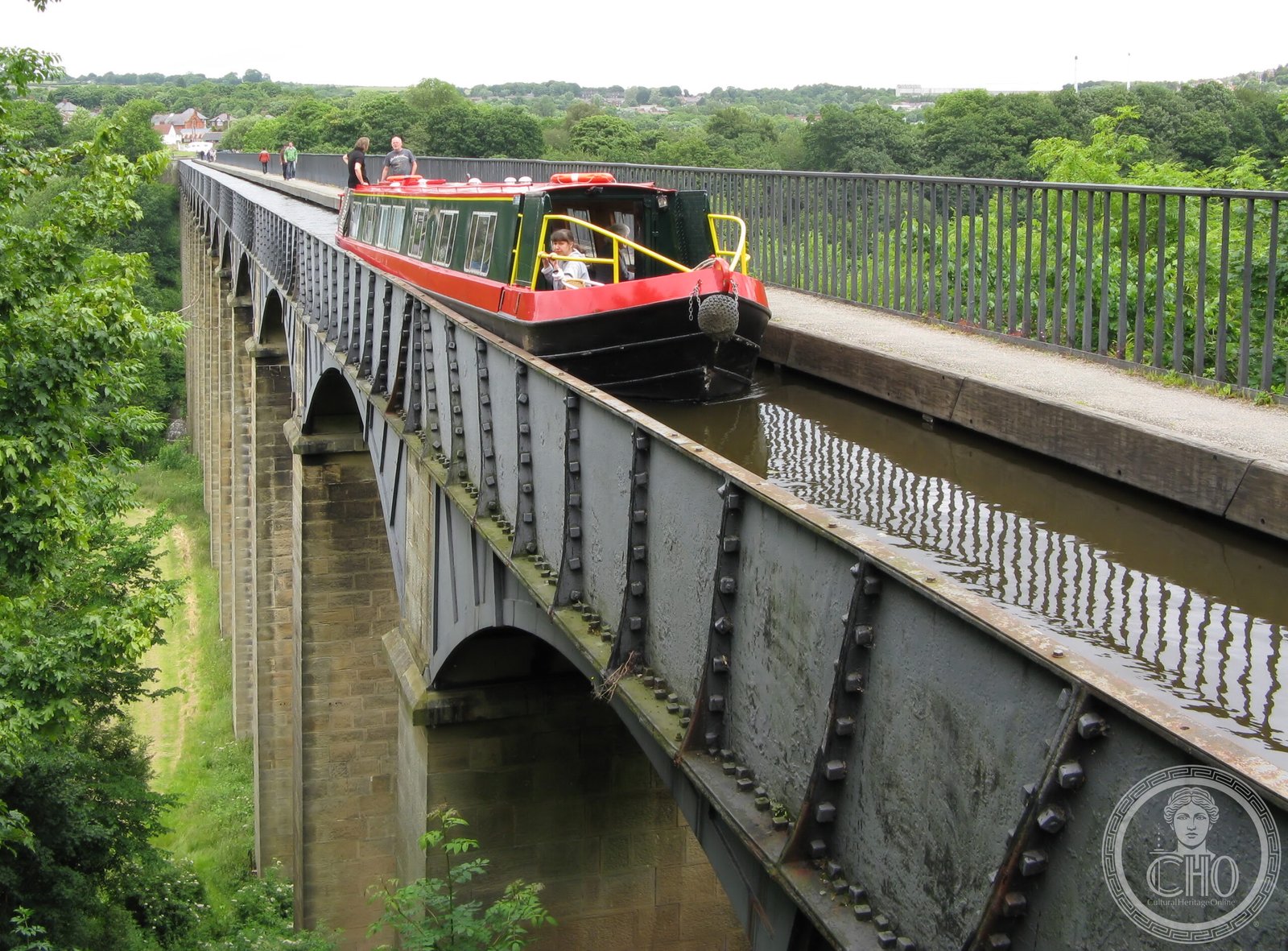
The longest and highest navigable aqueduct in Great Britain, carrying the Llangollen Canal 38 metres above the Dee Valley on 18 slender masonry piers — an Industrial Revolution masterpiece still in daily use, and a UNESCO World Heritage Site since 2009.
At a glance
Completed in 1805 to designs by Thomas Telford and William Jessop, Pontcysyllte Aqueduct stretches 307 metres across the Vale of Llangollen in northeastern Wales. Its cast-iron trough — just 3.65 metres wide — is balanced 38 metres above the River Dee, supported on 18 hollow masonry piers tapering to elegant stems. Narrowboats crossing the aqueduct today experience the same vertiginous sensation their Victorian predecessors described: gliding through open air, the valley floor far below on one side, the tow-path cantilevered over nothing on the other. UNESCO inscribed the aqueduct and 11 km of the associated Llangollen Canal in 2009, praising its “elegance of proportions, boldness of design, and the quality of its innovative structural form.”
Key facts
- Total length: 307 metres (the longest navigable aqueduct in Great Britain)
- Height above valley floor: 38 metres (the highest navigable aqueduct in Great Britain)
- Number of piers: 18, hollow masonry construction tapering from base to deck
- Canal trough dimensions: 3.65 m wide × 1.6 m deep, carrying up to 1.2 m of water
- Tow-path: cantilevered on the eastern side of the trough
- Designers: Thomas Telford (1757–1834) and William Jessop
- Construction period: 1795–1805 CE
- UNESCO inscription: 2009 (with 11 km of Llangollen Canal)
- Status: still in daily operation for leisure narrowboat traffic
- Sealing technique: cast-iron joints sealed with lime mortar mixed with Welsh flannel soaked in boiling sugar
History
The Ellesmere Canal Company commissioned the aqueduct in the 1790s to connect the coalfields and limestone quarries of northeastern Wales with the English canal network. The design challenge was formidable: the Dee Valley at this point dropped nearly 40 metres below the required canal level, and conventional stone arch construction would have required either a massive embankment or an impossibly deep structure.
Thomas Telford proposed a radical solution: a cast-iron trough supported on the slenderest possible masonry piers, with the structural work done entirely by the iron rather than the masonry. This was unprecedented at the scale required. Construction began in 1795 and the aqueduct opened on 26 November 1805. The opening was attended by crowds who reportedly found the sight of boats apparently sailing through the sky above the valley almost incomprehensible.
The Llangollen Canal survived the decline of commercial canal traffic in the railway age because it continued to supply water from the River Dee to communities along its route. Leisure boating revived strongly from the 1960s onwards, and the aqueduct today carries roughly 15,000 boats per year.
What you see
Approaching the aqueduct from the Trefor (southern) end, the scale becomes apparent only gradually — the piers appear delicate from a distance, their tapering profile giving almost no visual clue to the engineering loads they carry. Each pier is hollow, reducing weight while maintaining structural stiffness. The cast-iron trough itself is a masterpiece of precision fabrication: the flanged plates were bolted together and the joints sealed with a mixture of lime mortar and Welsh flannel dipped in boiling sugar — an improvised technique that proved extraordinarily durable.
Crossing by narrowboat, the gunwales of the boat are at the level of the tops of the piers. There is no side wall to the trough — only the 1.6-metre depth of the iron sides, and then open air dropping 38 metres to the valley floor. The tow-path on the eastern side is cantilevered beyond the trough on iron brackets. Modern safety railings have been added to the tow-path, but the experience of crossing remains one of the most dramatic on the British canal network.
Practical information
- Access: free to walk across the tow-path at any time; no admission charge
- By narrowboat: hire boats available from Trevor Basin (immediately south of the aqueduct) and from multiple operators along the Llangollen Canal
- Trevor Basin: the main visitor hub — car parking, café, Canal & River Trust visitor information
- Best views: from the valley floor below (access via footpaths from Trevor village) or from Froncysyllte village on the opposite bank
- Horse-drawn boat trips: traditional horse-drawn day trips on the canal operate seasonally from Llangollen Wharf (5 km west of the aqueduct)
- Nearest town: Llangollen, 5 km west; Wrexham, 16 km northeast
Getting there
Trevor Basin (the main visitor access point) is located off the B5434 road between Llangollen and Chirk in Wrexham County Borough, Wales. By car from Llangollen: follow the A539 east, then signs for Trevor and the aqueduct (approximately 10 minutes). From Wrexham: take the A483 south, then the A539 west. On-site parking available at Trevor Basin. There is no direct rail service to Trevor — the nearest stations are Chirk (5 km, on the Shrewsbury–Wrexham line) and Ruabon (8 km). Regular bus services connect Llangollen with the wider regional network.
Nearby
- Llangollen (5 km west): historic market town on the River Dee; annual International Musical Eisteddfod; Llangollen Railway steam heritage line; Valle Crucis Abbey ruins
- Chirk Castle (5 km south): National Trust medieval border castle with formal gardens, continuously inhabited since 1310 CE
- Chirk Aqueduct and Tunnel: also part of the UNESCO inscription — the earlier (1801) Chirk Aqueduct by Telford crosses the Ceiriog Valley
- Erddig Hall (12 km northeast): National Trust late 17th-century country house, notable for its servants quarters and estate records
Sources
- UNESCO World Heritage List: Pontcysyllte Aqueduct and Canal — whc.unesco.org
- Canal & River Trust: official information on the Llangollen Canal and Pontcysyllte Aqueduct
- Wikipedia: Pontcysyllte Aqueduct — en.wikipedia.org
- Historic England: listed building and scheduled monument records
- Rolt, L.T.C.: Thomas Telford (1958) — definitive biography including the aqueduct construction history
Find it on the map
See this place and what’s around it →📷 Become a Cultural Heritage Online photographer
Share your photos of places: they stay published under your name as the author. The more they're seen, the more you get noticed — and soon a contest will reward the most appreciated photos.
Log in or sign up free to add a photo