
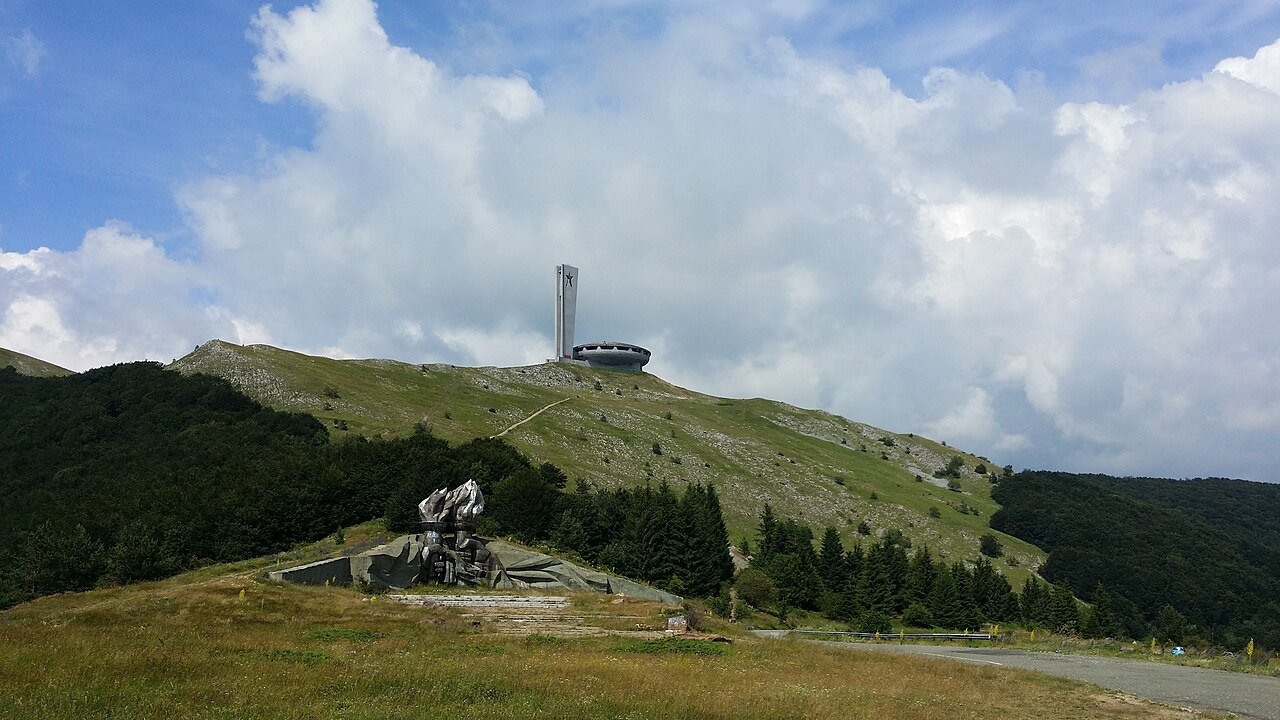
Balanced on the summit of a Balkan Mountain peak at 1,441 m, this vast concrete monument — a 70-metre flying-saucer hall rising on a trapezoidal stem — is one of the most dramatic, photographed, and debated examples of Cold War architectural heritage in Europe.
At a glance
Built between 1974 and 1981 to the design of Bulgarian architect Georgi Stoilov, Buzludzha served as the communist Bulgarian Communist Party headquarters and a monumental memorial hall. Its site is charged with historical significance: in 1891, Bulgarian socialists led by Dimitar Blagoev held a secret congress here in the mountains, founding the Bulgarian Social Democratic Party — the antecedent of the ruling communist party. The building was abandoned after the fall of communism in 1989. Since then it has suffered serious deterioration — collapsed roof sections, shattered glazing, stripped copper — yet its surviving mosaic fragments remain extraordinary works of Cold War monumental art. It is now one of the most photographed abandoned buildings in Europe.
Key facts
- Architect: Georgi Stoilov
- Built: 1974–1981 CE
- Abandoned: 1989 (following the fall of communism in Bulgaria)
- Location: Buzludzha Peak, Balkan Mountains, Stara Zagora Province, Bulgaria; altitude 1,441 m
- Dimensions: Main hall 70 metres in diameter; entrance tower 70 metres tall
- Original features: Enormous mosaic murals depicting communist history; red star atop the tower; copper-clad roof elements (now stripped)
- UNESCO status: Not yet inscribed; preservation campaign led by the Buzludzha Project Foundation
History
On 20 July 1891, a group of socialist activists met secretly in the Buzludzha Pass area of the Balkan Mountains and founded what would become the Bulgarian Social Democratic Party. For the communist state that ruled Bulgaria from 1944, this event held mythological significance as the founding moment of the movement. When a major new monument was commissioned in the 1970s, the Buzludzha Peak — visible for miles across the central Bulgarian plateau — was chosen as its site.
Construction lasted from 1974 to 1981 and was a national effort: tens of thousands of volunteers contributed labour, and the project drew on the best Bulgarian artists and craftsmen of the era. The mosaic programme was particularly ambitious — enormous scenes of communist history, workers, and ideological motifs in stone and glass tesserae covered the interior walls. The monument was inaugurated on 23 August 1981, the anniversary of Bulgaria joining the Warsaw Pact.
After the 1989 revolution, the Bulgarian Socialist Party (successor to the Communist Party) lost interest in maintaining the building. By the early 1990s it was officially closed and the state disclaimed responsibility. Stripped of its copper roof elements, exposed to the extreme temperatures of a mountain summit, and broken into by urban explorers, the structure has suffered severe damage. Yet it remains structurally sound at its core, and the mosaic fragments that survive are of extraordinary artistic quality.
What you see
The building is approached via a winding mountain road from the village of Shipka or from the Kazanlak direction. From the car park, a broad ceremonial approach leads to the entrance tower — a 70-metre obelisk-like trapezoidal column bearing the now-ruined letters of communist slogans. The main hall is a circular concrete disc 70 metres in diameter, set on the stem of the tower: its form deliberately evokes a spacecraft or flying saucer, an architectural language of technological optimism that was common in Eastern Bloc civic architecture of the 1970s.
Inside, where access is possible (the building is officially closed but enforcement is minimal), the scale is overwhelming. The circular hall was designed to seat hundreds for party gatherings. The mosaic programme, though badly damaged, remains visible in places: heroic workers, red flags, scenes of Bulgarian revolutionary history, and the faces of Marx and Lenin rendered in coloured stone at monumental scale. The collapsed sections of the roof have opened the interior to the sky, creating a dramatic juxtaposition of ruin and preserved artwork.
At the apex of the entrance tower, the five-pointed red star, a defining feature of the skyline, has been damaged by weather and vandalism but remains in place. On clear days the view from the summit encompasses the entire Rose Valley, the Kazanlak basin, and the Thracian plain to the south.
Practical information
- Access: The building is officially closed; visitors walk around the exterior freely; interior access is at personal risk and is technically unauthorised
- Mountain road: The road to the summit is steep and may be snow-covered October–April; a 4WD vehicle is recommended outside summer months
- Best time to visit: Late spring to early autumn (May–September); the summit is cold even in summer — bring warm clothing
- Nearest town: Kazanlak (c. 25 km south) or Shipka (c. 12 km north)
- Preservation: The Buzludzha Project Foundation is raising funds for emergency stabilisation; consider supporting their work
Getting there
The monument is located on Buzludzha Peak in the Stara Zagora Province of central Bulgaria. The nearest significant town is Kazanlak, approximately 25 km to the south, accessible by bus from Sofia (3.5 hours) and Plovdiv (2 hours). From Kazanlak, a car is essential: the mountain road climbs from the Shipka Pass direction or from Kazanlak through the Rose Valley. There is no public transport to the summit. Sofia is approximately 180 km to the west by road (c. 2.5 hours).
Nearby
- Shipka Memorial Church — 12 km north; a magnificent 1902 Russian Orthodox church built to commemorate the 1877–78 Russo-Turkish War
- Valley of the Roses, Kazanlak — the centre of Bulgarian rose oil production; the Kazanlak Thracian Tomb (UNESCO WHS) is in the town
- Shipka Pass — the historic mountain pass beneath the monument, scene of key battles in 1877
- Etar Architectural-Ethnographic Complex — c. 40 km south; an open-air museum of Bulgarian 19th-century crafts
Sources
Find it on the map
See this place and what’s around it →📷 Become a Cultural Heritage Online photographer
Share your photos of places: they stay published under your name as the author. The more they're seen, the more you get noticed — and soon a contest will reward the most appreciated photos.
Log in or sign up free to add a photo