
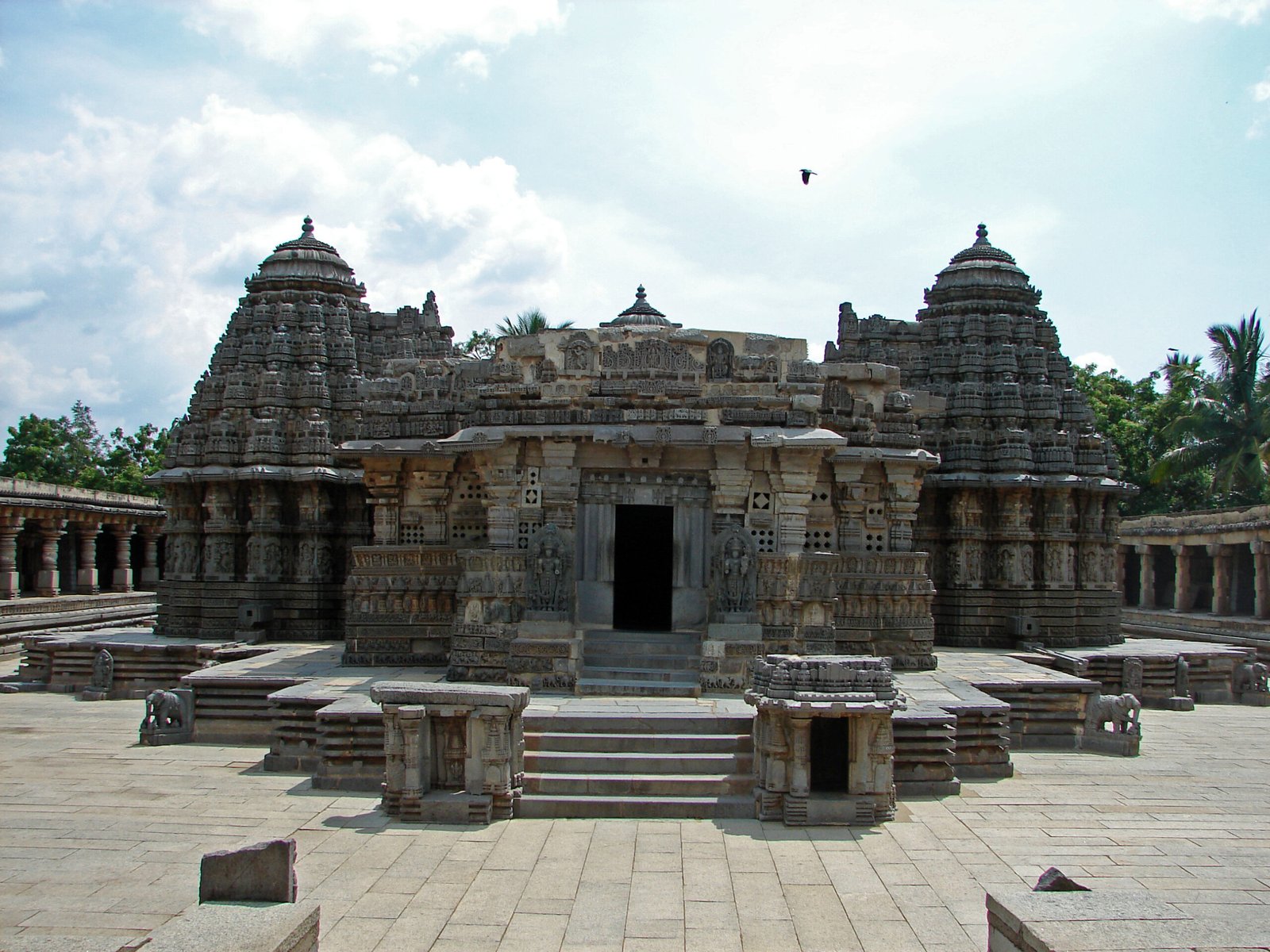
Three groups of Hoysala temples at Belur, Halebidu, and Somnathapura in Karnataka, where every exterior surface is encrusted with the most elaborate stone sculpture in India — inscribed UNESCO World Heritage in 2023.
At a glance
The Sacred Ensembles of the Hoysalas comprise three temple complexes in Hassan and Mysuru districts, built under the Hoysala Empire in the 12th and 13th centuries CE. UNESCO inscribed them in 2023. The Chennakeshava Temple at Belur (1117 CE), the twin Hoysaleshwara and Shanthala temples at Halebidu (c. 1121 CE), and the Keshava Temple at Somnathapura (1268 CE) share one aesthetic: every exterior surface is carved in fine-grained chloritic schist — a greenish-grey stone that allows a level of detail impossible in sandstone or granite.
Architecture and sculpture
Hoysala temples stand on a star-shaped platform (jagati) that causes their walls and towers to project outward in a rippling series of angles, multiplying carving surfaces and giving them animated movement even from a distance. Exterior bands of sculpture, read bottom to top, follow a canonical sequence: elephants (stability), horses (speed), scrolling foliage, narrative friezes from the Ramayana and Mahabharata, makaras, hamsas, deities, and celestial maidens. The density at Halebidu is extraordinary: over 240 sculptural bands run around the exterior, and the elephant frieze alone contains more than two thousand individual elephants, no two identical. Individual shilpis (sculptors) signed their panels in some instances — an unusual honour in medieval Indian temple art.
The three sites
Belur — Chennakeshava Temple (1117 CE): The largest and oldest, begun by King Vishnuvardhana to commemorate a military victory. Still active as a place of worship, it is celebrated for its bracket figures of celestial maidens projecting from the exterior walls and for its richly carved entrance gopura.
Halebidu — Hoysaleshwara and Shanthala Temples (c. 1121 CE): The former Hoysala capital and the most expansive site: two nearly identical twin temples side by side, dedicated to Shiva and his consort. The towers were never completed, possibly interrupted by the Khalji raids of the early 14th century. The Archaeological Museum here holds inscriptions and loose sculptures found on site.
Somnathapura — Keshava Temple (1268 CE): The smallest, latest, and most perfectly preserved of the three, its three towers reflected in the surrounding moat. Built by the Hoysala general Somanatha, it is the finest example of the trikuta (triple-shrine) plan and is considered the highest point of quality in Hoysala carving.
History
The Hoysala Empire (c. 1026–1343 CE) rose from a chieftainship in the Western Ghats to rule much of Karnataka. Under kings Vishnuvardhana and Veera Ballala II the court became a major centre of Kannada literature and both Shaivite and Vaishnavite patronage. Halebidu was sacked twice by Malik Kafur, a general of the Delhi Sultanate, in 1311 and 1327, explaining the unfinished towers and some damage. The empire gave way to the Vijayanagara Empire in the mid-14th century. European documentation begins with British surveyor Colin Mackenzie’s visit in 1807; the Archaeological Survey of India has maintained the sites since.
Key facts
- Country: India (Karnataka)
- Three sites: Belur, Halebidu (Hassan District), Somnathapura (Mysuru District)
- GPS (ensemble centroid): 13.162°N, 75.880°E
- UNESCO inscription: 2023 (listing #1670)
- Building material: chloritic schist
- Construction: 1117–1268 CE (Hoysala Empire)
- Guardianship: Archaeological Survey of India (ASI)
Practical information
- Belur and Halebidu are 16 km apart; both can be visited from Hassan (35–40 km) in one day.
- Somnathapura is 35 km east of Mysuru and best visited from there.
- All three sites open daily; ASI charges a modest entry fee for foreign visitors.
- Best light at Belur: early morning. Best light at Halebidu: afternoon (west-facing facade).
Getting there
The nearest major airports are Kempegowda International in Bengaluru (~220 km from Belur) and Mysuru Airport (for Somnathapura). Hassan is the best base for the Belur–Halebidu circuit, connected by rail from Bengaluru and Mysuru. KSRTC runs day-tour buses from both cities covering all three sites.
Nearby
- Shravanabelagola (57 km from Belur) — Jain pilgrimage site with the 18 m monolithic Gommateshwara statue
- Mysuru — city palaces, silk market, Chamundeshwari Temple
- Chikkamagaluru — coffee estates and trekking in the Western Ghats
Sources
Find it on the map
See this place and what’s around it →📷 Become a Cultural Heritage Online photographer
Share your photos of places: they stay published under your name as the author. The more they're seen, the more you get noticed — and soon a contest will reward the most appreciated photos.
Log in or sign up free to add a photo