
The most completely preserved Mycenaean palace in Greece — and the site where Linear B, the earliest written Greek, was discovered still baking in the archive fire that destroyed the building.
At a glance
On a low ridge called Ano Englianos, approximately 17 km north of the modern town of Pylos in Messenia, the Palace of Nestor is the best-preserved Bronze Age palatial complex in the Aegean world. Its plan is more fully legible than Mycenae or Tiryns — over 105 rooms survive, including the great megaron, storage magazines with pithos jars still in position, the palace wine cellar, bronze-smithing quarters, and the only intact Mycenaean bathtub in existence. Built around 1300 BC and destroyed by fire around 1180 BC, the palace was excavated by Carl Blegen of the University of Cincinnati between 1939 and 1966. The fire that ended the palace preserved it: 1,087 clay tablets inscribed in Linear B were baked hard in the archive room, surviving to be translated by Michael Ventris in 1952 as the earliest written records of the Greek language.
Key facts
- Period: Late Helladic IIIB–C, c. 1300–1180 BC (Mycenaean)
- Area: approximately 12,000 m² across more than 105 rooms
- Tablets: 1,087 Linear B clay tablets — the largest archive from any Mycenaean palace
- Excavator: Carl Blegen, University of Cincinnati, 1939–1966
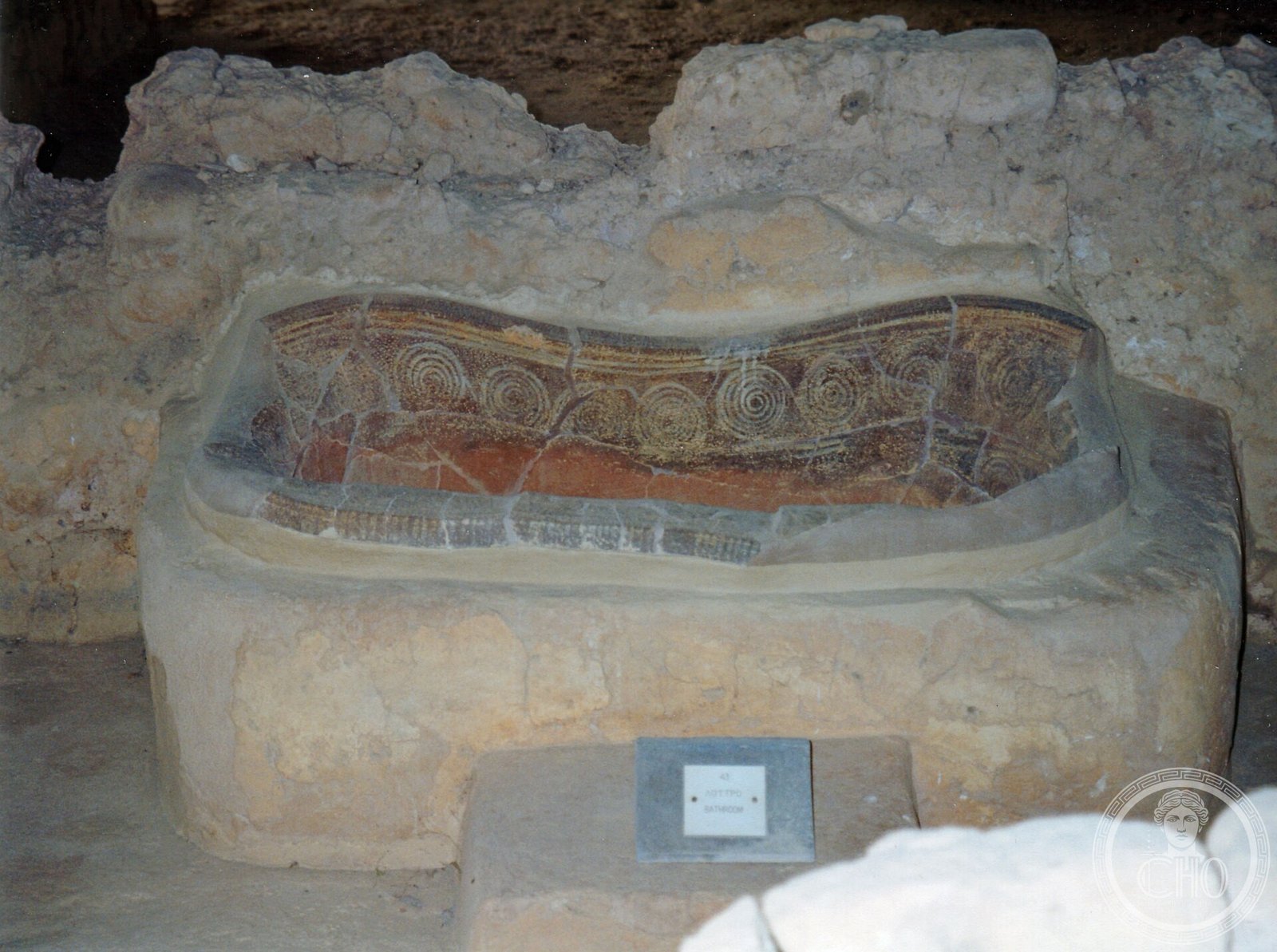
- Unique survivor: the only intact Mycenaean bathtub in the world, still in situ
- Location: Ano Englianos ridge, 17 km north of Pylos, Messenia, Greece
- Access: covered by a modern roof structure; Museum of Pylos holds the finds
History
The palace was built approximately 1300 BC at the height of Mycenaean power in the southwestern Peloponnese, likely serving as the administrative and ceremonial centre for a kingdom that controlled Messenia. It was destroyed in a single catastrophic fire around 1180 BC — part of the widespread collapse of Bronze Age palatial civilisation across the eastern Mediterranean at the end of the Late Bronze Age. The destruction was almost certainly violent: among the last Linear B tablets written at the palace are records of coastal watchers stationed at various points along the Messenian coast to watch for approaching sea raiders, apparently composed only weeks before the end.
The site was first excavated by Konstantinos Kourouniotis in 1926, who identified it as a Bronze Age palace site. Carl Blegen, returning in 1939 with a University of Cincinnati team, found the Linear B archive on the very first day of excavation — a discovery that preceded Michael Ventris’s 1952 decipherment by thirteen years. Blegen’s systematic excavations continued until 1966, revealing the full extent of the complex and establishing it as the most completely preserved Mycenaean palace known.
The palace is associated by later Greek tradition with Nestor, the wise king of Pylos whose kingdom features prominently in the Iliad and Odyssey. While the Homeric poems were composed centuries after the palace’s destruction, the palatial records do confirm a powerful Mycenaean kingdom centred at this site during the Bronze Age.
What you see
The main megaron — the throne room — measures approximately 12 × 11 metres and preserves its circular central hearth surrounded by four limestone column bases, the painted throne dais on the east wall, and floor plaster decorated with painted octopus and dolphin motifs. The frescoed walls, though fragmentary, preserve enough to show that the megaron was decorated with processional scenes and hunting imagery comparable to Tiryns and Mycenae. A propylon (gatehouse) and waiting room precede the megaron, and a suite of storerooms for olive oil extends to the north, the pithos storage jars still standing in position. The palace archive room — where the tablets were found — opens off the entrance court; the wine magazine and bronze-smithing quarters lie in the southwestern wing.
The bathroom, accessible from a corridor near the megaron, preserves its terracotta bathtub still in situ — the only surviving example from the Mycenaean world. It is built into a clay-lined platform and once stood beside a terracotta basin and storage jar for water. The overall plan suggests a two-storey structure, with stucco staircases leading to an upper floor; sufficient material survived for Linear B tablets to have been stored on both levels.
Practical information
- Opening hours: Tuesday–Sunday, approximately 08:00–15:00 (check current hours at visitgreece.gr)
- Tickets: combined ticket with the Museum of Pylos recommended (finds are displayed there, not on site)
- On site: the ruins are covered by a modern protective roof; the site is partially paved
- Museum of Pylos: holds the Linear B tablets (casts; originals in Athens), frescoes, and finds
- National Archaeological Museum, Athens: holds original tablets and key finds
Getting there
The Palace of Nestor lies approximately 17 km north of the modern town of Pylos on the Messenian coast. By car from Pylos, take the road north toward Chora; the site is signposted and lies east of the main road, near the village of Chora. There is a small car park at the site. The nearest town with accommodation is Pylos, reachable from Kalamata (60 km) or Patras via Olympia. No direct public transport serves the site; a taxi from Pylos is the practical alternative without a car.
Nearby
- Museum of Pylos (Chora): 1 km from the palace — houses the finds, frescoes, and Linear B tablet casts
- Bay of Navarino (Pylos): 17 km south — site of the 1827 Battle of Navarino; scenic harbour town
- Voidokilia beach: near Pylos — Omega-shaped lagoon bay, one of the finest beaches in Greece
- Nestor’s Cave: above Voidokilia — Mycenaean cult site associated by tradition with the Homeric king
Sources
- Blegen, C.W. et al. The Palace of Nestor at Pylos in Western Messenia, 3 vols. Princeton University Press, 1966–1973.
- Shelmerdine, C.W. (ed.) The Cambridge Companion to the Aegean Bronze Age. Cambridge University Press, 2008.
- Ventris, M. & Chadwick, J. Documents in Mycenaean Greek. Cambridge University Press, 1956.
- Wikipedia: Palace of Nestor
- Greek Ministry of Culture: Odysseus cultural heritage database
Find it on the map
See this place and what’s around it →📷 Become a Cultural Heritage Online photographer
Share your photos of places: they stay published under your name as the author. The more they're seen, the more you get noticed — and soon a contest will reward the most appreciated photos.
Log in or sign up free to add a photo