

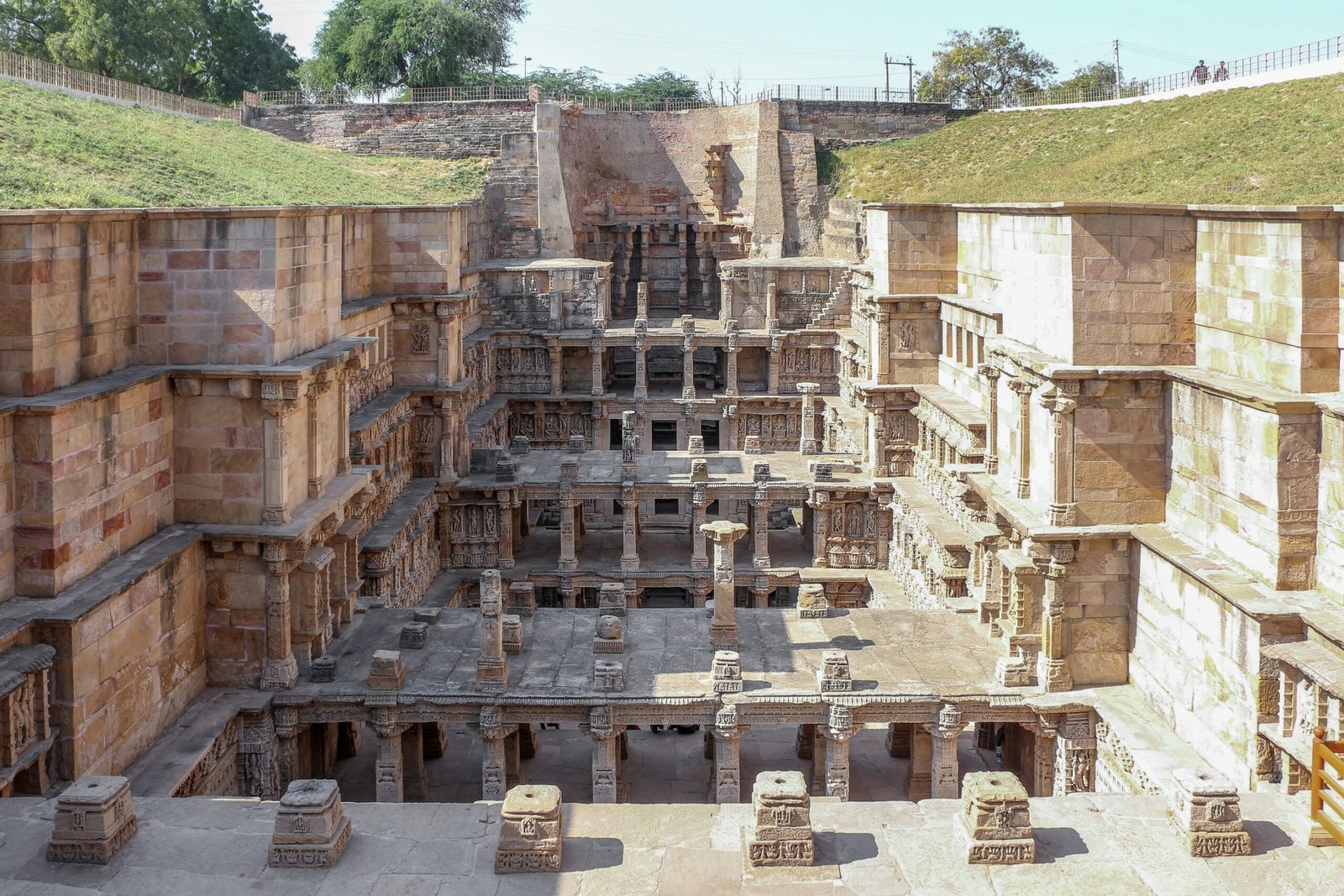
Built as a memorial stepwell by Queen Udayamati in the 11th century, Rani ki Vav descends 28 metres through seven levels of sculpted terracing — UNESCO’s “finest example of a stepwell in India,” buried under silt for centuries and emerging to reveal more than 800 major sculptural panels in extraordinary condition.
At a glance
Rani ki Vav (the Queen’s Stepwell) at Patan in northern Gujarat was built approximately 1022 to 1063 AD by Queen Udayamati as a memorial to her husband King Bhimdev I of the Solanki dynasty. The stepwell descends approximately 28 metres below the surrounding plain through seven levels of sculpted terracing, with approximately 800 major sculptural panels and more than 1,000 smaller figures covering the walls. UNESCO inscribed it on the World Heritage List in 2014 as “the finest example of a stepwell in India.” The stepwell was buried under silt following a flood of the Saraswati River, rediscovered in the 20th century, and excavated by the Archaeological Survey of India between 1958 and 1986 — its centuries of submersion preserving the sculpture in exceptional condition. Rani ki Vav is depicted on the Indian 100-rupee banknote.
Key facts
- Built: c. 1022-1063 AD by Queen Udayamati, Solanki dynasty, as memorial to King Bhimdev I
- Location: Patan, northern Gujarat, India
- UNESCO status: World Heritage Site (2014) — “Rani-ki-Vav (the Queen’s Stepwell)”
- Depth: approximately 28 metres below ground level; seven terrace levels
- Sculpture count: approximately 800 major panels, more than 1,000 smaller figures
- Discovery and excavation: buried by Saraswati River flood; excavated by ASI 1958-1986
- Currency: depicted on the reverse of the Indian 100-rupee banknote
History
Patan (ancient Anahilwada Patan) was the capital of the Solanki dynasty and the largest city in India during the 11th century. Queen Udayamati built Rani ki Vav as a nandivardhan — an inverted temple — to serve as both a functional water source and a memorial monument to her late husband Bhimdev I. The stepwell typology (vav in Gujarati) was already well established in the subcontinent, but Rani ki Vav was the most ambitious example ever attempted: a complete inverted temple architecture in which the descent to the water level was conceived as a progression through cosmic levels, with the deepest sculpture showing the reclining Vishnu at the level closest to the water.
At some point in the 12th or 13th century, following a major flood of the Saraswati River, the stepwell was buried under metres of silt. Its location was not entirely forgotten — local tradition preserved knowledge of its existence — but the structure itself was inaccessible for centuries. The Archaeological Survey of India began systematic excavation in 1958; the work revealed sculpture preserved in a condition impossible on above-ground sites, without weathering, salt damage, or the interventions of later worshippers. The excavation was completed in 1986, and the site was subsequently consolidated and opened to visitors.
What you see
The entrance to Rani ki Vav is from the east. A porch leads to the first of the seven descending terraces, each defined by a colonnade of elaborately carved pillars and walls covered in sculptural panels. The programme is explicitly cosmological: as the visitor descends, the subjects depicted move from celestial beings and apsaras in the upper levels toward increasingly powerful divine forms in the lower levels. The penultimate level shows the Dashavataras (ten incarnations of Vishnu) in a continuous frieze. At the lowest level, closest to the water, the principal sculpted panel shows Sheshashayi Vishnu — the cosmic Vishnu reclining on the serpent Shesha, his navel sprouting the lotus from which Brahma emerges to create the universe — accompanied by Lakshmi at his feet and attendants.
The technical quality of the sculpture equals or exceeds the Modhera Sun Temple built by the same dynasty in the same period. The panels are carved in the round on three sides, with elaborate undercutting; subsidiary figures around the main icons show deity attributes, celestial musicians, and devotional figures, all of whose faces retain expressive individuality. The overall effect of descending through the seven levels, with the walls converging toward the rectangular well shaft at the bottom, is of a building that inverts the normal relationship between the sacred and the ground — the holiest space is the deepest, where the water is.
Practical information
- Entry: Archaeological Survey of India ticketed site; separate fee for foreign and Indian visitors
- Hours: 8:00 AM to 6:00 PM daily (closed during national holidays)
- Photography: permitted throughout; no flash in the deepest levels
- Footwear: remove shoes at the entrance; the stone floors are clean but can be wet in monsoon season
- On-site facilities: small visitor centre with excavation photographs; no food on site
- Best visit timing: early morning for cooler temperatures; avoid midday in summer
Getting there
Patan is approximately 125 km north of Ahmedabad, connected by train (Patan station, roughly 2.5 hours on express services) and frequent buses from Ahmedabad’s Geeta Mandir Bus Stand. From the Patan town centre, Rani ki Vav is approximately 2 km and reachable by auto-rickshaw. The nearest commercial airport is Sardar Vallabhbhai Patel International Airport, Ahmedabad (IATA: AMD). Patan is most efficiently combined with a visit to Modhera Sun Temple, approximately 35 km to the east — both are Solanki-era sites of the same 11th-century building campaign.
Nearby
- Modhera Sun Temple — Solanki solar temple, approximately 35 km east; same dynasty, same king
- Sahastralinga Talav — 11th-century Solanki reservoir with 1,000 Shiva shrines, within walking distance in Patan city
- Patan Patola Heritage — workshops demonstrating the rare double-ikat Patola silk weaving tradition for which Patan is famous
- Ahmedabad — UNESCO World Heritage historic city, 125 km south
Sources
- UNESCO World Heritage Centre, “Rani-ki-Vav (the Queen’s Stepwell) at Patan, Gujarat” (WHS 2014)
- Livingston, Morna, Steps to Water: The Ancient Stepwells of India, Princeton Architectural Press, 2002
- Wikipedia, “Rani ki vav” — consulted June 2026
- Archaeological Survey of India, Rani ki Vav excavation reports (1958-1986)
Find it on the map
See this place and what’s around it →📷 Become a Cultural Heritage Online photographer
Share your photos of places: they stay published under your name as the author. The more they're seen, the more you get noticed — and soon a contest will reward the most appreciated photos.
Log in or sign up free to add a photoIs this page about you?
This page is read by travellers and heritage enthusiasts who find it on Google. Tell us how you are connected to this place and we will take it from there.