
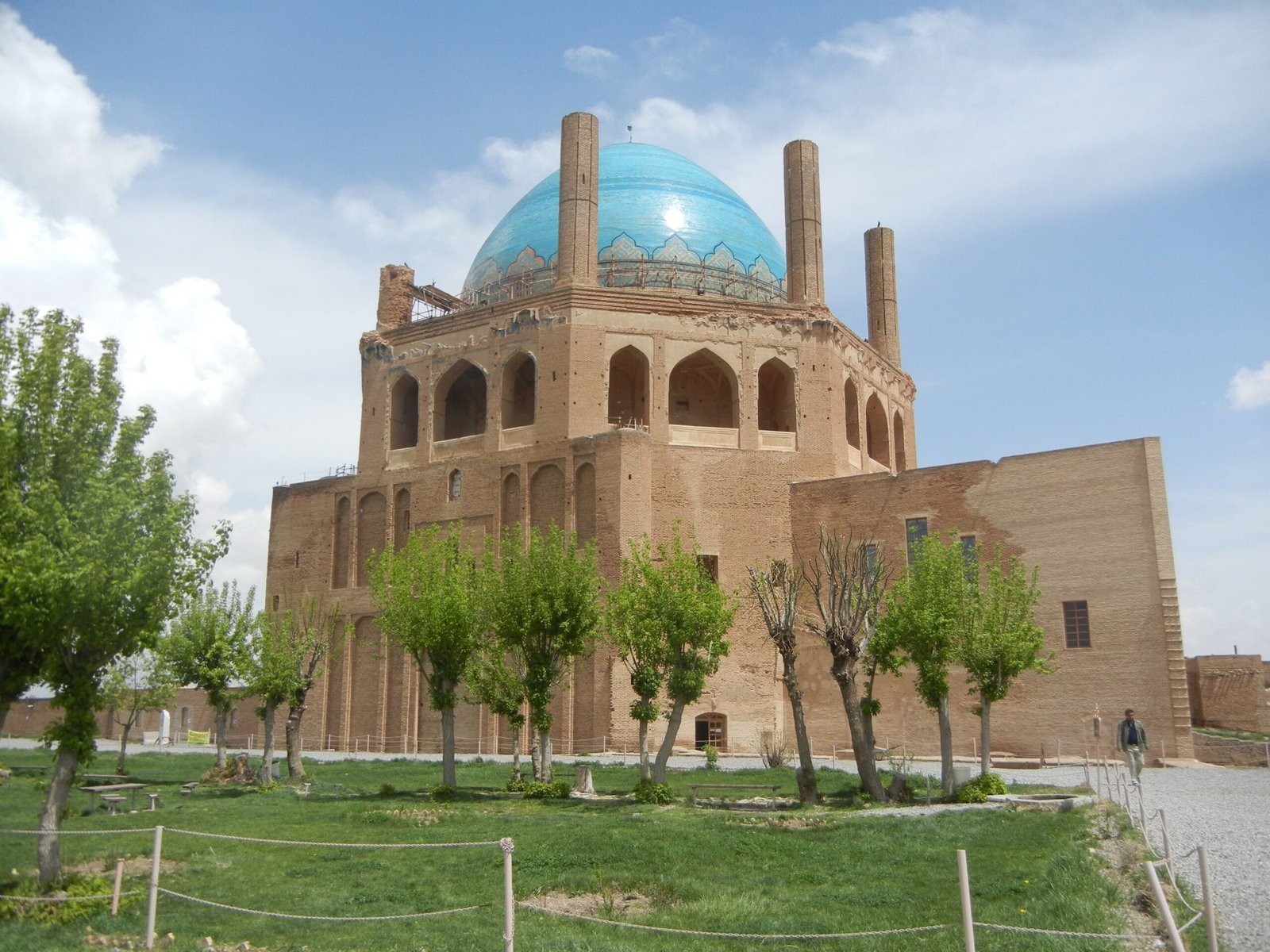
The largest brick dome in the world when completed in 1313 AD, Soltaniyeh’s mausoleum of Sultan Öljaitü remained the largest dome of any construction technique anywhere on Earth until Brunelleschi finished Florence Cathedral more than 120 years later — and its double-shell construction may have directly inspired the Florentine solution.
At a glance
On a high plateau in Zanjan Province, northwestern Iran, the mausoleum of Sultan Öljaitü rises 50 metres above the flat surrounding plain with an authority that makes clear why the Ilkhanate Mongol court chose this spot for an imperial capital. Built between 1302 and 1313 AD for the Mongol ruler Muhammad Öljaitü, its octagonal double-shell dome 24.5 metres in diameter represents the most ambitious architectural enterprise in the Islamic world between the Dome of the Rock (691 AD) and the Süleymaniye Mosque (1558 AD). The interior preserves exceptional Ilkhanate decoration: muqarnas stalactite vaulting, carved plasterwork arabesques, and Quranic calligraphy. UNESCO designated Soltaniyeh a World Heritage Site in 2005.
Key facts
- Built: 1302–1313 AD for Ilkhanate Sultan Öljaitü (r. 1304–1316)
- Dome: 50 m height, 24.5 m diameter — largest brick dome in the world
- Structural innovation: Double-shell construction predating Brunelleschi’s Florence Cathedral dome by over 120 years
- Exterior: Turquoise faience tile cladding; eight minarets at octagonal corners (six survive)
- Original intended use: Reception of remains of Shia Imams Ali and Husayn — plan abandoned; Öljaitü buried there himself
- UNESCO WHS: 2005
- Location: Town of Soltaniyeh, Zanjan Province, northwestern Iran
History
The Ilkhanate — the western branch of the Mongol Empire, established after the sack of Baghdad in 1258 — converted gradually from Buddhism and shamanism to Islam over the late 13th century. Öljaitü’s conversion was particularly dramatic: born a Nestorian Christian (baptised Nicholas), he converted to Sunni Islam on his accession in 1304 and then to Twelver Shia Islam c. 1310. His initial intention for Soltaniyeh was to create the supreme Shia pilgrimage site: relocating the bodies of the Imams Ali and Husayn from Najaf and Karbala to a new mausoleum in his own capital would have concentrated Shia devotional life at a Mongol-controlled city. The plan was abandoned — probably due to resistance from Arab Shia communities — and Öljaitü was ultimately buried in the mausoleum himself.
The architectural achievement is independent of intended function. The architects (unnamed in sources) solved the structural problem of a large dome over an octagonal base by separating inner and outer shells, reducing weight and outward thrust on the lower drum dramatically. This double-shell technique — which allowed the inner dome to be thinner than a single shell would require — appears in no earlier Islamic building of comparable scale. Whether Brunelleschi’s identical solution at Florence (1420–1436) was independently arrived at or transmitted through Timurid-Italian diplomatic channels remains one of the open questions of architectural history: Timur maintained active embassies with the Italian city-states in the 1400s, and ambassadorial accounts describe Timurid buildings in terms suggesting direct architectural knowledge.
After Öljaitü’s death the Ilkhanate collapsed rapidly (1335 AD), and Soltaniyeh declined from imperial capital to provincial town. The mausoleum survived because its scale made demolition impractical; it was used at various periods as a mosque, caravanserai, and warehouse before modern conservation efforts began in the 20th century. Restoration continues under Iranian Cultural Heritage Organisation supervision.
What you see today
The exterior presents as an octagonal drum approximately 30 metres tall, faced in brick with tile inlay, supporting the blue-green dome that dominates the town from every approach. Six of the original eight minarets survive at the corners; two collapsed in earlier centuries. The turquoise faience tile cladding is partially restored — a continuing conservation challenge, as the original tile formula has not been precisely replicated. The drum is pierced by large arched windows that flood the interior with light; the entrance portal on the north face preserves its original carved stone arch and tiled tympanum.
Inside, the height of the dome above the floor exceeds that of the Pantheon in Rome. The decoration is distributed across multiple registers: carved plasterwork panels in arabesque and geometric patterns in the lower zone; large arched niches with muqarnas half-domes in the corners at the middle level; a zone of ornate Quranic calligraphy transitioning to the dome above. A lower chamber beneath the main hall contains Öljaitü’s cenotaph. The ruins of the surrounding palace complex, visible as earthen mounds in the town, give a sense of the original scale of the Ilkhanate capital.
Practical information
- Opening: Daily except Mondays; hours vary seasonally (typically 8:00–17:00)
- Entry: Admission fee; combined ticket may include the site museum
- Dress code: Conservative dress required; women must cover hair; scarves available at entrance
- Best light: Morning for the exterior dome; midday for interior illumination through the drum windows
- Duration: Allow 1.5–2 hours for the mausoleum and surrounding ruins
- Facilities: Small site museum; basic refreshments in town; full services in Zanjan (35 km)
Getting there
Soltaniyeh town is approximately 35 km southeast of Zanjan city on the main Tehran–Tabriz highway. Regular buses and minibuses from Zanjan bus terminal stop at Soltaniyeh; journey time approximately 45 minutes. By private car the site is 4.5 hours from Tehran (330 km) and 3.5 hours from Tabriz (260 km) on the intercity expressway. Nearest airport: Zanjan (ZJN) with domestic flights to Tehran; international travellers typically route through Imam Khomeini International Airport (IKA). The mausoleum is in the centre of Soltaniyeh town and walkable from the bus stop.
Nearby
- Zanjan city (35 km) — historic bazaar, Rakhtshuikhaneh Museum (restored 19th-century public washhouse), Zanjan Bazaar Complex
- Takht-e Soleyman (130 km southeast) — UNESCO WHS 2003; Sassanid fire temple complex on a volcanic lake
- Alamut Castle (200 km east) — 11th-century stronghold of the Nizari Ismaili Assassins in the Alborz Mountains
Sources
- Sheila Blair, “The Epigraphic Program of the Tomb of Uljaytu at Sultaniyya,” Ars Orientalis 17, 1987
- UNESCO World Heritage List, “Soltaniyeh,” whc.unesco.org/en/list/1188
- Robert Hillenbrand, Islamic Architecture, Edinburgh University Press, 1994
- Abbas Daneshvari, “The Double-Shell Dome at Sultaniyya and Its Transmission to Renaissance Italy,” Muqarnas 3, 1985
Find it on the map
See this place and what’s around it →📷 Become a Cultural Heritage Online photographer
Share your photos of places: they stay published under your name as the author. The more they're seen, the more you get noticed — and soon a contest will reward the most appreciated photos.
Log in or sign up free to add a photoIs this page about you?
This page is read by travellers and heritage enthusiasts who find it on Google. Tell us how you are connected to this place and we will take it from there.