
Tayma – The Ancient Oasis Where Babylon Last King Exiled Himself for Ten Years
In the desert of northwestern Saudi Arabia, the oasis of Tayma is where Nabonidus, the last king of Babylon, abandoned his capital and the New Year festivals of Marduk for a decade — the most extraordinary voluntary royal relocation in ancient Near Eastern history.
At a glance
Tayma is a natural oasis in the Hejaz region of northwestern Saudi Arabia, fed by groundwater that has sustained human settlement for at least 3,000 years. It appears in Assyrian, Babylonian, and biblical sources as a major caravan station. When Nabonidus, last king of Babylon, spent approximately ten years here from c. 553 BC, Tayma became in effect the capital of the Babylonian Empire. German-Saudi excavations since 2004 have confirmed Bronze Age and Iron Age city remains, Babylonian-period structures, and Nabataean monuments. The Tayma Stone, a 6th-century BC trilingual stele discovered at the site, has been in the Louvre since 1884.
Key facts
- Location: Tabuk Province, northwestern Saudi Arabia; approximately 280km east of Tabuk
- Nabonidus residence: c. 553-543 BC; the Nabonidus Chronicle records his decade-long absence from Babylon
- The Tayma Stone: Trilingual stele in Aramaic, Babylonian cuneiform, and Egyptian hieroglyphs; in the Louvre since 1884
- Excavations: German-Saudi collaborative project (DAI and Saudi Heritage Commission) since 2004
- Fortification walls: Massive mudbrick circuit enclosing approximately 9 square kilometres
- Trade significance: Junction of the Incense Road and Mesopotamian caravan routes
- Modern context: Inhabited town of approximately 50,000 people with a municipal museum
History
Tayma enters the historical record when Tiglath-Pileser III of Assyria received tribute from its king in 738 BC, and Sargon II similarly exacted tribute in 716 BC. The oasis appears in the Hebrew Bible (Isaiah 21:14; Job 6:19) as a wealthy settlement known for its caravans. But its most extraordinary moment came in the 6th century BC, when Nabonidus, last king of Babylon, abandoned his capital for approximately ten years and took up residence here. The Nabonidus Chronicle, a cuneiform tablet in the British Museum, records that in the third year of his reign Nabonidus went to Tayma and failed to return to Babylon for multiple years to perform the Akitu New Year festival. The Verse Account of Nabonidus elaborates that he killed the local prince, took over the palace, and built a structure modelled on the Esagila temple complex of Babylon.
The motivations for this act remain debated. Babylonian priestly sources hostile to Nabonidus stress his religious heterodoxy and preference for the moon god Sin over Marduk. Modern historians have proposed strategic reasons: control of the Arabian incense and gold trade routes, or a response to Persian expansion. During his absence, Nabonidus entrusted effective rule to his son Belshazzar, whose administrative records survive in large numbers from Babylon. The Book of Daniel preserves a tradition of a Babylonian king spending years outside his capital that may echo memory of this episode. In 539 BC Cyrus the Great conquered Babylon without significant resistance; Nabonidus surrendered and was reportedly treated mercifully.
After the Babylonian period, Tayma continued as a Lihyanite, Nabataean, and Roman-period settlement. The Nabataean period left temples and inscribed monuments. Charles Doughty visited in 1877, producing observations that appeared in Arabia Deserta. German-Saudi excavations since 2004 have explored the Bronze Age settlement mound, the Nabonidus-period palace area, the Nabataean temple, and the fortification walls.
What you see
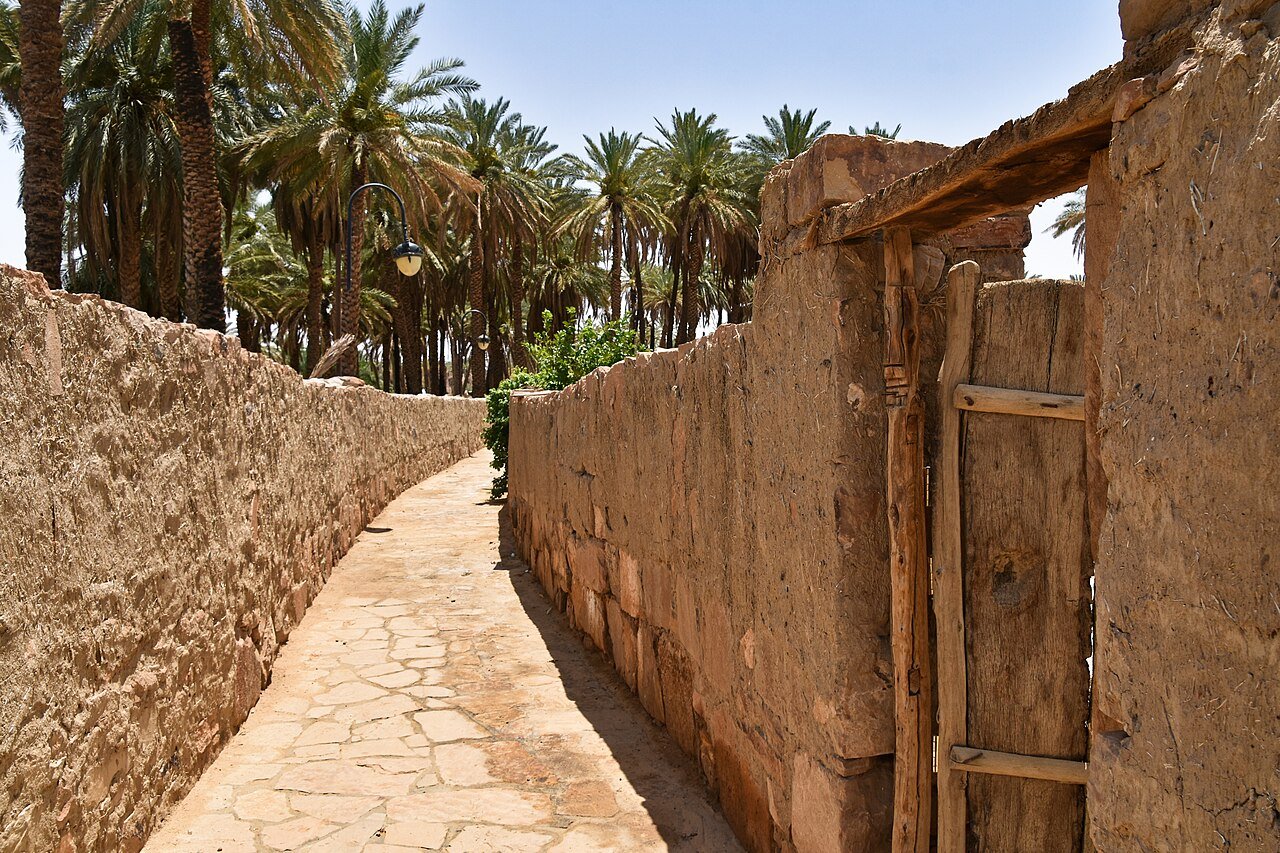
The most visible ancient feature is the massive mudbrick Haddaj wall, which originally enclosed approximately 9 square kilometres. Sections of this wall, reaching several metres in preserved height, are accessible around the perimeter of the ancient settlement. The Haddaj well, a large ancient stone-dressed well still in use into the 20th century, marks the settlement primary resource. The Qasr al-Hamra, the Nabataean temple, shows well-preserved carved stonework and is accessible with local guidance.
The Tayma Municipal Museum in the town centre displays pottery, inscribed stones, metalwork, and reconstructed architectural elements from the excavations. Several Lihyanite and Aramaic inscribed stones are displayed here; the Tayma Stone itself is in the Louvre. The museum provides essential context for the spread-out ancient remains visible across the modern town and its periphery.
Practical information
- Tayma Museum: In the town centre; free entry; typically open Saturday through Wednesday mornings
- Site access: The Haddaj wall circuit is accessible on foot; palace area and temple require permission or guided access
- Accommodation: Basic hotels in Tayma town; Tabuk offers a wider range and the nearest major airport
- Visitor registration: Foreign visitors should register with the Saudi Heritage Commission in advance
- Best time: October to March; summer temperatures exceed 45 degrees Celsius
Getting there
Tayma lies approximately 280km east of Tabuk on Highway 70, which connects Tabuk and Ha’il. Tabuk Regional Airport has connections to Riyadh and Jeddah. No public transport connects Tabuk and Tayma; private vehicle or organised tour from Tabuk are the practical options, with a drive of approximately 2.5 hours through desert plateau. AlUla (the Nabataean city of Hegra, UNESCO World Heritage Site) lies approximately 250km south of Tayma on Highway 375 and forms a logical combined destination.
Nearby
- AlUla and Hegra — Nabataean city with rock-cut royal tombs, UNESCO World Heritage Site; approximately 250km south
- Khaybar — ancient volcanic oasis settlement with lava field archaeology; approximately 300km south on the road to Medina
- Tabuk — regional capital 280km northwest; Tabuk Castle and small archaeological museum
- Dedan (al-Ula old town) — pre-Nabataean oasis kingdom with lion-carved rock monuments in the AlUla valley
Sources
- Beaulieu, P.-A. — The Reign of Nabonidus, King of Babylon 556-539 B.C. Yale Near Eastern Researches, 1989
- Hausleiter, A. et al. — The Oasis of Tayma: Interdisciplinary Research at a Major Bronze and Iron Age Centre in Northwest Arabia, Proceedings of the Seminar for Arabian Studies 40, 2010
- Gadd, C.J. — The Harran Inscriptions of Nabonidus, Anatolian Studies 8, 1958
- Doughty, C.M. — Travels in Arabia Deserta, 1888
- Wikipedia: Tayma
Find it on the map
See this place and what’s around it →📷 Diventa un fotografo di Cultural Heritage Online
Condividi le tue foto dei luoghi: restano pubblicate con la tua firma come autore. Più vengono viste, più ti fai conoscere — e presto un concorso premierà le foto più apprezzate.
Accedi o registrati gratis per aggiungere una foto