
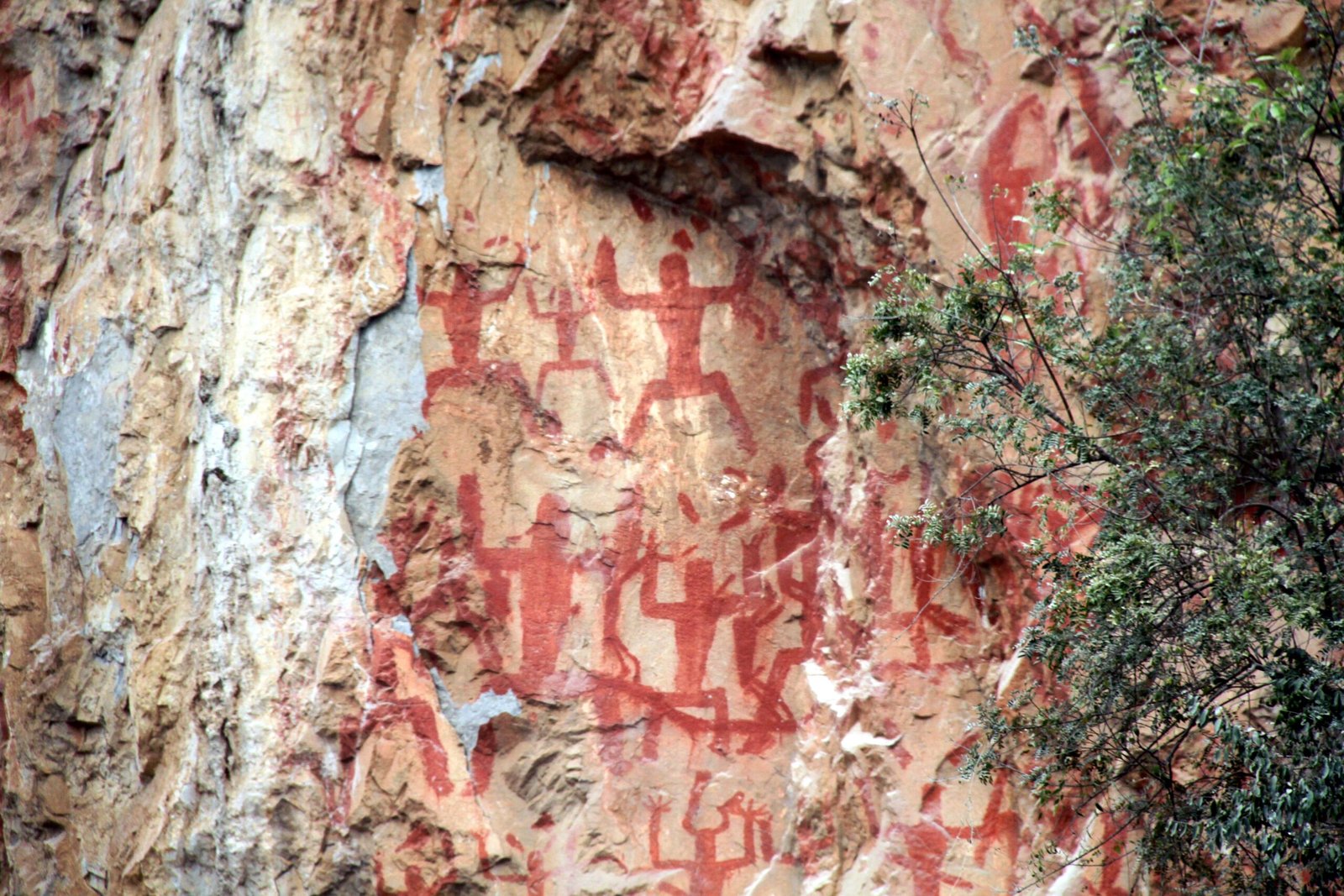
On the vertical faces of sheer limestone cliffs rising above the Li River in southern China, thousands of red ochre paintings were made by the Luoyue people — ancestors of the modern Zhuang, China’s largest ethnic minority — between 500 BC and 200 AD. Only visible from the river. How they were made remains unsolved.
At a Glance
The Zuojiang Huashan Rock Art Cultural Landscape, inscribed by UNESCO in 2016, comprises a succession of sheer limestone cliffs along the Mingjiang River (Li River) in Guangxi, southern China, bearing red ochre paintings created by the Luoyue people between approximately 500 BC and 200 AD. The Huashan cliff itself is approximately 220 metres wide with 40 metres of painted surface, containing over 1,900 individual figures — the largest single painted cliff face in China and the largest rock art composition in the world in terms of figures on a single surface. The paintings can only be seen from the river: visitors take boat tours along the Mingjiang.
Key Facts
- Period: c. 500 BC – 200 AD (Luoyue / Zhuang people)
- UNESCO WHS: 2016 (Zuojiang Huashan Rock Art Cultural Landscape)
- Figures at Huashan cliff: Over 1,900 individual figures on a single surface
- Height: Paintings at up to 100 metres above the river surface
- Pigment: Red ochre (iron oxide) mixed with animal blood or fat
- Access: River boat only; paintings cannot be approached at close range
- Nearest city: Chongzuo, Guangxi; 4 hours from Nanning by road
History and People
The paintings were created by the Luoyue, the ancient inhabitants of what is now Guangxi and northern Vietnam, who are considered the direct ancestors of the modern Zhuang — China’s largest ethnic minority, numbering approximately 18 million people. The paintings were made over a period of roughly 700 years, from approximately 500 BC to 200 AD, a time span that encompasses the late Zhou dynasty through the early Han dynasty in Chinese historical terms. During this period the Luoyue maintained a distinct identity outside the expanding Chinese empire, with their own bronze drum culture, ritual practices, and material world.
The paintings were known to local people and to Chinese officials in the region for centuries — the earliest written reference is from the Song dynasty (960–1279 AD). Scientific study began in the 1950s with surveys by Chinese archaeologists. The 2016 UNESCO inscription recognised the site as an exceptional example of Bronze Age ritual art associated with an ethnic culture that survives to the present.
The Paintings
The pigment is a red ochre (iron oxide) mixed with animal blood or fat, applied in a flat, silhouette style without internal detail. The largest human figure at Huashan is approximately 3 metres tall. The composition at the main Huashan cliff is organised around a central large figure with upraised arms — interpreted as a chief, a shaman, or a deity — surrounded by lateral figures in similar postures, horses, dogs, bronze drums (the most sacred objects of Luoyue culture), and boats with oarsmen. Bronze drums appear repeatedly across the composition: they were used in rain ceremonies, fertility rituals, and as symbols of chiefly authority.
The mystery of how the paintings were made has never been resolved to scholarly consensus. The cliff faces at Huashan are not scalable by ordinary climbing, and an overhang above the painted sections would prevent rope work from above. The river at the base was 20–30 metres lower in the ancient period. Theories include: scaffolding from boats; floating bamboo scaffolding assembled on water; or suspension from tree roots (physically impossible for the highest sections). No definitive explanation exists. This unresolved question is part of the site’s enduring fascination.
Practical Information
The site is managed by the Ningming County government and the Guangxi cultural heritage authority. Visitors take organised boat tours on the Mingjiang River from a purpose-built visitor centre near Ningming city, Chongzuo. Boat tours typically last 2–3 hours and include commentary in Mandarin (English audio guides available at the visitor centre). The paintings cannot be approached on foot — there is no path along the cliff base. Early morning light from the east illuminates the red ochre most vividly. The site is open year-round; best in dry season (October–April) when river levels and visibility are optimal.
Getting There
- From Nanning: High-speed rail to Chongzuo (c. 45 min); then bus or taxi to Ningming (c. 1 hour); then shuttle to visitor centre
- By road: Chongzuo to Ningming approximately 60 km south; visitor centre is 10 km further along the river
- Nearest airport: Nanning Wuxu International Airport (NNG), 180 km north
- Boat tours: Depart from the visitor centre; combined with the Huashan scenic area; book at the site or through Chongzuo tourism agencies
Nearby
- Mingjiang River scenic corridor — the same boat tour passes multiple painted cliff sections beyond Huashan; the full Zuojiang UNESCO landscape covers 13 river sections across 105 km
- Ningming Huashan scenic area — ground-level interpretive centre with bronze drum collection and Zhuang cultural exhibits adjacent to the boat departure point
- Detian Waterfall (Détián Puù) — 200 km east near the Vietnamese border: one of the largest waterfalls in Asia, on the Sino-Vietnamese border; a natural landmark of comparable drama
- Chongzuo Eco-Park — home to the world’s largest population of white-headed langurs, an endangered primate found only in this limestone karst region
Sources & Resources
- Wikipedia: Zuojiang Huashan Rock Art
- UNESCO World Heritage: Zuojiang Huashan Rock Art Cultural Landscape
- Wei Zheng, Huashan Rock Art and the Luoyue Culture (Guangxi Normal University Press, 2014)
- Guangxi Cultural Heritage Bureau — Survey Reports on Huashan Rock Art (1985–2003)
- David S. Whitley, The Cambridge Handbook of the Archaeology of Rock Art (Cambridge University Press, 2017)
Find it on the map
See this place and what’s around it →📷 Become a Cultural Heritage Online photographer
Share your photos of places: they stay published under your name as the author. The more they're seen, the more you get noticed — and soon a contest will reward the most appreciated photos.
Log in or sign up free to add a photo