
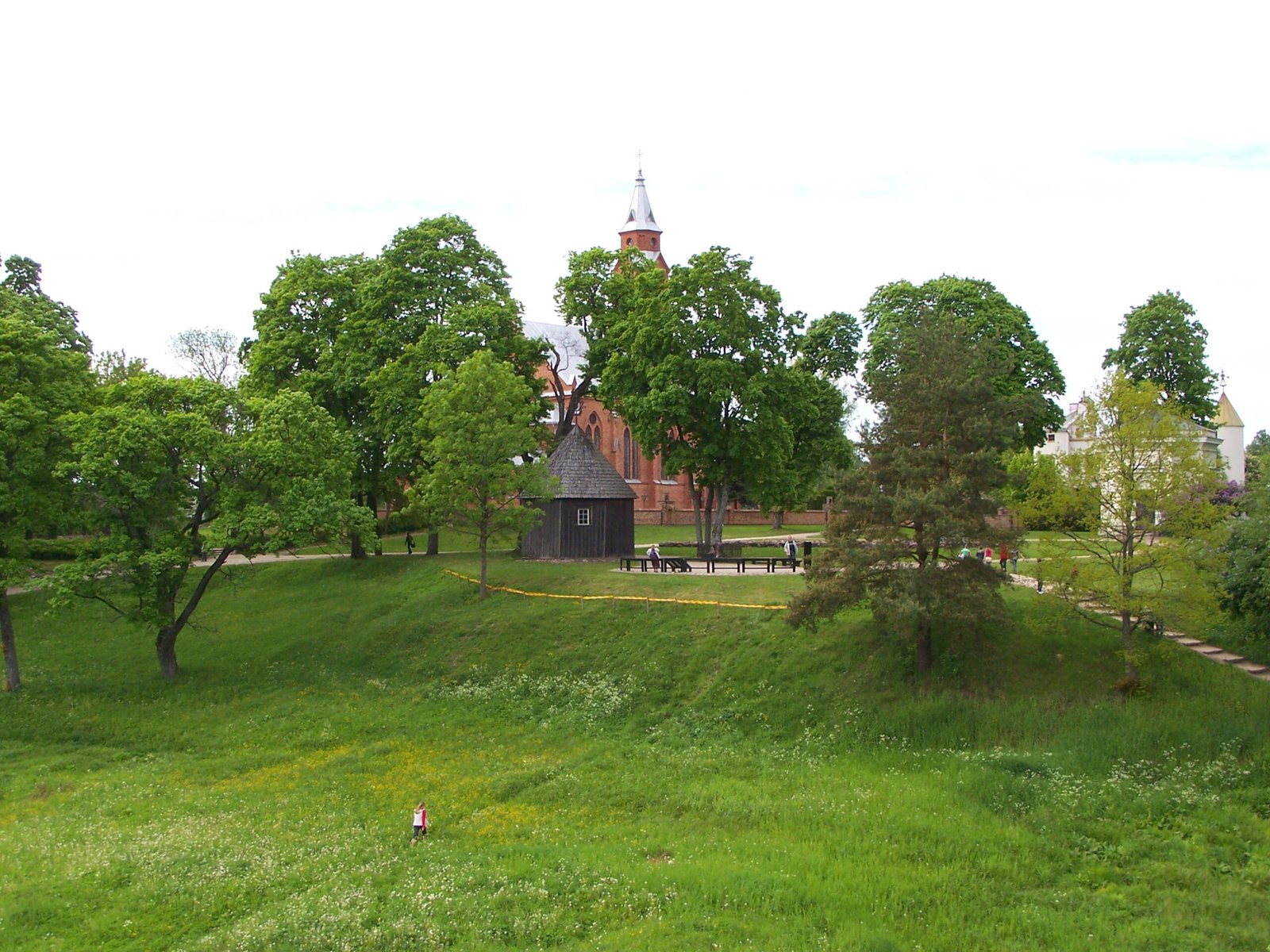
Five dramatic earthen hill-forts on a bend of the Neris River mark the site of Lithuania’s first capital — a town that flourished for a century, was destroyed by the Teutonic Knights in 1390, and was never rebuilt, leaving the most complete frozen record of medieval Baltic urban life in existence.
At a glance
Called the Lithuanian Troy for its superimposed layers of occupation spanning 12,000 years, Kernavė is the ancient capital of Lithuania. Five steep earthen mounds rise dramatically above the Neris River floodplain 35 kilometres northwest of Vilnius: each mound represents a different fortified settlement built on the same strategic river bend, from the Upper Palaeolithic through the medieval period. The medieval town — which flourished in the 13th-14th centuries as the first capital of the unified Lithuanian state — was razed by the Teutonic Knights in 1390 and never recovered, making it an archaeologically intact record of pagan Baltic culture. UNESCO inscribed it in 2004.
Key facts
- Location: Širvintos district, Lithuania — 54°52′60″N, 24°50′0″E; 35 km northwest of Vilnius
- Occupation span: c. 10,000 BC (Upper Palaeolithic) to 14th century AD — over 12,000 years continuous
- UNESCO inscription: 2004 — exceptional testimony to the pagan Baltic cultural tradition
- Medieval capital: First capital of Lithuania under Duke Mindaugas (crowned king 1253 AD, the only Lithuanian ruler ever crowned)
- Destroyed: 1390 by the Teutonic Knights; never rebuilt — making it archaeologically intact
- Oldest calendar in the Baltic region: Bone fragment with calendrical notches, c. 12,000 BC, recovered from Kernavė
- Nickname: the Lithuanian Troy for its multi-layered stratigraphy
History
The five hill-forts of Kernavė occupy the same strategic position — a bend in the Neris River where elevated ground commands the river crossing — but represent successive, separate settlements built over 12,000 years. The earliest occupation dates to the Upper Palaeolithic (c. 10,000 BC); subsequent layers include Mesolithic camp sites, Neolithic settlements, Bronze Age hillforts, Iron Age fortified towns, and finally the medieval city. Excavations since the 1960s have produced remarkable finds: the oldest known calendar in the Baltic region (a bone fragment with calendrical notches dated to approximately 12,000 BC), Iron Age iron-smelting workshops, and cremation burial sites demonstrating the Baltic pagan ritual tradition.
The medieval chapter of Kernavė is the most politically significant. In the early 13th century, Duke Mindaugas unified the Lithuanian tribes and made Kernavė his capital. In 1253, Mindaugas was crowned King of Lithuania by papal decree — the only Lithuanian ruler ever to receive a royal crown — before being assassinated in 1263 in a dynastic struggle. Under subsequent rulers, Kernavė remained an important centre: a town of approximately 1,000 inhabitants with an Orthodox church, a Dominican monastery, metalworking and leather workshops, and significant craft production. The town’s prosperity rested on its position controlling river trade.
In 1390, Teutonic Knights — the crusading military order that had waged a century-long campaign to Christianise the pagan Lithuanians — attacked and burned Kernavė. The town was never rebuilt. Vilnius, the new capital established in 1323 by Grand Duke Gediminas, absorbed all administrative and commercial functions. Kernavė’s destruction created, inadvertently, one of Europe’s most valuable archaeological sites: a medieval Baltic town frozen at a single moment, without the later construction layers that have destroyed comparable sites elsewhere.
What you see
The five mounds are the dominant visual feature: steep, grass-covered earthen fortifications rising abruptly from the flat Neris River floodplain. From the highest mound, the river bend and the surrounding agricultural landscape are visible for kilometres in every direction — the strategic logic of the site is immediately apparent. The mounds are linked by footpaths; interpretive panels mark key locations. At the base of the mounds, excavations have exposed sections of the medieval town’s streets, building foundations, and refuse deposits. The on-site museum (State Cultural Reserve of Kernavė) presents the chronological sequence through artefacts including the bone calendar fragment, Iron Age tools, medieval ceramics, and religious objects from the Orthodox church. In late June, the site hosts Lithuania’s largest living history festival, Midsummer celebration, drawing thousands of visitors in medieval costume.
Practical information
- Museum opening hours: Tuesday–Sunday 10:00–18:00 (seasonal variation; check ahead in winter)
- Entry fee: Paid admission to the museum; the mounds themselves can be walked freely
- Guided tours: Available from the museum; advance booking recommended for groups
- Midsummer Festival: Annual event in late June — extraordinary living history gathering; book accommodation in Vilnius well in advance
- Walking: Comfortable shoes essential; mound paths are steep and can be slippery after rain
Getting there
Kernavė lies 35 kilometres northwest of Vilnius, in Širvintos district. By car from Vilnius: take the A2 motorway northwest, then local roads via Musninkai (approx. 45 minutes). By public transport: regular buses from Vilnius Central Bus Station to Kernavė village (approx. 1 hour); the museum is a short walk from the village centre. The site is also accessible as a half-day guided tour from Vilnius — the most convenient option for visitors without a car. Vilnius International Airport is 40 km from the site.
Nearby
- Vilnius Old Town — 35 km southeast; UNESCO-inscribed baroque capital; Cathedral Square, Gediminas Tower, Užupis artists’ quarter
- Trakai Castle — 25 km south; Gothic island castle of the Lithuanian Grand Dukes on Lake Galvė
- Neris Regional Park — surrounding area; river meanders, forests, and medieval mound sites accessible by kayak or on foot
Sources
Find it on the map
See this place and what’s around it →📷 Diventa un fotografo di Cultural Heritage Online
Condividi le tue foto dei luoghi: restano pubblicate con la tua firma come autore. Più vengono viste, più ti fai conoscere — e presto un concorso premierà le foto più apprezzate.
Accedi o registrati gratis per aggiungere una foto