
The Most Acoustically Perfect Theater Ever Built
Stand at the centre of the orchestra — the circular stone floor of the Theatre of Epidaurus, 20 metres in diameter — and speak in a normal voice. In the back row, sixty metres away and thirty metres above you, a person can hear every word with perfect clarity. This is not acoustical legend or archaeological hyperbole: it has been measured, tested, and since 2007, explained. The Theatre of Epidaurus is the acoustically best-performing large open-air theater ever built, and it achieves its effect through properties of its limestone seating that its architects could not have understood by modern physics — but that they somehow designed correctly.
Built around 340–330 BC by the architect Polykleitos the Younger, the theater has survived more than 2,350 years of use and non-use, earthquake, and sediment burial. It was rediscovered in 1881, excavated 1881–1883, and has been in continuous seasonal use since the Epidaurus Festival was established in 1954. Every summer, 14,000 people sit in an open-air theater built in the fourth century BC and watch ancient Greek drama performed in the language it was written in.
The Architecture of Perfect Sound
The theater has 55 rows of seats arranged in a near-perfect semicircle on a naturally sloping hillside: the lower 34 rows at a gradient of 26°, the upper 21 rows at 27°. The seating capacity is approximately 13,000–14,000 spectators. The orchestra — the circular performance area — has a diameter of 20.28 metres and is surfaced in compacted stone. The theatron (the seating area) terminates at either end in parabolic curved retaining walls called the analemma.
The acoustic geometry is precise: the center of the orchestra is the focal point of the semicircular seating plan, which means that sound waves from a speaker at the center radiate outward in a pattern that reaches every seat at approximately the same angle. This geometry is common to all Greek theaters. What is extraordinary at Epidaurus is the additional acoustic filtration provided by the limestone seats themselves.
The 2007 Scientific Explanation
For more than a century after its rediscovery, the acoustics of Epidaurus were attributed to the theater’s geometry, to the surrounding hills, or — less charitably — to exaggeration. The acoustic effect was real (every visitor confirmed it) but no agreed physical explanation existed. In 2007, researchers at Georgia Institute of Technology (led by Nico Declercq and Cindy Dekeyser) published a study in the Journal of the Acoustical Society of America that identified the mechanism.
The limestone rows of seats act as acoustic filters: they absorb low-frequency sounds (bass tones, crowd murmurs, wind, environmental background noise) while reflecting high-frequency sounds back toward the audience. Human speech contains its intelligibility — the consonants that distinguish words — primarily in the high-frequency range above 500 Hz. Background noise is concentrated in the low-frequency range. The limestone seats, in effect, eliminate the noise and amplify the signal. The theater was not designed with any modern understanding of acoustics, but the builders chose the right material, the right geometry, and the right dimensions — and the result is a signal-to-noise ratio that no modern outdoor theater engineer has reliably replicated at this scale.
Theater as Medicine
The theater was not built for entertainment in the modern sense. It was an integral part of the Sanctuary of Asclepius at Epidaurus — one of the most important healing sanctuaries in the ancient world. Asclepius was the Greek god of medicine, and Epidaurus was his primary sanctuary; patients travelled from across the Mediterranean to receive healing through incubation — sleeping in the sacred dormitory (enkoimeterion) and receiving healing dreams from the god.
The ancient Greeks believed that music, theatrical performance, and comedy were themselves therapeutic: watching a comedy or a tragedy was considered beneficial to health, a relief of tension, an emotional cleansing. Patients at Epidaurus were required to attend theatrical performances as part of their treatment. The theater was built to serve the sanctuary’s medical mission — which makes Epidaurus the world’s first institution to formally integrate performance with healthcare. The acoustic perfection of the theater may thus have been understood not as engineering but as sacred gift: the voice of Asclepius, carrying without effort to the farthest seat.
The Sanctuary of Asclepius
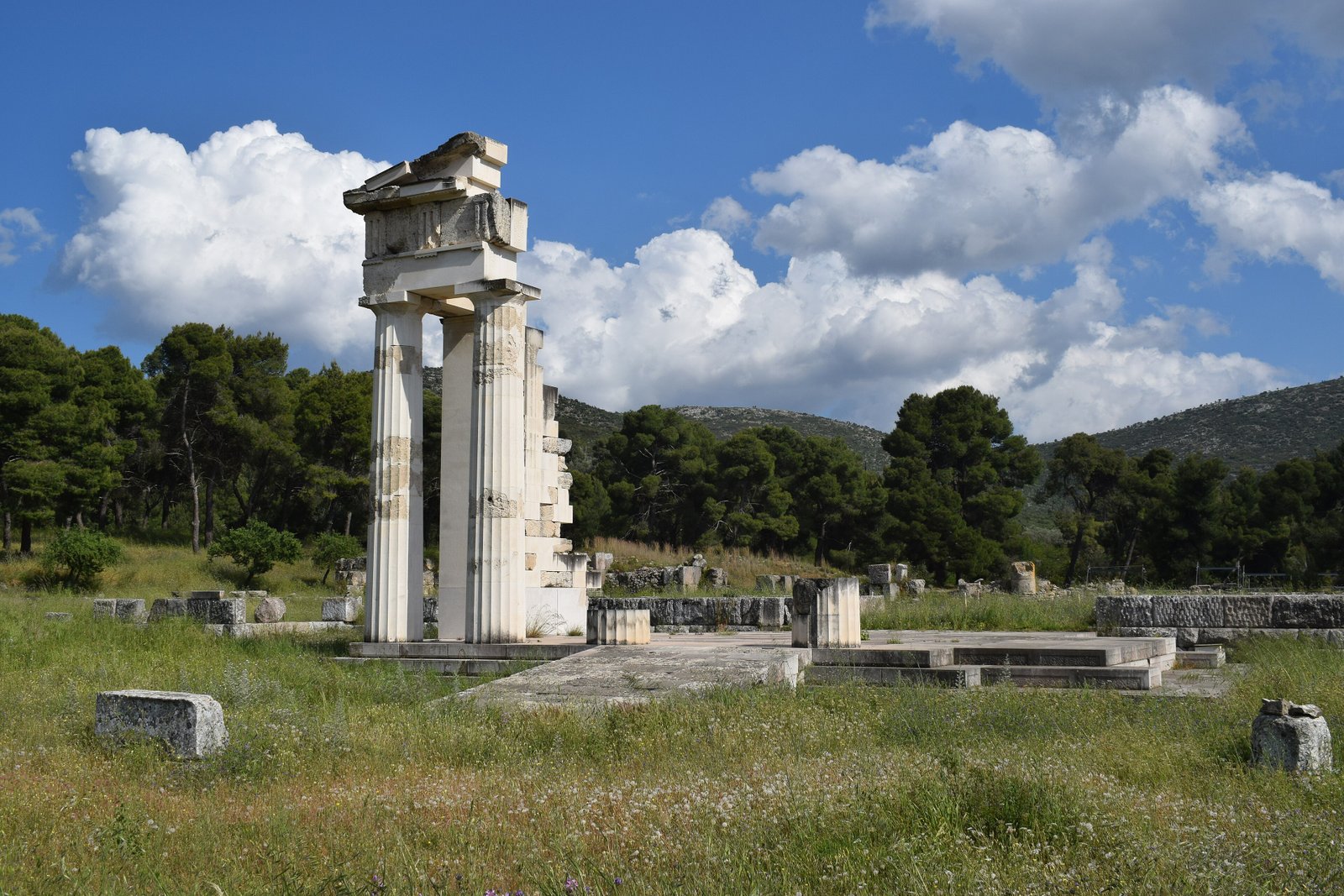
The theater is the most famous element of a larger sanctuary complex that includes several other significant structures. The Temple of Asclepius (c. 380 BC) housed the cult statue and was one of the most important temples in Greece; fragments of its sculptural programme survive in the on-site museum. The Tholos (c. 360 BC) — a circular building whose function remains debated — has one of the most intricate floor plans in ancient Greek architecture, with concentric rings of different-coloured stone. The enkoimeterion (the sacred dormitory where patients slept awaiting healing dreams) was a large colonnade building; the banqueting hall (hestiatorion) could seat 300 per room across multiple dining halls.
The sanctuary operated as a complete resort of the ancient world: gymnasium, stadium, guest houses, and baths supplemented the medical and religious programme. At its height in the fourth and third centuries BC, Epidaurus was receiving patients and pilgrims from across the Eastern Mediterranean. Dedicatory inscriptions recording miraculous cures (the iamata, or cure steles) survive in the museum — a catalogue of diseases, injuries, and afflictions that ancient Greeks brought to Asclepius over several centuries.
Discovery, Excavation, and the Epidaurus Festival
The theater fell into disuse in the third century AD as Christianity spread and the pagan sanctuary was closed. Over the following centuries, it was buried under accumulated sediment and forgotten — its existence known only from ancient texts. The site was rediscovered in 1881 by archaeologist Panagiotis Kavvadias of the Greek Archaeological Society, who conducted the first systematic excavation in 1881–1883 and cleared the theater to its current state. The seating rows that visitors walk on today were cleared and partially restored (primarily the upper tier) in the twentieth century.
The Epidaurus Festival was established in 1954 by the National Theatre of Greece. It runs each summer (typically late June through August), staging ancient Greek tragedy and comedy — in ancient Greek and in modern Greek translation — on Fridays and Saturdays. Performances draw audiences from across Greece and internationally; tickets sell out weeks in advance for major productions. The experience of sitting in the third-century BC theater as the sun sets over the hills while an ancient text is performed in the original language, audible without amplification to every one of 14,000 seats, is without precise parallel anywhere in the world.
Visiting Epidaurus
Epidaurus is approximately 30 kilometres east of Nafplio and 150 kilometres southwest of Athens, in the Argolid region of the northeastern Peloponnese. By car from Athens: take the A7/E65 motorway south toward Nafplio and follow signs to Ligourio/Ancient Epidaurus — allow approximately 2 hours. By public transport: KTEL buses run from Athens to Nafplio, with connections toward Epidaurus. During the Festival season, special coaches run from Athens directly to the theater on performance evenings.
The archaeological site and museum are open daily year-round. The theater’s acoustic demonstration (dropping a coin in the orchestra) can be tested at any time outside performances. Allow 2–3 hours for the full site; the museum holds original architectural fragments and the iamata cure steles and is not to be skipped.
Essential Facts
- Built
- c. 340–330 BC; architect Polykleitos the Younger
- Capacity
- 13,000–14,000 spectators; 55 rows of limestone seats; 20.28m diameter orchestra
- Acoustic phenomenon
- A coin dropped in the orchestra is audible in the back row; explained 2007 by Georgia Tech: limestone seats filter low-frequency noise while reflecting speech frequencies
- Context
- Part of the Sanctuary of Asclepius; theatrical performance was prescribed as medical therapy
- UNESCO WHS
- 1988 (Archaeological Site of Epidaurus)
- Epidaurus Festival
- Annual since 1954; late June–August; ancient Greek drama; 14,000-seat outdoor theater
- Location
- 30 km east of Nafplio, Argolid, Peloponnese, Greece
- GPS
- 37.5978°N, 23.0756°E
- Access
- 2 hours from Athens by car; seasonal buses; festival coaches in summer
Find it on the map
See this place and what’s around it →📷 Become a Cultural Heritage Online photographer
Share your photos of places: they stay published under your name as the author. The more they're seen, the more you get noticed — and soon a contest will reward the most appreciated photos.
Log in or sign up free to add a photoIs this page about you?
This page is read by travellers and heritage enthusiasts who find it on Google. Tell us how you are connected to this place and we will take it from there.