
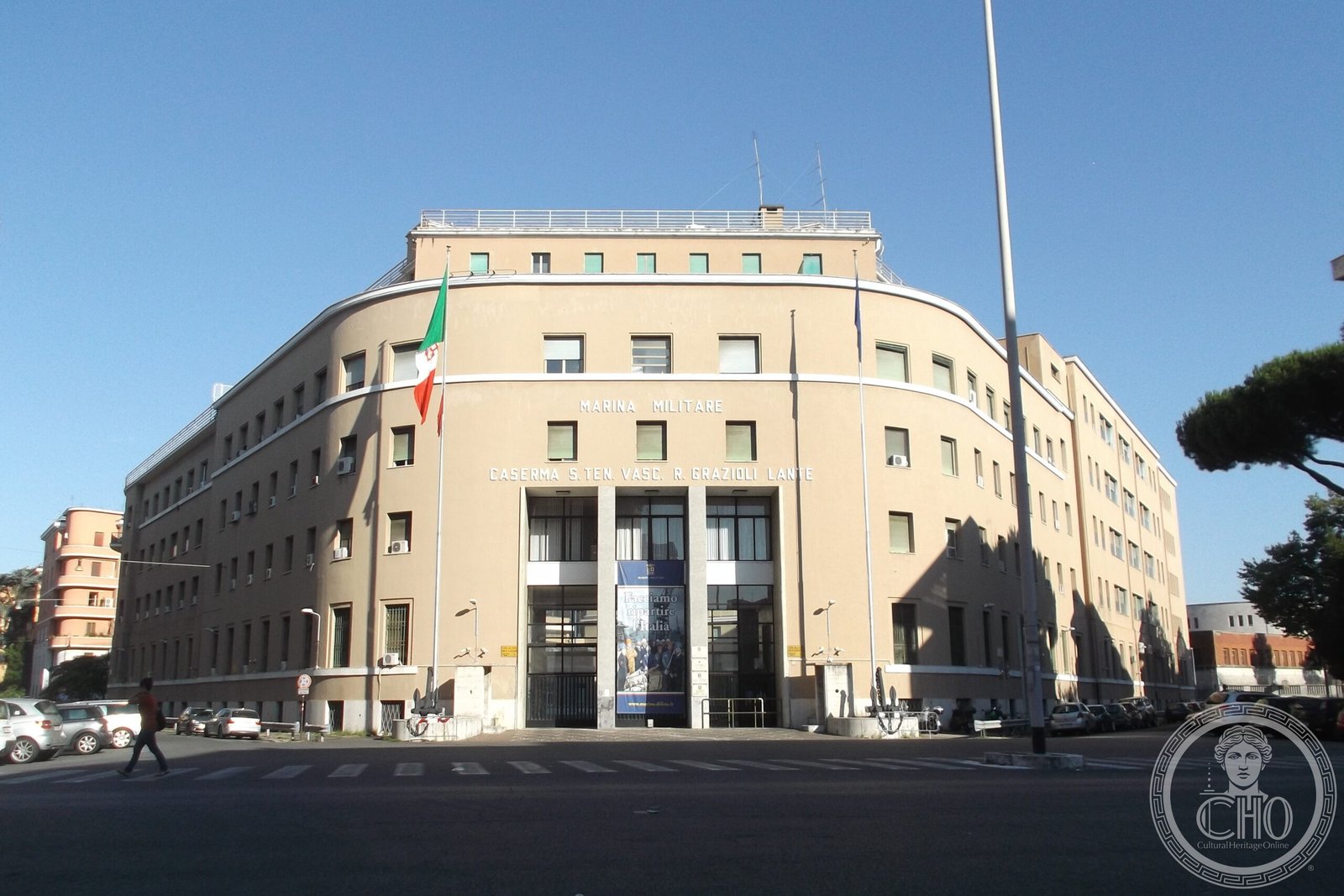
Military Navy Barracks – Grazioli Lante
The Caserma Riccardo Grazioli Lante della Rovere is a Rationalist military complex built in 1938 in the Prati district of Rome, near the Vatican. It serves as a barracks for the Italian Navy (Marina Militare) and stands as a representative example of the institutional architecture produced under the Fascist state in the late 1930s.
History
The building was commissioned and completed in 1938 as part of a broader programme of military urban construction in Rome ordered during the Mussolini era. This period saw the capital acquire numerous new public and institutional buildings in the Rationalist idiom — an Italian architectural movement that emerged in the late 1920s, combining modernist formal simplicity with monumental scale and references to classical Roman geometry. The barracks is named after Riccardo Grazioli Lante della Rovere, an Italian naval officer. Its construction coincided with the regime’s investment in military expansion and the symbolic refashioning of Rome as the capital of an empire. After World War II the building continued in active military use under the Italian Republic and remains a functioning Navy installation.
What to See
The complex is notable for its austere Rationalist façade: horizontal banding, clean geometric massing, and the restrained ornamental vocabulary characteristic of late-1930s Italian state architecture. The building forms part of the Prati neighbourhood’s layered urban fabric, where Fascist-era institutional blocks stand alongside earlier nineteenth-century residential streets. As an active military installation, interior access is restricted; the exterior is visible from the public street and reads clearly within the surrounding urban context.
Getting There
The barracks is located in the Prati district of Rome, west of the Tiber and north of the Vatican. The nearest Metro station is Ottaviano (Line A), approximately 10 minutes on foot. Several bus lines serve Via della Giuliana and adjacent streets. As the complex is an active military site, visitors should observe from the public pavement only.
Find it on the map
See this place and what’s around it →📷 Diventa un fotografo di Cultural Heritage Online
Condividi le tue foto dei luoghi: restano pubblicate con la tua firma come autore. Più vengono viste, più ti fai conoscere — e presto un concorso premierà le foto più apprezzate.
Accedi o registrati gratis per aggiungere una foto