
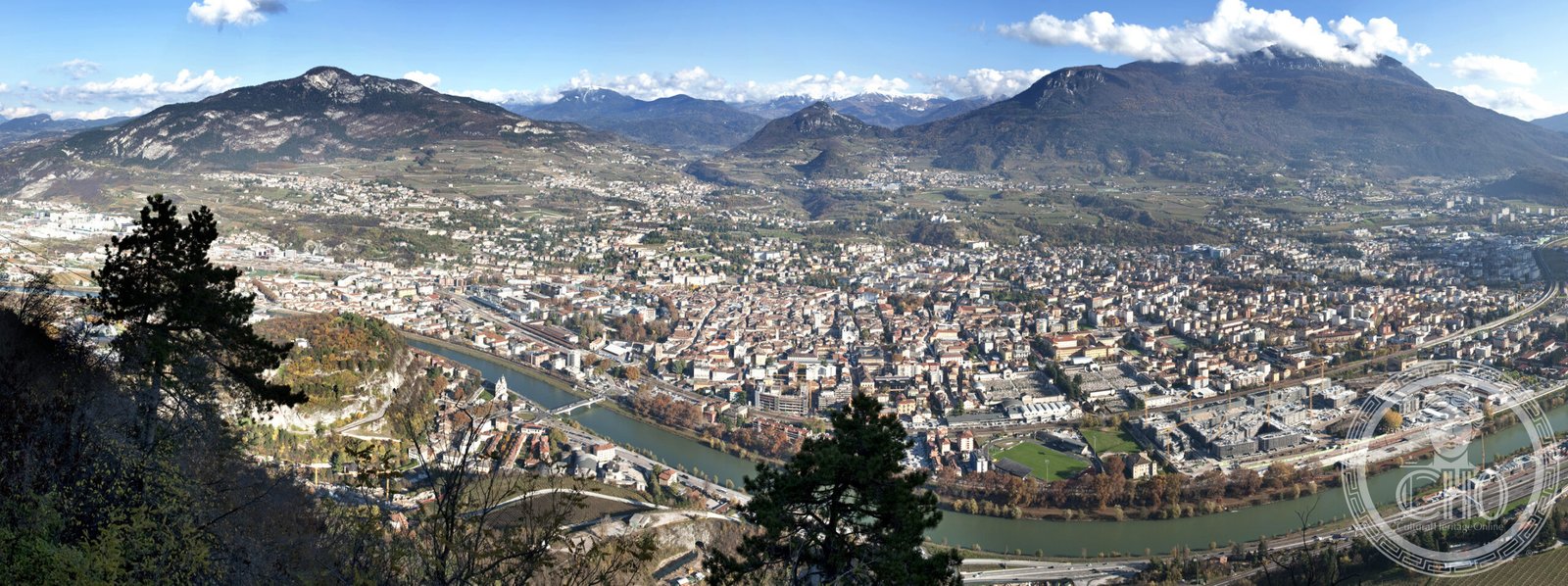
The capital of Trentino-Alto Adige, Trento evolved from a Roman military settlement into a strategic stronghold shaped by centuries of cultural exchange and geopolitical conflict.
At a glance
Trento’s history spans two millennia, from its origins as the Roman Tridentum through its pivotal role as a First World War fortress to its modern status as an autonomous regional capital. The city’s layered past reflects its position as a crucial crossroads in the Alpine valley system.
History
Archaeological evidence suggests Trento developed on a previous Rhaetian settlement, possibly built atop an ancient fortress on Doss Trento. The Adige Valley’s importance as a north-south communication route encouraged cultural exchanges with Venetian, Etruscan and Gallic populations before Roman contact.
Roman forces conquered Trentino during the first century BC. The settlement was transformed into a military camp and later elevated to municipium status between 50 and 40 BC, taking the name Tridentum—possibly derived from three hills resembling teeth (Doss Trento, Sant’Agata and San Rocco).
During the Augustan period, strategic Alpine operations elevated Trento’s importance. The city expanded according to classical Roman principles, with a quadrangular plan bounded by the Adige River and defensive walls punctuated by gates and towers.
In 1915, during the First World War, Trento became the headquarters of the Austro-Hungarian southern front and a fortress city ringed by defensive forts carved into rock—many still visible. More than 60,000 soldiers from Trentino served in Austro-Hungarian forces; approximately 10,000 from the province fell in battle.
Fascist policies dissolved Trento’s municipal council in 1923, ending centuries of autonomy. The Second World War brought devastating bombing campaigns from September 1943 to May 1945, with 80 air raids killing about 400 civilians and damaging over 1,700 buildings. Autonomy returned only after 1945 with the establishment of the Autonomous Region of Trentino-Alto Adige.
What you see
Trento’s Roman streetplan—with its cardo and decumanus axes—remains legible beneath medieval and modern development. The original defensive circuit included the monumental porta veronencis, a double gate flanked by circular towers.
The First World War fortress system dominates the surrounding landscape. Major General Steinhardt’s defensive network includes numerous forts partially preserved and open to visitors, many constructed within mountain rock itself. These structures testify to Austro-Hungarian military engineering at scale.
Cultural significance
Trento exemplifies the intersection of Alpine geopolitics, classical urbanism and twentieth-century conflict. Its Roman origins, medieval transformations and modern autonomy movement make it a palimpsest of European history compressed into one valley settlement.
The city’s experience during the Austro-Hungarian era and both World Wars illuminates the human cost of frontier regions caught between empires. Its subsequent development as an autonomous region represents post-war European recalibration of identity and governance.
Key facts
- Address: Via Rodolfo Belenzani 19
- Coordinates: 46.0804401, 11.050316
- Official website: http://www.comune.trento.it/
- Phone: 0461 884111
Practical information
The First World War fortress forts are partly open to visitors. Specific hours and access details are best confirmed at the city’s official website or by contacting the municipality directly.
Getting there
Trento is the capital and primary transportation hub of Trentino-Alto Adige. The city is served by road, rail and air connections to major Italian and Alpine destinations. Check official websites for current transport links and routes.
See the place
Sources & resources
Find it on the map
See this place and what’s around it →Historical events at this place (2)
📷 Become a Cultural Heritage Online photographer
Share your photos of places: they stay published under your name as the author. The more they're seen, the more you get noticed — and soon a contest will reward the most appreciated photos.
Log in or sign up free to add a photo