

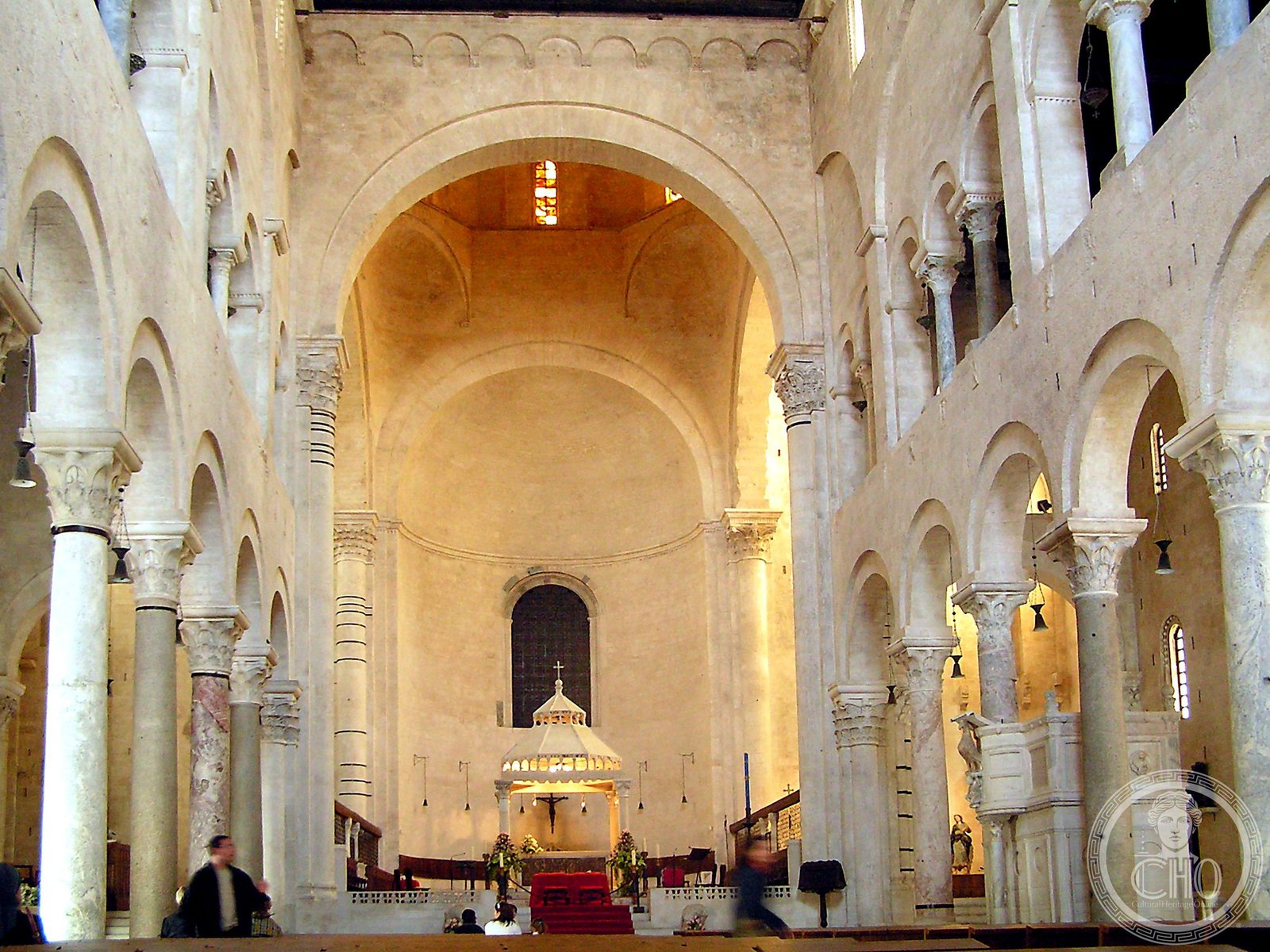
Built on the ruins of a Byzantine cathedral, this Romanesque church rose under Archbishop Rainaldo’s patronage and stands as a monument to Bari’s layered history of faith, crusade, and cultural exchange.
At a glance
The Cathedral of San Sabino, completed in 1292, represents one of Bari’s most significant architectural achievements. Constructed in Romanesque style across the 12th and 13th centuries, the building occupies a site of profound historical importance, replacing a Byzantine cathedral that had been destroyed. Its portal bears an image of King Arthur, a detail that speaks to the complex mythologies layered into the city’s identity.
History
Archbishop Rainaldo commissioned the cathedral’s construction on foundations marked by earlier devastation. The original floor of the Malo (1156) remains partially visible on the right side of the transept, extending beneath the central nave and offering archaeological evidence of the site’s continuous sacred use.
Bari itself held extraordinary historical weight during the medieval period. It was the seat of the only Arab Emirate on mainland Italy and the departure point for the First Crusade. In 1200, the city again became a stage for Crusade history during the Sixth Crusade, when Frederick II—excommunicated for his diplomatic overtures to Muslim powers—sailed from these waters. Around the same time, St. Francis of Assisi departed from nearby Ancona in 1219 to seek peace with Sultan Malik al-Kamil, establishing the Friars Minor’s presence in Jerusalem, a position they would hold exclusively among Western Catholic religious orders until the mid-19th century.
What you see
The cathedral embodies Romanesque architectural principles, with its construction concentrated in the later 13th century. The distinctive portal features an image of King Arthur, an unusual choice that underscores Bari’s intersection with Celtic mythology and the Matter of Brittany. Visitors can examine remnants of the 12th-century Malo structure, particularly on the right transept, where the original flooring stretches beneath the modern nave.
Cultural significance
San Sabino anchors Bari’s identity as a crossroads of cultures. The cathedral sits in a city that historically harbored Eastern influences, Arab rule, and profound connections to Crusade narratives. The presence of King Arthur in its iconography reflects medieval cultural currents that linked the Mediterranean Christian world to Northern European mythologies—a connection that appears in Bari’s traditions even before Arthur entered the literary canon. The cathedral also stands near the shrine of St. Nicholas, Bari’s patron saint, whose veneration bridges Eastern Orthodox and Western Catholic traditions.
Key facts
- Address: Piazza della Odegitria, 1, Bari
- Coordinates: 41.1285181, 16.8690502
- Completed: 1292
- Architectural style: Romanesque
- Phone: 080 521 0605
- Official website: https://www.arcidiocesibaribitonto.it/luoghi-di-culto/cattedrale/view
Practical information
The cathedral is located in central Bari on Piazza della Odegitria. Opening hours and admission details are available through the official diocesan website or by telephone.
Getting there
The cathedral is situated in Bari’s historic center. You can reach it by local public transport or on foot from the main train station. GPS coordinates are 41.1285181, 16.8690502.
See the place
Sources & resources
Find it on the map
See this place and what’s around it →📷 Become a Cultural Heritage Online photographer
Share your photos of places: they stay published under your name as the author. The more they're seen, the more you get noticed — and soon a contest will reward the most appreciated photos.
Log in or sign up free to add a photoIs this page about you?
This page is read by travellers and heritage enthusiasts who find it on Google. Tell us how you are connected to this place and we will take it from there.