
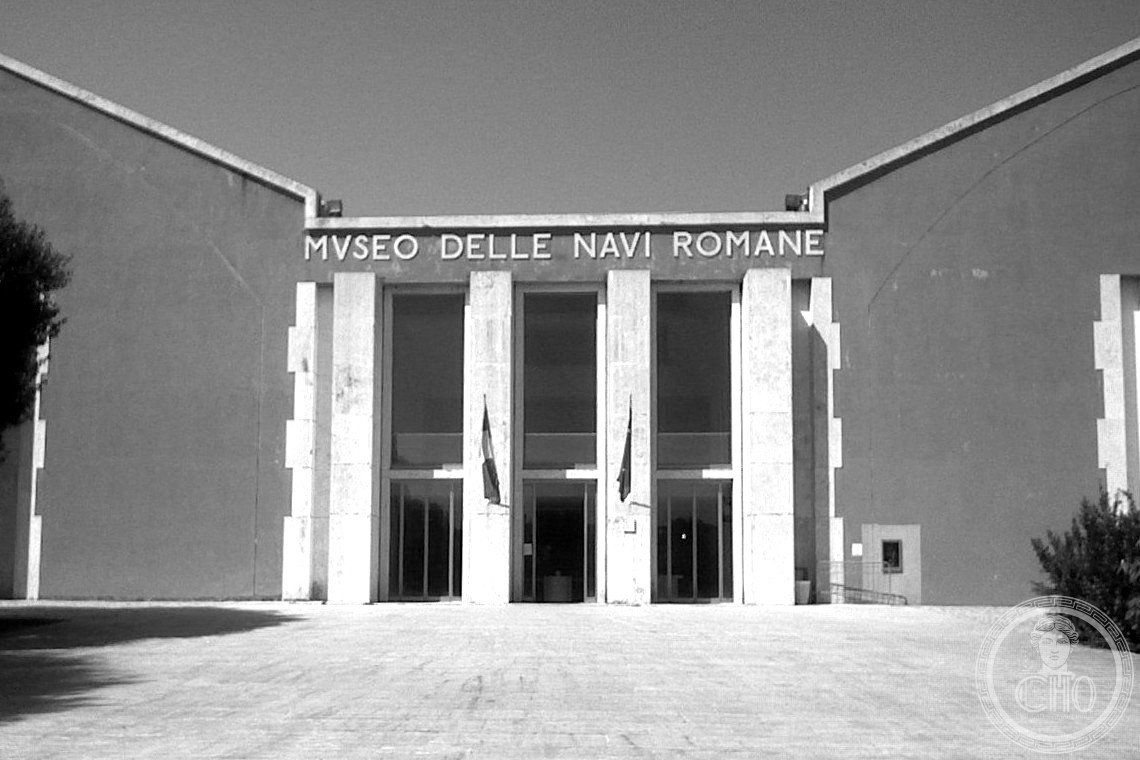
Two monumental vessels once belonged to Emperor Caligula. Sunk in Lake Nemi for nearly two millennia, they were recovered in the 20th century—only to be destroyed in World War II.
At a glance
The museum preserves the archaeological record of two extraordinary Roman ships discovered in Lake Nemi, southeast of Rome. Though the original vessels were destroyed by Allied bombing in 1944, the museum houses recovered artifacts and 1/5-scale reproductions that reconstruct their former grandeur.
History
No ancient author recorded the ships’ existence, yet fishermen pulled mysterious objects from the lake’s depths throughout the Middle Ages. The discovery of fistulae aquariae—lead pipes stamped with the imperial name—revealed their connection to Caligula. Upon the emperor’s death, the vessels were apparently sunk as an act of damnatio memoriae, his official condemnation and erasure from history.
Recovery attempts spanned four centuries. Cardinal Prospero Colonna commissioned the first effort in 1446, enlisting Leon Battista Alberti and Genoese swimmers. In 1535, Francesco De Marchi used an early diving bell; he measured the nearest ship at 64 meters long and 20 meters wide, its wood remarkably preserved beneath protective mud.
The third attempt came in 1827 under Annesio Fusconi; the fourth in 1895 recovered significant artifacts including bronze feline heads, rollers, hinges, and mosaic fragments. By 1926, a state commission under Senator Corrado Ricci proposed the definitive solution: lower the lake itself.
On 20 October 1928, Benito Mussolini activated the Etruscan-era drainage tunnel. On 28 March 1929, both ships surfaced. The triumph was short-lived: on the night of 31 May–1 June 1944, Allied bombing of a Nazi anti-aircraft battery destroyed both vessels entirely. Only artifacts previously moved to Rome’s National Museum survived.
What you see
The museum displays two 1/5-scale wooden reproductions of the original ships, exhibited sequentially in a dedicated wing. These models are based on detailed measurements and documentation from the 20th-century recovery.
The permanent collection includes recovered finds: ornamental bronze elements, lead pipes bearing imperial stamps, ceramic tiles, glass-paste mosaic fragments, and metalwork that attest to the vessels’ luxury and sophistication. These objects illustrate Roman engineering and the wealth of the imperial household.
Cultural significance
The ships represent a rare material window into imperial Roman life and naval construction. Their recovery dramatized early 20th-century archaeology and engineering prowess—yet their destruction epitomizes how modern conflict erases irreplaceable heritage.
The site itself remains potent: Lake Nemi’s shores once held the sanctuary of Diana, and the ancient drainage tunnel, built in the Etruscan period and refined by Romans, remains one of Europe’s earliest large-scale hydraulic engineering feats.
Key facts
- Address: Via del Tempio di Diana, 13, 00040 Nemi
- Coordinates: 41.722°N, 12.702°E
- Phone: 06 939 8040
- Official website: museonaviromane.it
- Original ships: Built for Emperor Caligula; sunk c. 37–41 CE
- Recovered: 1929; destroyed 1944
Practical information
Opening hours and admission fees are not listed on the provided source material; check the official website or call ahead for current details. The museum is managed by the Italian Ministry of Culture (MIBACT) as part of the Lazio museum complex.
Getting there
Nemi lies in the Castelli Romani hills, about 40 kilometers southeast of Rome. By car, take the Appian Way (Via Appia) or the Grande Raccordo Anulare toward Frascati, then follow signs to Lake Nemi and the museum. Public transport options from Rome include regional trains and buses to nearby towns, followed by local transport to the lake.
See the place
Sources & resources
Find it on the map
See this place and what’s around it →📷 Become a Cultural Heritage Online photographer
Share your photos of places: they stay published under your name as the author. The more they're seen, the more you get noticed — and soon a contest will reward the most appreciated photos.
Log in or sign up free to add a photoIs this page about you?
This page is read by travellers and heritage enthusiasts who find it on Google. Tell us how you are connected to this place and we will take it from there.