
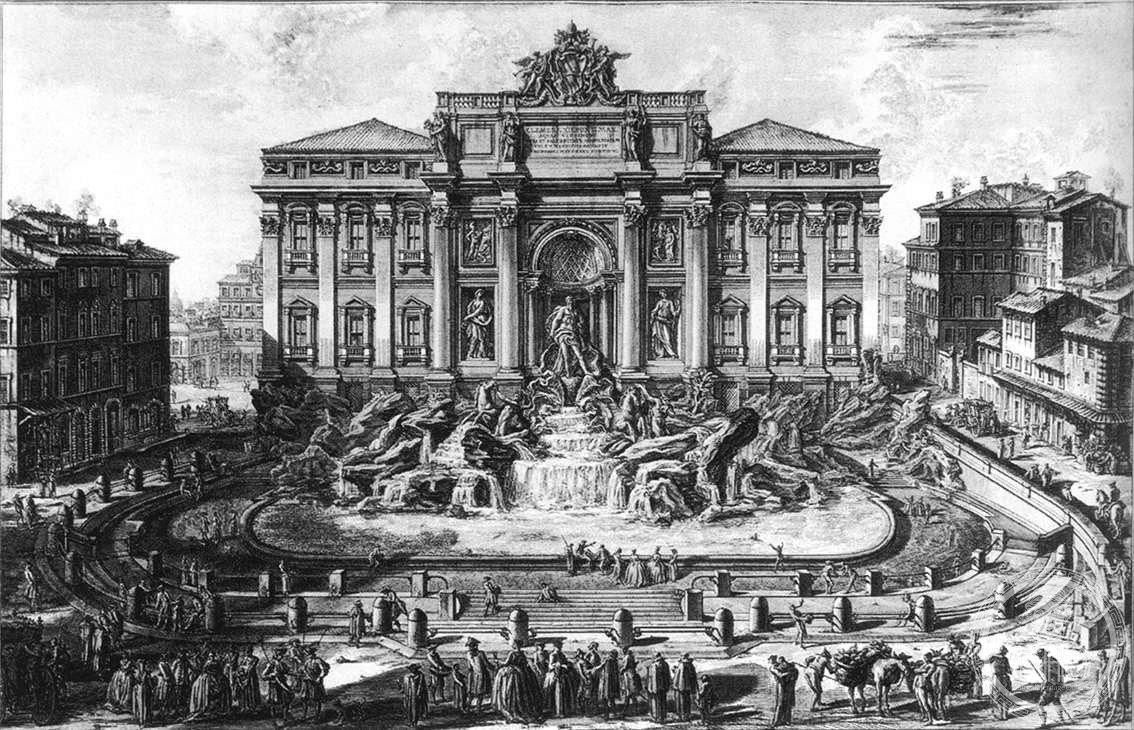
Rome’s largest and most celebrated fountain, the Trevi Fountain stands as a masterpiece of late Baroque design and one of the world’s most iconic water features.
At a glance
A monumental late Baroque fountain integrated into the façade of Palazzo Poli, the Trevi Fountain commands the piazza with its theatrical composition of marble, travertine, and sculptural drama. The fountain draws millions of visitors annually to its spray and grandeur.
History
Pope Clement XII commissioned a competition to design a fountain at this location. Nicola Salvi won the commission and began construction in 1732. Following Salvi’s death, Giuseppe Pannini oversaw the fountain’s completion in 1762, bringing three decades of work to conclusion.
What you see
The fountain combines travertine, marble, plaster, stucco, and metals in an elaborate sculptural program. At its center stands a marble statue of Oceanus, the god of the sea, commanding a triton who wrestles a wild seahorse—a dynamic composition that animates the entire composition with movement and energy.
Cultural significance
The Trevi Fountain represents the culmination of Baroque fountain design in Rome. Its integration with Palazzo Poli creates an urban spectacle where architecture and water merge, making it not merely a functional water feature but a sculptural and theatrical statement that has captivated viewers for nearly three centuries.
Key facts
- Address: Piazza di Trevi, 00187 Rome
- Coordinates: 41.9010, 12.4834
- Designed by: Nicola Salvi
- Completed by: Giuseppe Pannini
- Construction period: 1732–1762
- Style: Late Baroque
Practical information
The fountain is accessible to the public at all times. No admission fee is required. Opening hours and contact information are available through the official Rome tourism website.
Getting there
The Trevi Fountain is located in central Rome at Piazza di Trevi. The site is accessible by public transport, including metro and bus lines serving the historic center. The surrounding neighborhood offers ample pedestrian access.
See the place
Sources & resources
Find it on the map
See this place and what’s around it →📷 Become a Cultural Heritage Online photographer
Share your photos of places: they stay published under your name as the author. The more they're seen, the more you get noticed — and soon a contest will reward the most appreciated photos.
Log in or sign up free to add a photoIs this page about you?
This page is read by travellers and heritage enthusiasts who find it on Google. Tell us how you are connected to this place and we will take it from there.