
Mozambique’s capital carries a Portuguese colonial centre where Art Déco lines from the 1930s and 1940s give way to a bolder tropical modernism. The two languages still share the same streets.
At a glance
Maputo was called Lourenço Marques until 1976, the year after Mozambican independence. Under Portuguese rule it grew into what the colonial press called a cosmopolitan port, served by piers, quays and electric cranes, and it filled with the architecture of successive decades. Today its inner streets hold Portuguese colonial neoclassical and Manueline facades alongside the geometric clarity of Art Déco, the flat planes of Bauhaus-influenced work, and the experimental tropical modernism that followed. The result is one of southern Africa’s most layered urban centres, where a single block can move from a 1781 fort lineage to a 1950s apartment building in a few steps.
Key facts
- Country: Mozambique
- Former name: Lourenço Marques (renamed Maputo in 1976)
- Key period: 1930s–1950s
- Architectural mix: Art Déco, tropical modernism, Portuguese colonial neoclassical and Manueline
- Essential sites: Maputo Central Railway Station (1908–1916); the modernist works of Pancho Guedes; Hotel Polana, by Herbert Baker
- Coordinates: -25.96889, 32.57333
History
A Portuguese fort was established on the site in 1781, and the settlement took the name of the navigator Lourenço Marques, who had been sent to explore the area in 1544. The place rose slowly through the nineteenth century: a town in 1876, a city in 1887, and from 1898 the capital of Portuguese Mozambique. Its fortunes were tied to the sea and to the railway that reached toward the South African interior, and by the early twentieth century the well-equipped seaport had made it a busy regional hub.
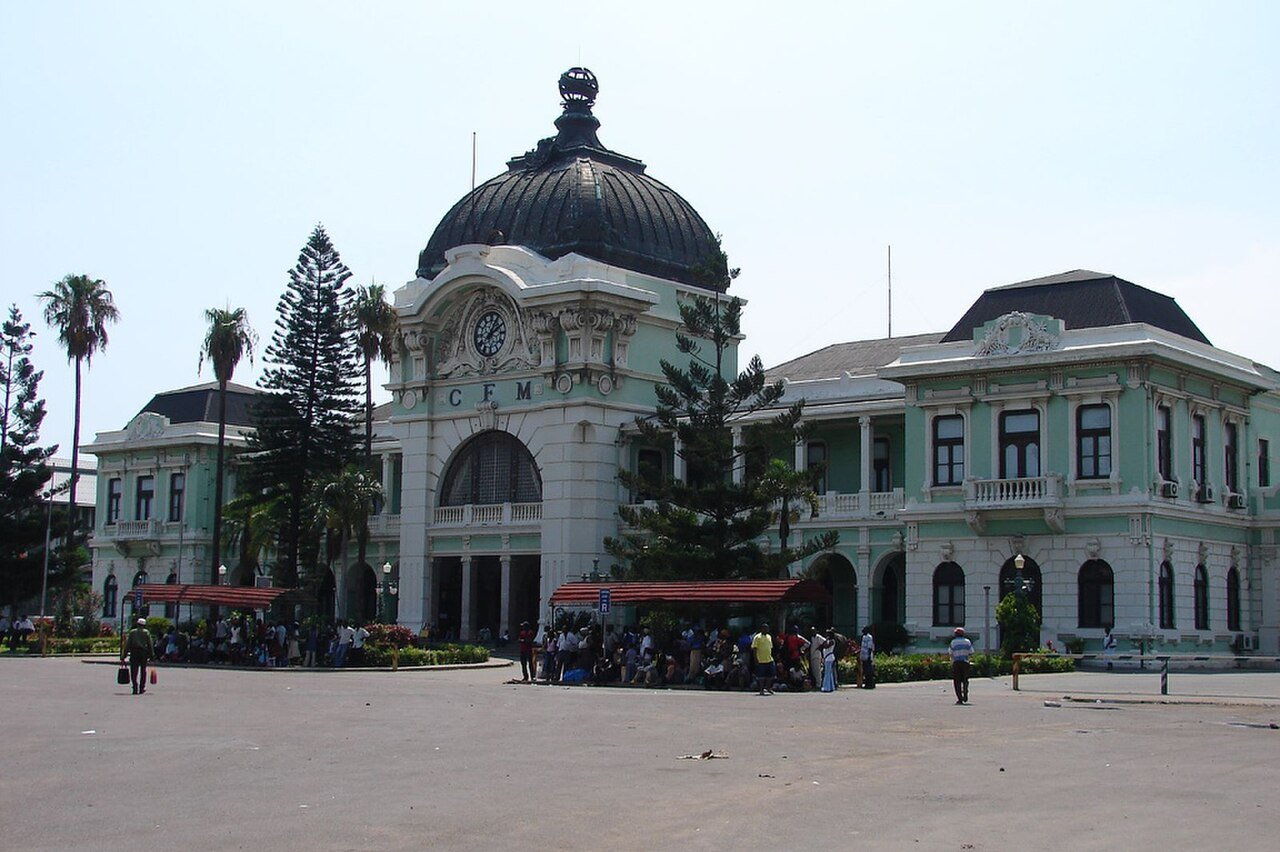
That commercial momentum shaped how the city looked. The Central Railway Station, planned by Alfredo Augusto Lisboa de Lima and Mario Veiga with a dome designed by José Ferreira da Costa, was built between 1908 and 1916 and inaugurated in 1910, a Beaux-Arts statement of the colony’s ambitions. In the decades that followed, as building activity intensified, the city centre absorbed the international currents of the 1930s and 1940s, and Art Déco became part of its everyday fabric.
The city changed names with the country. After independence in 1975, Lourenço Marques became Maputo in February 1976. The colonial-era buildings remained, now read through a different history: not as monuments to empire but as a built record that the city has continued to inhabit, repair and reinterpret.
What you see
The railway station anchors any first impression. Its copper-clad semispherical dome, often incorrectly attributed to Gustave Eiffel but in fact designed by José Ferreira da Costa, rises above a symmetrical Beaux-Arts facade of baked brick and cement, with ornamentation by Pietro Buffa Buccellato. From there the centre opens into the quieter rhythm of the interwar streets, where Art Déco buildings carry the period’s vocabulary of stepped parapets, vertical fins and clean horizontal banding.
The later layer belongs largely to Pancho Guedes — Amâncio d’Alpoim Miranda Guedes (1925–2015) — who built extensively here through the 1950s and 1960s. His Smiling Lion Apartments (Leão Que Ri) of 1956 is among his best-known works, an eclectic, sculptural modernism that bends practical apartment-block requirements toward figure and ornament. Walking the centre, the visitor reads these languages in sequence: colonial neoclassical, geometric Déco, and Guedes’s restless tropical modernism, often within the same few blocks.
Practical information
- The historic centre is compact and best explored on foot during daylight hours.
- The railway station building remains in use and its main hall and dome are the obvious starting point.
- Maputo sits on Maputo Bay; the climate is tropical, hot and humid in the wet season.
- Allow at least half a day to take in the station, the Déco streets and the Guedes buildings.
- Many buildings are working homes and offices; photograph facades respectfully.
Getting there
Maputo International Airport (airport code MPM) serves the capital and connects it to regional and international routes. From the airport the city centre is a short drive, and the railway station, the Déco core and the seafront are all within the central districts, close enough to combine on foot once you arrive.
Related in CHO
- Durban — Art Déco on the Indian Ocean
- Johannesburg — The Art Déco Skyline of the Gold City
- Cape Town — Mutual Heights and Cape Art Déco
Sources

Find it on the map
See this place and what’s around it →Record researched and written by Luigi De Marchi for Cultural Heritage Online, 2026.
📷 Become a Cultural Heritage Online photographer
Share your photos of places: they stay published under your name as the author. The more they're seen, the more you get noticed — and soon a contest will reward the most appreciated photos.
Log in or sign up free to add a photo