
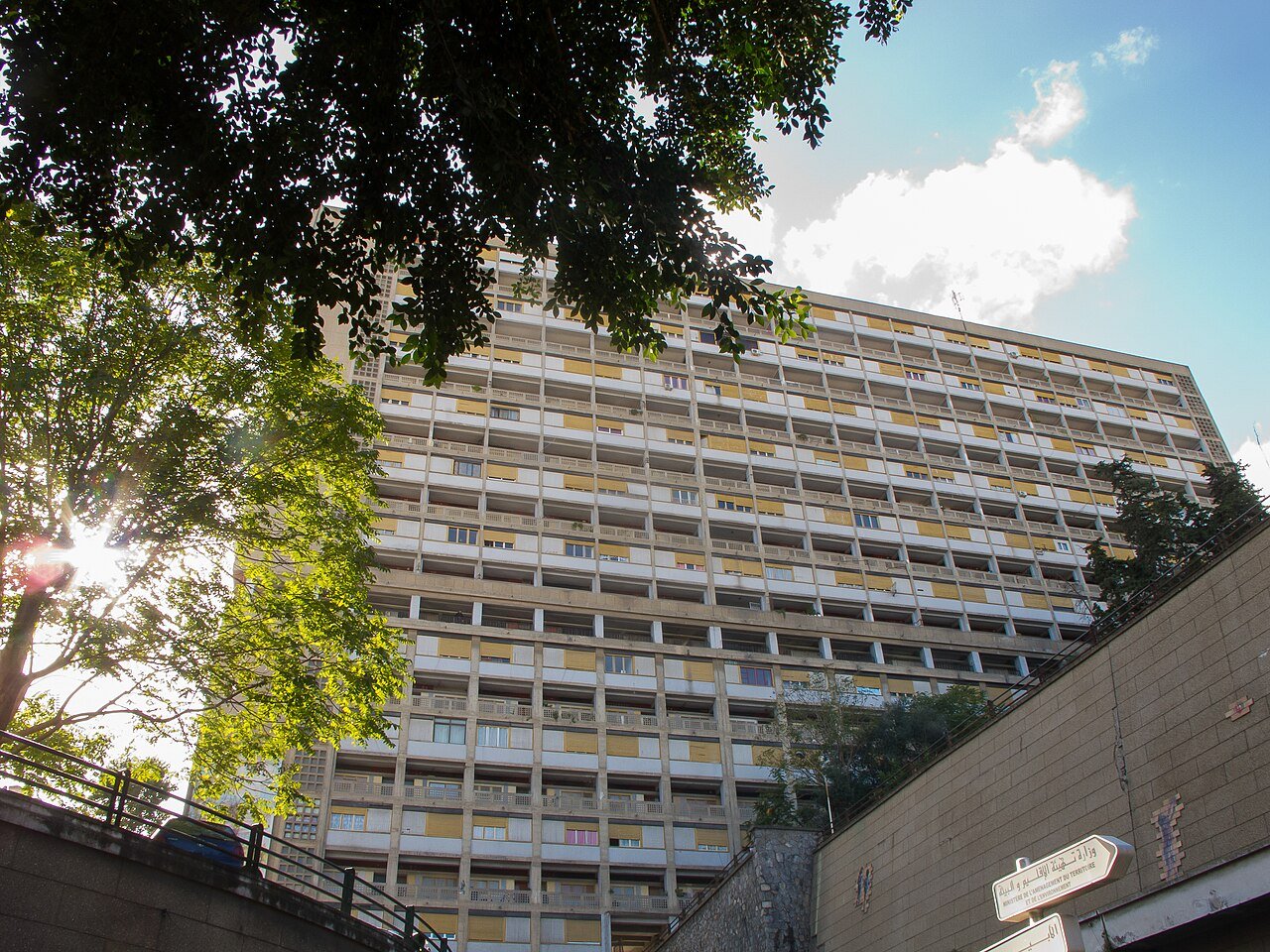
Above the Mediterranean, Algiers carries two layered ambitions: a colonial-era city of Art Déco and modernist blocks, and Le Corbusier’s vast unbuilt scheme for the bay. The drawings stayed on paper; the modern city did not.
At a glance
Algiers rises in white tiers from a curving Mediterranean bay, a city the French built upon and transformed across more than a century of colonial rule, from 1830 to 1962. Within that long period, the 1930s through 1950s left a dense modern legacy: Art Déco and modernist apartment blocks lining the boulevards, the Grande Poste, and the bold residential megastructure of the Aérohabitat above the Telemly heights. Hovering over all of it is a project that was never built — Le Corbusier’s radical plan to redesign the entire city, the most famous unrealised urban vision of the twentieth century. Algiers today is a place to read modern architecture against a Mediterranean horizon, alongside the older Casbah it never erased.
Key facts
- Country: Algeria
- Key period: 1930s–1950s (French colonial Algeria, 1830–1962)
- Key figures: Le Corbusier (Algiers urban plan, early 1930s, unbuilt); Louis Miquel, Pierre Bourlier and José Ferrer-Laloë (Aérohabitat, 1952–1955)
- Essential sites: the bay-front boulevards, the Aérohabitat at Telemly, the Grande Poste, the Casbah
- Coordinates: 36.7325° N, 3.0872° E
History
The French took Algiers in 1830 and held it for 132 years, until Algerian independence in 1962. Over that period the colonial administration reshaped the lower city: it cleared sections of the old fabric, opened broad boulevards and squares such as the Place des Martyrs, and built in the European styles of the day. By the early twentieth century the seafront and the inland slopes carried Haussmann-influenced terraces, then Art Déco facades, and finally the clean horizontal lines of modernism.
In the early 1930s the Swiss-French architect Le Corbusier (1887–1965) turned his attention to Algiers, then governed as part of France. He drew up a sweeping plan to redesign the colonial city — most famously an elevated concrete viaduct carrying residential units, running the length of the city above the existing streets. Unlike his earlier Paris proposals, the scheme did not call for demolishing the old Casbah. He returned to the idea through the decade in successive variants. The plan provoked intense debate but was repeatedly ignored by the French administration and never came close to construction; it survives only as one of the most studied unbuilt projects in architectural history.
What did get built came after the war. Between 1951 and 1955 a group of architects connected to CIAM-Algiers — Louis Miquel, Pierre Bourlier and José Ferrer-Laloë — raised the Aérohabitat on the Telemly heights, a residential complex of four buildings and some 300 apartments inspired by Le Corbusier’s “unité d’habitation” idea. Inaugurated in May 1955, it remains the clearest realised expression of the modernist ambition that Le Corbusier had sketched for the whole bay.
What you see
The Aérohabitat reads as a long horizontal block lifted above the slope, its repeating balconies forming a screen against the light. Its designers gave it an exterior circulation system and an interior street at mid-height, departing from Le Corbusier’s models even as they worked in his spirit. From the boulevard below, and from the bay, it stands out as a deliberate modern object among the older terraces of central Algiers.
Down at sea level, the front-de-mer boulevards trace the curve of the bay with arcaded colonial blocks, while the streets behind hold Art Déco shopfronts and apartment houses from the 1930s. The monumental Grande Poste and the dense, UNESCO-listed Casbah — inscribed as a World Heritage Site in 1992 — sit within walking distance, so a single day can move from Ottoman-Andalusian alleys to interwar Déco to post-war concrete. Visitors should treat exteriors as the experience: most residential buildings, including the Aérohabitat, are private homes.
Practical information
- The Aérohabitat is on boulevard Krim Belkacem in the Telemly area of Alger-Centre; it is a private residence, so view it from the street.
- The Casbah, Grande Poste and front-de-mer boulevards are concentrated in the central district and walkable in a day.
- Best light for the white facades and the bay is morning to early afternoon.
- Algeria requires a visa for most visitors; check current requirements before travelling.
- French is widely understood alongside Arabic; the city is busy and hilly, so comfortable shoes help.
Getting there
Algiers is served by Houari Boumediene Airport, about 20 kilometres east of the centre, with connections across Europe, the Maghreb and the Middle East. From the airport, taxis and bus links reach Alger-Centre, from where the bay-front boulevards, the Casbah and the Telemly heights are reachable on foot or by short taxi rides.
Related in CHO
- Casablanca — Art Déco and the Mauresque City
- Tunis — The Ville Nouvelle and Avenue Bourguiba
- Marseille / Berlin & Dessau — Modernism
Sources

Find it on the map
See this place and what’s around it →📷 Become a Cultural Heritage Online photographer
Share your photos of places: they stay published under your name as the author. The more they're seen, the more you get noticed — and soon a contest will reward the most appreciated photos.
Log in or sign up free to add a photo