
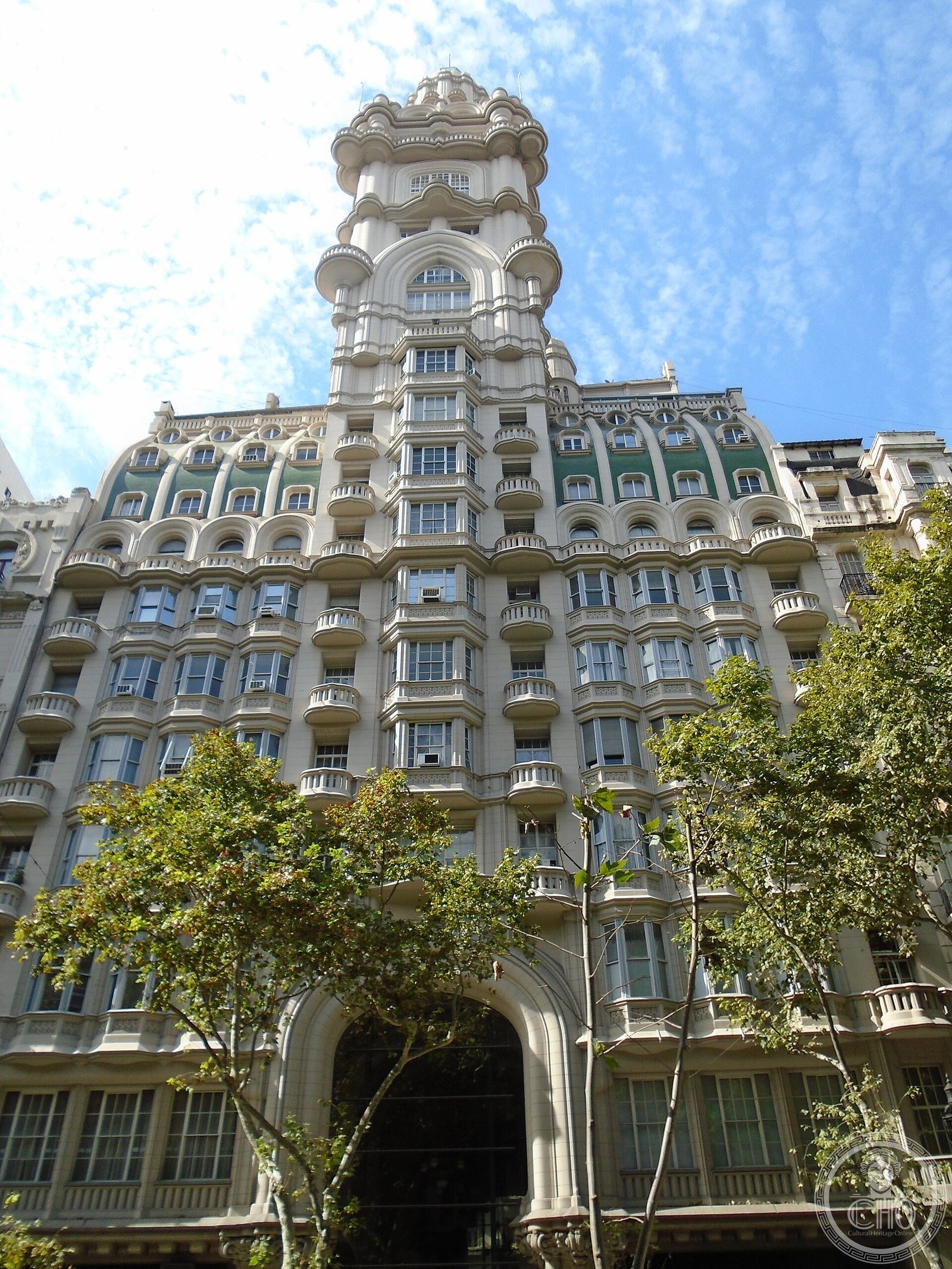
Buenos Aires built its Belle Époque in a single generation: the export wealth of the pampas financed European architects, imported Parisian ironwork and Catalan ceramics, and produced a downtown of extraordinary stylistic ambition — from the eclectic palaces of Avenida de Mayo to the Dante-coded symbolism of Mario Palanti’s Palacio Barolo.
At a glance
Between 1880 and 1930 Buenos Aires underwent the fastest urban transformation in the Americas: a city of 300,000 grew to 2.5 million, funded by the Argentine beef and grain export economy and powered by European immigration. The architecture that resulted drew on every style available — French Second Empire, Spanish colonial revival, Italian eclecticism, Art Nouveau and Art Déco — producing a downtown whose density of ornate facades rivals Paris or Budapest. Mario Palanti, an Italian architect who settled in Buenos Aires in 1909, gave the city its most symbolically ambitious building in the Palacio Barolo (1919–1923): a 22-storey tower on Avenida de Mayo structured according to a numerological reading of Dante’s Divina Commedia, with Hell in the basement arcade, Purgatory in the mid-floors and Paradise in the lighthouse dome.
Key facts
- Country: Argentina
- Key periods: Belle Époque (1880s–1910s); Art Déco (1920s–1940s)
- Key figure: Mario Palanti (1885–1946) — Italian-Argentine architect, Palacio Barolo, Palacio Salvo (Montevideo)
- Scale: the downtown San Nicolás and Montserrat neighbourhoods hold hundreds of Belle Époque and Art Déco facades within walking distance
- Essential sites: Palacio Barolo, Kavanagh Building, Confitería del Molino, Café Tortoni, Teatro Colón (1908)
- UNESCO tentative list: Buenos Aires city centre historic area (national monument listings cover most major buildings)
History
Mario Palanti arrived in Buenos Aires in 1909 and won the Palacio Barolo commission from textile magnate Luis Barolo in 1919. The building (1919–1923) was the tallest in South America on completion. Its 22 floors correspond to the 22 cantos of Dante’s Inferno; the 100-metre height equals the 100 cantos of the Commedia; the lighthouse dome rotates and was intended to be visible across the Río de la Plata to Montevideo, where Palanti simultaneously designed the Palacio Salvo as its counterpart. The lobby arcade recreates Hell in polished stone and iron; the upper floors Purgatory; the dome Paradise. The building now operates as a commercial property with a panoramic terrace and guided tours.
The Kavanagh Building (1936, Sánchez, Lagos y de la Torre) rose 120 metres above Plaza San Martín — the tallest reinforced-concrete structure in the world on completion and one of the purest Art Déco towers in South America. Its stepped crown and limestone cladding recall the Chrysler Building; its ground-floor lobby retains original terrazzo and chrome fittings. The Confitería del Molino (1916–1917, Francisco Gianotti) across from the Congress — a Liberty-Art Déco hybrid with a windmill crown — closed in 1997, fell into severe disrepair, and reopened after extensive restoration in 2022, recovering one of Buenos Aires’s most significant interior spaces.
What you see
Avenida de Mayo (the axis connecting the Casa Rosada to the Congress) is the essential Belle Époque walk: its six-storey facades of Second Empire balconies, Spanish colonial pilasters and Liberty ironwork form one of the most complete period streetscapes in the Americas. The Café Tortoni (No. 825), open since 1858 and frequented by Borges and García Lorca, has the Belle Époque interior most accessible to visitors — stained glass, marble tables and a tango-dinner programme. Palacio Barolo guided tours (Av. de Mayo 1370) depart at night for the full Dante experience; the lighthouse rotation is operated on clear evenings.
The Teatro Colón (Cerrito 628), completed in 1908, is one of the world’s great opera houses — rivalling La Scala in acoustic quality and exceeding it in spatial grandeur. Its backstage and main hall tours (colón.org.ar) are the best way to see the main hall ceiling and the seven-storey stage machinery. The Kavanagh Building (Florida 1065) can be seen from Plaza San Martín; its ground floor is accessible during business hours. The Confitería del Molino (Rivadavia 1801) is now open as a cultural café and museum of its own restoration.
Practical information
- Palacio Barolo tours: day and night tours daily; palaciob.com.ar (book in advance)
- Teatro Colón: tours daily 09:00–17:00; teatrocolon.org.ar
- Confitería del Molino: open daily as café and museum; free entry
- Currency: Argentine peso (ARS); card acceptance is widespread but carry cash for small transactions
- Time needed: 2 days for the Belle Époque / Art Déco downtown itinerary; 3 including San Telmo and Recoleta
Getting there
Ezeiza International Airport (EZE) is 35 km from downtown; the Manuel Tienda León bus reaches Retiro in 40 minutes; taxis take 45–60 minutes. Aeroparque Jorge Newbery (AEP, 8 km north) handles domestic and some regional flights. The historic district is clustered around the A, B, C, D and E metro lines; Avenida de Mayo is served by line A (Perú, Piedras and Congreso stops).
Related in CHO
- New York — Tiffany, the Gilded Age and Art Déco
- Paris — Belle Époque, Art Nouveau and Modernism
Sources
Find it on the map
See this place and what’s around it →📷 Become a Cultural Heritage Online photographer
Share your photos of places: they stay published under your name as the author. The more they're seen, the more you get noticed — and soon a contest will reward the most appreciated photos.
Log in or sign up free to add a photo