
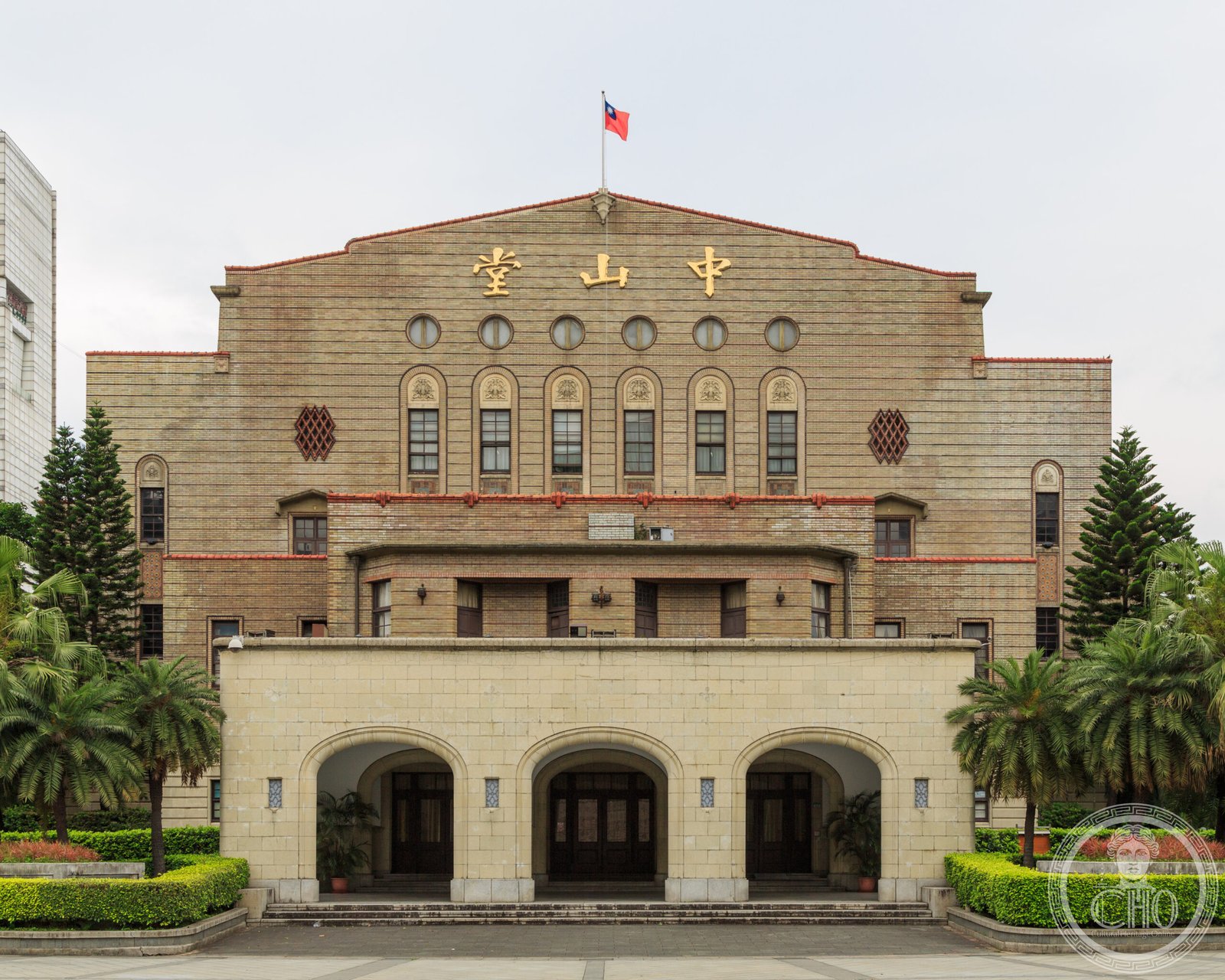
Standing in the Ximending neighbourhood of Taipei’s Zhongzheng District, Zhongshan Hall is a four-storey monument to the layered history of Taiwan. Designed by chief Japanese colonial engineer Ide Kaoru and built between 1932 and 1936 at a cost of 980,000 yen and 94,500 workers, it was conceived as the Taihoku City Public Auditorium — the fourth-largest civic hall in the Japanese Empire at the time. The building’s distinctive light-green tile cladding was chosen to reduce its visibility to aerial bombers, while its windows are adorned with classical motifs in a Spanish Islamic style. After Japan’s surrender in 1945, General Chen Yi accepted the formal handover of Taiwan from the last Japanese Governor-General within these walls. Renamed in honour of Sun Yat-sen, Zhongshan Hall became Taiwan’s principal ceremonial space for decades, hosting Richard Nixon, Syngman Rhee, and other heads of state. Recognised as a historic site in 1992, it remains one of the island’s most significant colonial-era buildings.
At a glance
- Type
- Historic civic auditorium & ceremonial hall
- Period
- 1932–1936 (construction); historic site designation 1992
- Style
- Japanese Colonial Modernism with Spanish Islamic decorative elements
- Location
- 98 Yanping South Road, Ximending, Zhongzheng District, Taipei, Taiwan
- Coordinates
- 25.0431° N, 121.5101° E
- Architect(s)
- Ide Kaoru (chief engineer, Taiwan Government-General)
Overview
Zhongshan Hall is the most historically charged interior space in Taiwan. With a total floor area of 113,750 square feet spread across four storeys, it was the grandest public building the Japanese colonial government erected in Taipei. Its structural system was designed to resist fire, typhoons, and earthquakes. Today managed by the Taipei City Government, it continues to serve as a venue for ceremonies, performances, and exhibitions, preserving its dual identity as civic monument and living cultural centre.
History
Construction began on 23 November 1932 to mark the ascension of Emperor Hirohito, on the site of a demolished Qing dynasty government office. When the Taihoku City Public Auditorium opened on 26 November 1936, it ranked fourth in size among Japan’s civic halls, behind only Tokyo, Osaka, and Nagoya. In 1945, the formal Japanese surrender of Taiwan took place here, after which the Kuomintang government renamed the hall Zhongshan in honour of Sun Yat-sen. Throughout the Cold War era it served as a reception hall for visiting dignitaries. In 1992 the government recognised it as a historic site, ensuring its protection and eventual restoration.
Architecture & Design
Ide Kaoru designed a steel-framed structure faced in light-green ceramic tile — a pragmatic wartime camouflage measure that became a defining aesthetic feature. The windows are framed by classical mouldings with Spanish Islamic geometric motifs, an eclectic blend typical of late Japanese colonial civic architecture. The four-storey massing is firmly symmetrical, with a restrained monumental character. Interior spaces include a large auditorium, reception rooms, and smaller meeting chambers, all detailed to accommodate heads of state and formal diplomatic ceremonies.
Cultural significance
No other building in Taiwan has witnessed as many pivotal events. The formal end of Japanese colonial rule in 1945, the diplomatic receptions of the Republic of China’s Cold War allies, and countless national ceremonies all unfolded under its roof. For Taiwanese historians the hall embodies both the ambivalences of the colonial period and the determination of successive governments to invest civic life with grandeur. Its heritage designation in 1992 marked a broader turning point in Taiwan’s willingness to preserve Japanese-era architecture.
Visiting today
Zhongshan Hall is open to the public and managed by the Taipei City Government. The building hosts regular cultural events, art exhibitions, and performances; the main auditorium is available for hire. Visitors can explore the ground-floor lobby and public exhibition areas freely. The official English website (english.zsh.gov.taipei) lists current events, opening hours, and ticketing. Guided tours in English are available on selected dates.
Getting there
Zhongshan Hall is a five-minute walk from Ximen Station on Taipei Metro Lines 5 (Blue) and 6 (Orange) — exit 1 leads directly towards Yanping South Road. Buses serving Zhongzheng District stop on Yanping South Road. The hall lies within Taipei’s YouBike (bike-share) coverage zone. By taxi from Taipei Main Station the journey takes roughly five minutes.
Sources & resources
Find it on the map
See this place and what’s around it →Record researched and written by Luigi De Marchi for Cultural Heritage Online, 2026.
📷 Become a Cultural Heritage Online photographer
Share your photos of places: they stay published under your name as the author. The more they're seen, the more you get noticed — and soon a contest will reward the most appreciated photos.
Log in or sign up free to add a photoIs this page about you?
This page is read by travellers and heritage enthusiasts who find it on Google. Tell us how you are connected to this place and we will take it from there.