

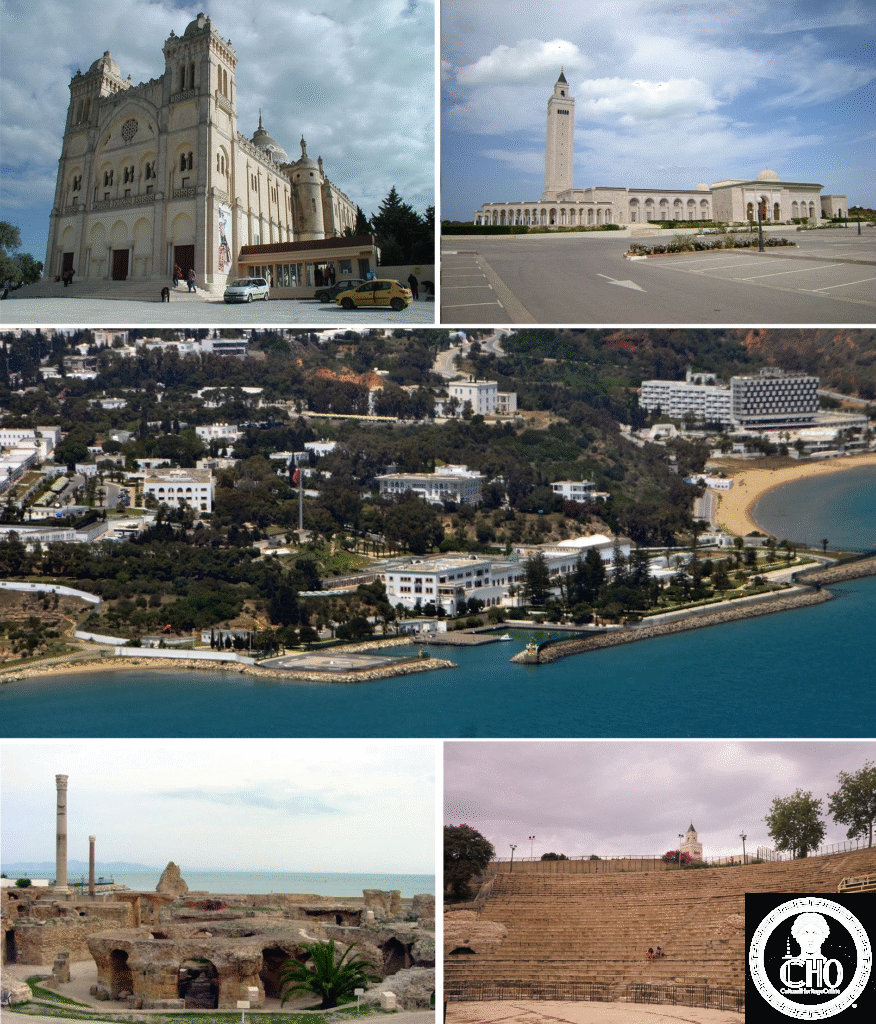
Carthage rose as a Phoenician trading colony, fought Rome across three wars for control of the western Mediterranean, and was razed to the ground in 146 BCE, only to be rebuilt by Julius Caesar and Augustus as the second city of the Roman Empire. Its Antonine Baths, Punic ports and tophet still trace that whole arc above the Bay of Tunis.
At a glance
Carthage stands on a promontory above the Bay of Tunis, the site of a Phoenician colony traditionally founded in 814 BCE by settlers from Tyre. It grew into the dominant trading power of the western Mediterranean, fought Rome three times over the following century, and was destroyed by Scipio Aemilianus in 146 BCE at the end of the Third Punic War. Julius Caesar and Augustus later rebuilt it as the capital of Roman North Africa, and for a time it ranked as the second city of the Roman Empire after Rome itself.
Roman Carthage became a major centre of early Christianity, home to the writers Tertullian and Cyprian and, in his youth, to St Augustine. It fell to the Vandals in 439 CE, was recovered for Byzantium in 533 CE, and was finally destroyed by the Arab general Hassan ibn al-Numan in 698 CE, ending its life as capital of the Byzantine Exarchate of Africa.
Key facts
- Founded: traditionally 814 BCE, by Phoenician colonists from Tyre under the legendary queen Dido, also called Elissa.
- Destroyed: 146 BCE, at the end of the Third Punic War, by the Roman general Scipio Aemilianus.
- Rebuilt: as a Roman colony under Julius Caesar and completed under Augustus, later capital of Roman Africa.
- “Delenda est Carthago”: the phrase attributed to the senator Cato the Elder, said to have closed every speech with a call for Carthage’s destruction.
- Salt myth: the tradition that Rome sowed the ruined city with salt is a nineteenth-century literary invention, with no ancient source behind it.
- Coordinates: 36.8528° N, 10.3233° E.
History
According to tradition, the Phoenician princess Elissa, known to the Romans as Dido, fled Tyre after her brother murdered her husband and founded Carthage in 814 BCE. The story of the oxhide, in which she cut a single hide into thin strips to encircle far more land than a local king had intended to grant, became the city’s founding legend. Under Punic rule the city controlled trade across the western Mediterranean, and archaeologists have found a sacred precinct known as the tophet containing urns of cremated infants and children, evidence that remains debated as a sign of ritual sacrifice.
Carthage and Rome fought three wars between 264 and 146 BCE. The Second Punic War saw Hannibal cross the Alps with war elephants and defeat Rome at Cannae, before Scipio Africanus turned the tide at Zama in 202 BCE. Decades later the Roman Senate, urged on by Cato the Elder, provoked the Third Punic War; Scipio Aemilianus besieged and destroyed the city in 146 BCE after seventeen days of burning, enslaving tens of thousands of survivors.
Julius Caesar ordered Carthage refounded as a Roman colony, a project completed under Augustus. The rebuilt city became capital of Roman Africa and a major Christian centre, producing Tertullian, Cyprian and, later, the young St Augustine, who described his time there in his Confessions. Vandal occupation from 439 CE gave way to Byzantine reconquest in 533 CE, before the Arab conquest of 698 CE brought the ancient city’s history to a close.
What you see
The Byrsa Hill, traditionally the spot where Dido founded the city, now holds the Carthage National Museum, whose collection of Punic stelae, urns, jewellery, terracotta masks and amphorae is among the finest of its kind. Below it lie the Punic ports: a circular naval harbour once large enough to berth some 220 warships around a central Admiralty Island, and a rectangular commercial harbour used by Punic merchant shipping.
The Antonine Baths, built under Antoninus Pius and completed around 162 CE, were the largest Roman bath complex outside Rome itself. A single re-erected column stands twelve metres tall among the surviving rows of massive column bases; the complex was originally four storeys high, and the excavated lower levels reveal the furnaces, pipes and corridors that once served the baths. From the site there is a wide view across the Bay of Tunis.
About two kilometres away lies the Tophet, the Punic sacred precinct where some twenty thousand urns spanning the eighth to second centuries BCE have been found, containing the cremated remains of young children. A partially excavated Roman amphitheatre, one of the largest in North Africa, and the Malga cisterns, twenty-four Roman reservoirs that once received water by aqueduct, complete the circuit.
Practical information
- Location: the ruins are spread across several separate areas in the modern suburb of Carthage, on the Bay of Tunis.
- Coordinates: 36.8528° N, 10.3233° E.
- Visiting: opening times and admission arrangements are set by the Tunisian heritage authorities; check their official channels before travelling.
Getting there
Carthage is served by Tunis-Carthage International Airport, named after the ancient city and close to the Antonine Baths, with international connections to Paris, Rome, Frankfurt and Istanbul. The TGM electric train links central Tunis with stations close to the archaeological sites.
Nearby
- The Tophet — about 2km from Byrsa Hill, the Punic sacred precinct where urns of cremated children were found.
- Malga cisterns — the twenty-four Roman cisterns that once stored water carried into Carthage by aqueduct.
- Zaghouan Spring — roughly 80km to the south, the source that fed the aqueduct supplying the Malga cisterns.
Sources
- UNESCO World Heritage Centre
- Augustine of Hippo, Confessions
Find it on the map
See this place and what’s around it →📷 Become a Cultural Heritage Online photographer
Share your photos of places: they stay published under your name as the author. The more they're seen, the more you get noticed — and soon a contest will reward the most appreciated photos.
Log in or sign up free to add a photoIs this page about you?
This page is read by travellers and heritage enthusiasts who find it on Google. Tell us how you are connected to this place and we will take it from there.