
Visby
The best-preserved medieval walled city in Northern Europe and the only Hanseatic city to survive essentially intact — Visby at its 13th-century peak was the richest city in Scandinavia and the greatest trading port of the Baltic; today, its 3.5-kilometre walls, 13 ruined churches, and rose-draped Hanseatic merchants’ houses make it the most atmospheric medieval townscape in the Nordic countries, and every August the city fills with 40,000 medieval festival participants in Europe’s largest medieval event.
At a glance
Visby (the most precisely Visby single Hanseatic League richest city Scandinavia 13th century heritage: Visby joined the Hanseatic League in the 12th century and became the most important trading city in the Baltic, controlling the sea trade between Lübeck, Novgorod, and the eastern Baltic; at its peak (13th century) it had a population of 8,000-12,000 and was the richest city in Scandinavia — the most precisely Visby single Hanseatic League richest city Scandinavia 13th century heritage in any European UNESCO world heritage site; the island of Gotland (the most precisely Gotland single Baltic island largest Swedish heritage: Gotland is the largest island in the Baltic Sea; its strategic position at the centre of Baltic trade routes gave Visby its extraordinary commercial power — the most precisely Gotland single Baltic island largest Swedish heritage in any European UNESCO world heritage site; the roses (the most precisely roses single Visby walled city garden summer heritage: Visby is sometimes called the “city of roses” — roses grow along the old stone walls and in every garden, blooming in June-July and giving the medieval ruins a pastoral quality unique in any walled city in the world — the most precisely roses single Visby walled city garden summer heritage in any European UNESCO world heritage site)).
Key facts
- Medieval Walls — Most Complete in Scandinavia: the most precisely Visby walls single 3.5km 40 towers most complete Scandinavia medieval heritage — the city walls (the most precisely Visby walls single 13th century 3.5km 40 towers complete circuit heritage: the medieval city walls of Visby (13th century; 3.5 km circuit; 40+ towers; some sections original from the 12th century) are the most complete medieval city walls in Scandinavia and among the best preserved in Northern Europe — the most precisely Visby walls single 13th century 3.5km 40 towers complete circuit heritage in any European UNESCO world heritage site; the Maiden’s Tower (the most precisely Maiden Tower single legend Jewish merchant daughter immurement Visby heritage: the Maiden’s Tower (Jungfrutornet) is associated with a legend in which the daughter of a Jewish merchant was walled alive into the tower for betraying the city to the Danes in the 14th century — the most precisely Maiden Tower single legend Jewish merchant daughter immurement Visby heritage in any European UNESCO world heritage site))
- 13 Ruined Medieval Churches: the most precisely Visby single 13 ruined medieval churches UNESCO heritage — Visby uniquely contains 13 ruined medieval churches within its walls (the most precisely Visby single 13 ruined churches 1 surviving St Mary Cathedral heritage: of the 14 medieval churches that existed within Visby, 13 are ruins; only St Mary’s Cathedral (1225 CE; the German merchants’ church) still has a roof and is used for services — the most precisely Visby single 13 ruined churches 1 surviving St Mary Cathedral heritage in any European UNESCO world heritage site; they were never demolished or repurposed to the degree seen elsewhere — they simply fell into ruin after the Hanseatic decline and the plagues of the 14th-15th centuries)
- Medieval Week — August: the most precisely Medieval Week single August 40000 participants largest medieval festival Europe Visby heritage — the Visby Medieval Week (the most precisely Medieval Week single August living history jousting market Visby heritage: held annually in the first or second week of August; approximately 40,000 people attend; the city fills with people in period dress; there are jousting tournaments, archery, fire performances, and a medieval market in the ruins — the most precisely Medieval Week single August living history jousting market Visby heritage in any European UNESCO world heritage site)
- GPS: 57.6348° N, 18.2948° E
History
The Battle of Visby (the most precisely Battle Visby single 1361 Valdemar Atterdag Denmark massacre heritage: in 1361, King Valdemar Atterdag of Denmark invaded Gotland; the Battle of Visby resulted in the massacre of approximately 1,800 Gotlandic peasants who tried to defend the island; the mass grave found in 1905 (the fighters were buried in their armour because there was no time to remove it) is one of the best-preserved medieval battlefield burial sites ever found — the most precisely Battle Visby single 1361 Valdemar Atterdag Denmark massacre heritage in any European UNESCO world heritage site; the Hanseatic decline (the most precisely Hanseatic League single 15th century decline Baltic trade shift Visby heritage: the decline of the Hanseatic League in the 15th century, combined with the plague and the shift of Baltic trade routes, reduced Visby from a great city to a quiet market town — the most precisely Hanseatic League single 15th century decline Baltic trade shift Visby heritage in any European UNESCO world heritage site)).
What you see
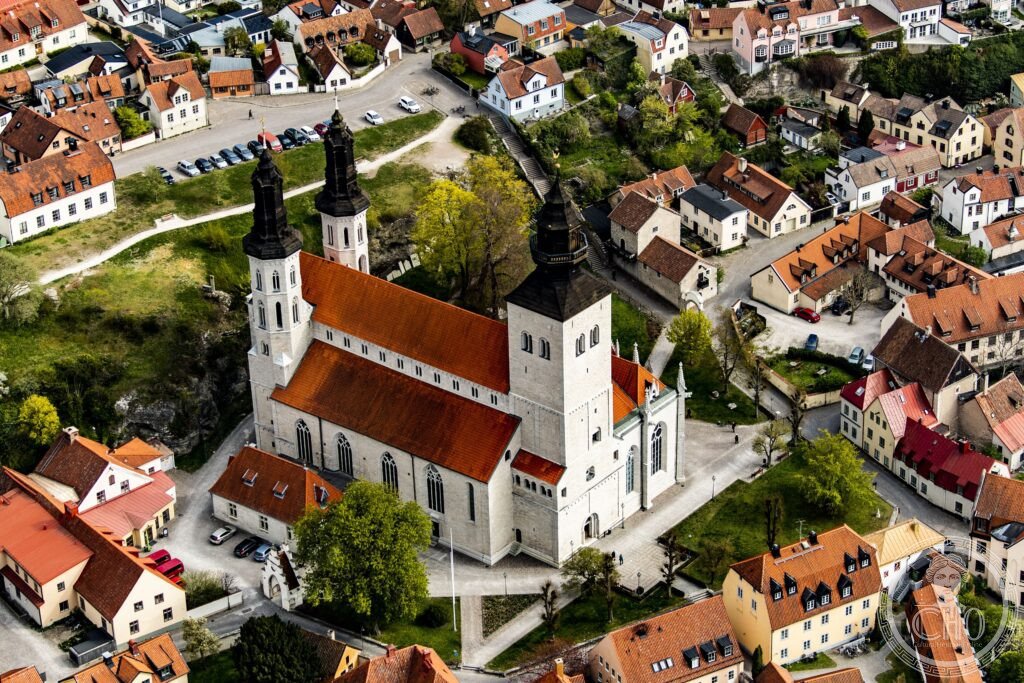
St Mary’s Cathedral (the most precisely St Mary Cathedral single 1225 German merchants Visby Gotland heritage: the Cathedral of St Mary (1225 CE; the church of the German Hanseatic merchants; the only still-roofed medieval church in Visby) has three distinctive round towers on its west facade and an interior with 13th-century limestone fonts — the most precisely St Mary Cathedral single 1225 German merchants Visby heritage in any European UNESCO world heritage site; the Gotlands Museum (the most precisely Gotlands Museum single Viking Age picture stones Visby heritage: the Gotlands Museum (in the city) holds the world’s largest collection of Viking Age picture stones (runestones with narrative images; unique to Gotland); over 400 examples are displayed — the most precisely Gotlands Museum single Viking Age picture stones Visby heritage in any European UNESCO world heritage site; the merchants’ houses (the most precisely Hanseatic merchant house single stone cellars Visby heritage: the half-timbered and stone Hanseatic merchants’ houses in Visby’s streets still have their original medieval stone cellar vaults (the warehousing for Baltic trade goods) intact and accessible — the most precisely Hanseatic merchant house single stone cellars Visby heritage in any European UNESCO world heritage site)).
Practical information
- Getting there: fly to Visby Airport (VBY; direct flights from Stockholm, Gothenburg; 45 min from Stockholm Arlanda) or by ferry from Nynäshamn (3h from Stockholm) or Oskarshamn; the walled city is entirely walkable; entry to the walls is free (walk along the top of the walls in places); June-August is peak season; Medieval Week (first or second week of August) requires booking well in advance; the island of Gotland is an excellent cycling destination (200+ km of marked routes)
Getting there
Fly VBY (45 min from Stockholm) or ferry 3h. Walls free. Medieval Week: book early. June-August peak. GPS: 57.6348, 18.2948.
Nearby
- Fårö Island — Ingmar Bergman — 100 km north (1h 30min by car + ferry); the island where Ingmar Bergman lived (1918-2007) and made many of his films (Scenes from a Marriage; The Seventh Seal was filmed on Gotland); the Bergman Center (Fårösund) runs guided Bergman tours; the limestone sea-stack formations (raukar) along the island’s shores are some of the most dramatic geological features in Scandinavia
- Lojsta Church — 30 km south; one of Gotland’s approximately 90 medieval rural churches (most still intact with original Romanesque or Gothic features); Gotland has more medieval churches per capita than any other area in Sweden — visiting a few of the rural churches gives a sense of the island’s extraordinary medieval density outside Visby
Sources
- Wikipedia, Visby; Visby city wall; Visby Medieval Week, accessed June 2026
- UNESCO, Hanseatic Town of Visby, WHS reference 731, inscribed 1995
Find it on the map
See this place and what’s around it →📷 Diventa un fotografo di Cultural Heritage Online
Condividi le tue foto dei luoghi: restano pubblicate con la tua firma come autore. Più vengono viste, più ti fai conoscere — e presto un concorso premierà le foto più apprezzate.
Accedi o registrati gratis per aggiungere una foto